


Layering Beats Either Alone: Reach R 8–12 With Shades and Curtains
Cellular shades generally deliver a higher R-value per window than thermal curtains, making them the stronger pick for pure insulation. Thermal curtains still earn their place when budget, decor, or blackout needs matter more than squeezing out every degree. The real winner in most homes is a layered approach, and how tightly either treatment is fitted and sealed often changes the outcome more than the fabric or cell count itself. The performance numbers and installation steps below fill in the specifics.
TL;DR:
- Cellular shades with honeycomb cells provide higher R-values, reaching up to R-8 with triple-cell designs, outperforming thermal curtains on raw insulation.
- Proper installation, including sealing edges and minimizing gaps, can significantly enhance a curtain’s thermal performance, sometimes surpassing premium models.
- Layering a cellular shade behind a thermal curtain can achieve combined R-values of R-8 to R-12, which greatly reduces heat loss more than individual treatments.
- Cost-effective single-cell shades range from $30 to $60, while custom thermal curtains with liners cost more but offer better sealing and performance.
- Renter-friendly insulation options, like tension rods and removable tracks, allow effective sealing without wall damage, especially when combined with proper fit.
Table of Contents
- How Shades and Curtains Actually Block Heat
- What the R-Values and Heat-Loss Numbers Really Mean
- How Should You Install Shades or Curtains for Maximum Insulation?
- What Should You Budget For Insulated Window Treatments?
- Which Style, Blackout, and Cleaning Factors Should You Weigh?
- What Marrion Recommends After Weighing the Trade-offs
- Get Custom-Lined Curtains Built for Your Windows
- Primary Sources and Further Reading
- Sources
- FAQ
How Shades and Curtains Actually Block Heat
Both treatments work the same basic way: they trap a pocket of still air between the glass and the room, and still air resists heat transfer far better than moving air. Cellular shades do this with honeycomb cells built into the shade itself, which is why they hold their R-value even with a mediocre installation. Thermal curtains rely on fabric density, an added lining, and a tight fit against the wall or frame to create that same insulating buffer.
That structural difference shows up directly in performance. According to EcoThrift’s breakdown of cellular shades and thermal curtains, single-cell shades typically run R-3 to R-4, double-cell R-4 to R-6, and triple-cell R-6 to R-8 or higher. A well-lined, properly sealed thermal curtain generally lands at a lower R-value range that varies based on installation.
Where curtains pull ahead is versatility and softness, not raw insulation:
- Decor range: Curtains come in far more fabrics, colors, and textures than shades, which tend toward a sleeker, more minimal look.
- Light and privacy control: Curtains layer easily over sheers or shades for graduated light control; shades offer a cleaner, more consistent block.
- Noise damping: Heavier curtain fabric absorbs more sound than a flat cellular shade.
- Renter fit: Curtains mount on tension rods with no drilling; shades usually need a bracket, though outside-mount options exist.
Quick fact: Layering a cellular shade behind a thermal curtain is additive. Combined R-values can reach R-8 to R-12, which beats either treatment working alone.
What the R-Values and Heat-Loss Numbers Really Mean
Numbers get thrown around loosely in this category, so it helps to separate two different claims: percent reduction in heat loss through the window versus percent savings on your whole heating bill. A curtain that cuts window heat loss by 25% is not cutting your total energy bill by 25%, since the window is only one of several paths heat escapes a house. The Department of Energy and Cornell Cooperative Extension both frame insulating curtains and attachment-category products this way, crediting well-installed curtains with a significant window heat-loss reduction when sealed correctly.
Independent product ratings from AERC put real-world savings from certified window attachments at roughly 5% to 16% per product, with the category as a whole contributing an estimated 15% of household HVAC energy savings.
Here is how the typical R-value bands stack up:
| Treatment | Typical R-Value | Notes |
|---|---|---|
| Single-cell shade | R-3 to R-4 | Good baseline insulation, slim profile |
| Double-cell shade | R-4 to R-6 | Stronger performance, still compact |
| Triple-cell shade | R-6 to R-8+ | Best shade-only insulation |
| Lined thermal curtain (sealed) | R-2 to R-4 | Performance depends heavily on fit |
| Shade + curtain layered | R-8 to R-12 | Additive effect, best overall result |
Quick fact: Cornell’s field experiments found sealed drapery with side tracks reaching 45% to 55% effectiveness, compared to just 5% to 10% for unsealed drapery hung loosely over a window. Fit changes the outcome as much as the fabric does.
How Should You Install Shades or Curtains for Maximum Insulation?
Fit and sealing move the needle more than most homeowners expect. A cheap curtain installed tightly can outperform a premium one hung loosely, based on Cornell’s installation-dependent testing.
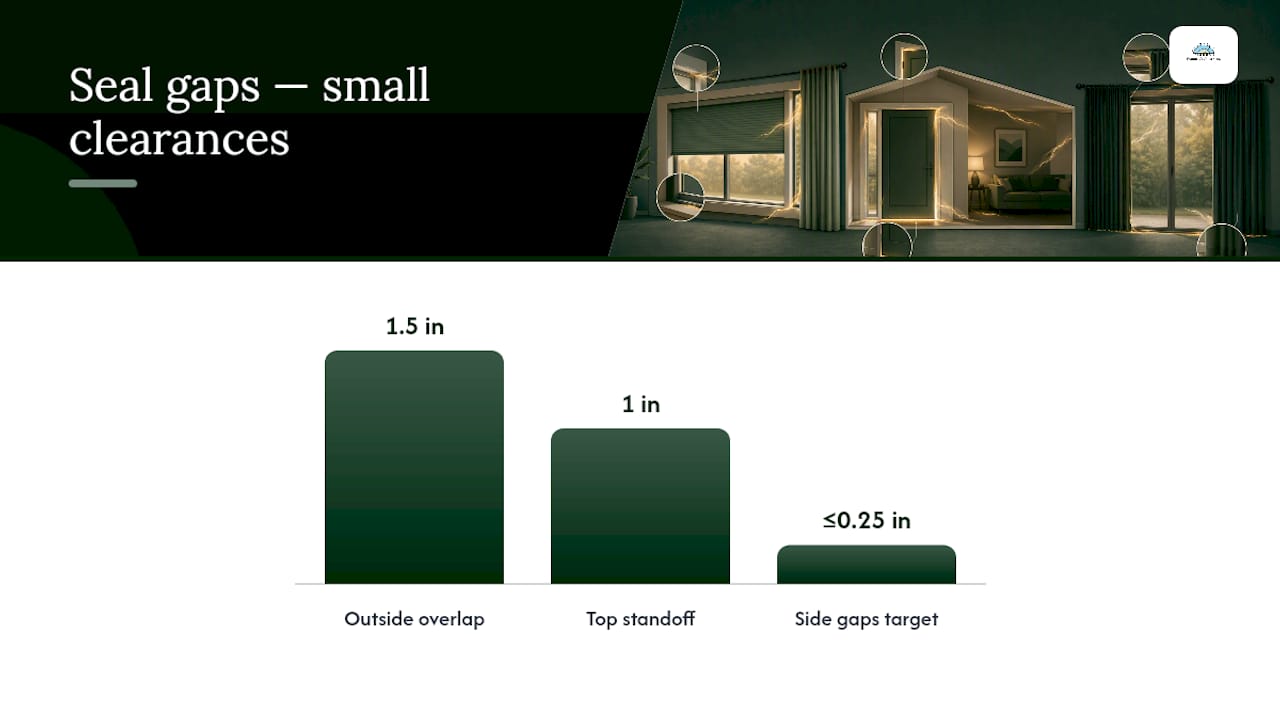
- Measure for a snug fit. Inside-mount shades need minimal tolerance around the frame; outside-mount curtains should overlap the window opening by at least 1.5 inches per side.
- Close the side gaps. Keep gaps under a quarter inch where possible. Side tracks or returns stop the “tunnel” effect where warm room air slips behind the treatment and cools against the glass.
- Add a top closure. A valance, cornice, or sealed header keeps warm air from rising up and over the treatment.
- Let curtains reach the floor or sill. Length matters. Weighted hems or sealed edges keep cold air from sliding underneath.
- Add a separate lining. A sewn-in thermal lining outperforms a bonded “thermal” label, since it adds real material density rather than a coating.
- Leave a small standoff for some shades. Extension guidance suggests roughly a 1-inch gap from the glass for certain shade installs to avoid trapping condensation.
Renters have real options here too: tension-mounted rods, magnetic strips, and removable adhesive tracks all approximate a sealed fit without a single hole in the wall, and outside-mount shades with generous overlap work well in a rental. Odd-sized windows, bay configurations, or a need for fully sealed edges are usually the point where it makes sense to call a drapery workroom rather than DIY it.
Pro Tip: If you only have time to fix one thing, fix the side gaps and consider how new interior doors improve energy efficiency in older Portland homes by reducing drafts and heat loss as well, enhancing overall savings How New Interior Doors Improve Energy Efficiency in Older Portland Homes | One Day Doors & Closets. A loose fit is the single biggest reason a “thermal” curtain underperforms its rating.
What Should You Budget For Insulated Window Treatments?
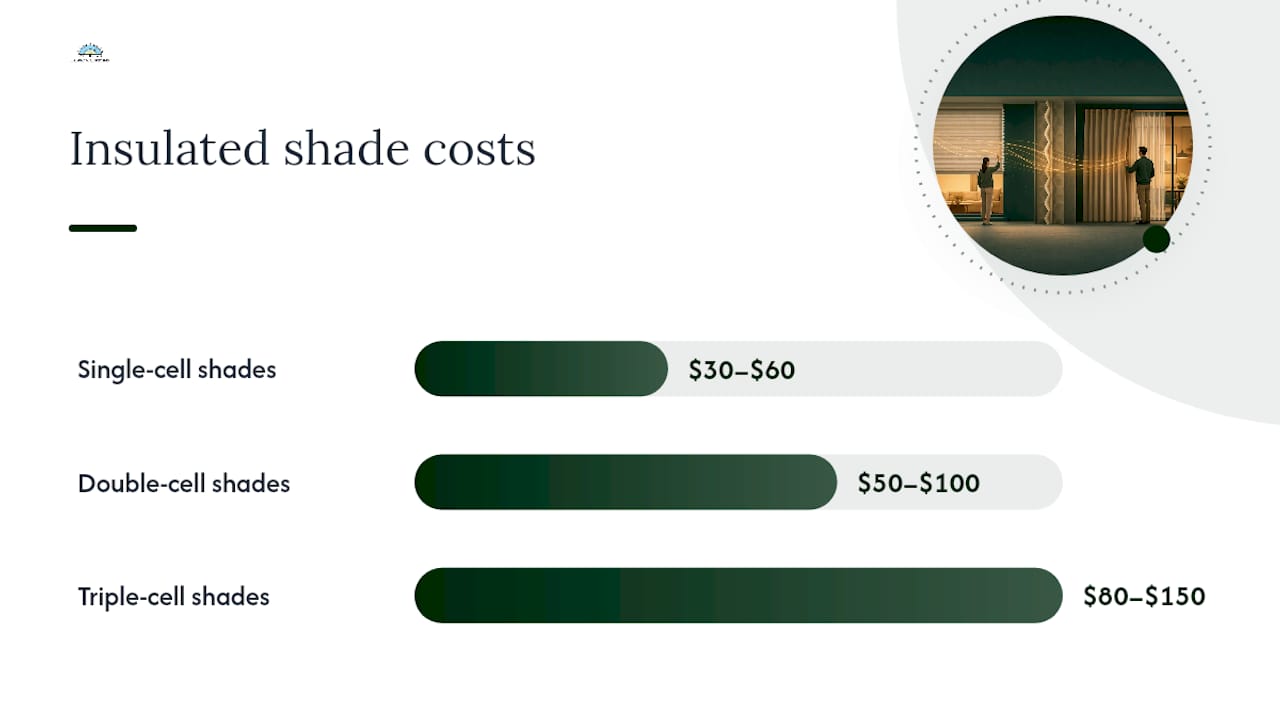
Cost varies by cell count and fabric, but the ranges are predictable enough to plan around. According to EcoThrift’s cost and savings guide, single-cell shades typically run $30 to $60, double-cell $50 to $100, and triple-cell $80 to $150. Thermal curtain panels off the shelf usually cost less, with custom or fully lined panels costing more depending on fabric.
Most buyers typically see payback within a heating or cooling season, though this depends on climate and how leaky the window was to begin with.
A few prioritization rules make the spending go further:
- Treat your largest windows first. Square footage of glass drives heat loss more than any other single factor.
- In heating climates, north-facing windows are the highest-return targets, since they get little solar gain and lose heat steadily all day.
- West-facing windows matter more for summer cooling loads, where afternoon sun drives up air-conditioning costs.
- Start with the rooms you actually spend time in. A bedroom you use nightly beats a guest room that sits empty most of the year.
Which Style, Blackout, and Cleaning Factors Should You Weigh?
Insulation is only half the decision for most households. Curtains still win on sheer variety: fabric weight, weave, color, and pattern options dwarf what shades offer, and curtains layer naturally with sheers for a finished look. Shades win on a clean, minimal profile that suits modern interiors and small windows where fabric would overwhelm the space.
Backing color changes seasonal performance in a way that surprises a lot of people. White or reflective backings bounce summer heat back outward, while darker linings can help capture daytime solar warmth in winter. Triple-weave and foam-backed curtains generally offer the strongest thermal performance if you only want one panel to do both jobs.
A few more practical points worth weighing:
- Cleaning: Curtains typically need washing or dry cleaning; cellular shades usually just need dusting or a light vacuum.
- Durability: Shades hold their shape over time better than lightweight curtain fabric, which can stretch or fade.
- Noise reduction: Heavier curtains outperform shades for sound dampening, useful on street-facing rooms.
- Renter aesthetics: Lightweight liners, clip-on weights, and removable tracks let you add thermal performance without violating a lease.
What Marrion Recommends After Weighing the Trade-offs
Most homeowners overthink the choice between curtains and shades when the smarter question is where each one fits. Cellular shades are the efficient default for windows where you want performance and don’t need much decorative presence. Thermal curtains earn their spot where the room’s look matters, where you want blackout flexibility, or where budget rules out custom shades for every window in the house. Marrion has covered the decor-and-performance balance in thermal curtain panels and the tradeoffs in lining choices at length, and the pattern holds: a sewn-in lining with a reflective backing consistently beats a bonded “thermal” label sold at a lower price point.
Custom service earns its cost on odd-sized windows, designer fabric requests, or anywhere seals need to be precise rather than approximate. That is where a workroom, not a big-box readymade panel, actually changes your R-value.
— Marrion
Get Custom-Lined Curtains Built for Your Windows
Skip the readymade panel that almost fits, and get a curtain built to actually seal your window. Beautifulwindowselgin sells designer fabric by the yard alongside custom drapery services, including thermal linings, fabric samples, and installation guidance, so you’re not guessing at cell counts or backing colors from a shelf tag.

For readers weighing lining fabric against a full custom order, the designer drapery fabric collection is a solid starting point, with weights and weaves suited to sealed, floor-length panels. Homeowners dealing with bay windows, unusual drops, or a specific fabric in mind for a whole room typically get more consistent sealing from a custom order than from an off-the-shelf panel, since the lining and hem weight are matched to the actual window rather than a standard size. Request a fabric sample, talk through lining options with the design team, and get a panel measured for your window instead of the other way around. Start by browsing the drapery fabric collection or requesting samples through Beautifulwindowselgin today.
Primary Sources and Further Reading
This comparison draws on Cornell Cooperative Extension’s window treatment research, EcoThrift’s cellular shade and thermal curtain data, and Utility Explained’s review of thermal curtain claims, along with practical guidance from Home Depot on energy-efficient window treatments.
Sources
- Energy-saving window treatment (Cornell Cooperative Extension Monroe County)
- Thermal Curtains & Cellular Shades: Cut Heating & Cooling Bills Up to 25% | EcoThrift Home
- Do Thermal Curtains Really Work? | Utility Explained
FAQ
Do Thermal Curtains Actually Work?
Yes, when installed with a tight fit and sealed edges.
Are Cellular Shades Better Than Curtains For Insulation?
Generally yes. Triple-cell shades reach R-6 to R-8 or higher, while even a well-lined thermal curtain typically tops out around R-4.
Can I Layer a Shade and a Curtain Together?
Yes, and it’s one of the most effective upgrades available. Combined R-values from layering can reach R-8 to R-12, well beyond what either treatment achieves alone.
Which Windows Should I Insulate First?
Start with your largest windows and, in heating climates, prioritize north-facing rooms since they lose heat steadily with little offsetting solar gain.
Are Thermal Curtains Worth It For Renters?
Yes. Tension rods, magnetic strips, and removable tracks let renters add real insulation without drilling, and a custom-lined panel travels with you to the next home.