

Jacquard vs Brocade: A 5 Step Checklist for Sewing & Drapery
Jacquard describes how a fabric is woven; brocade is a specific kind of jacquard that uses extra supplementary weft threads to build raised, ornamental motifs. That single distinction explains almost every visual and practical difference you’ll notice: brocade looks embossed and often catches light differently on the front versus the back, while other jacquard weaves like damask stay flatter and frequently look nearly identical on both sides.
TL;DR:
- Brocade’s raised, embossed look relies on supplementary weft threads that float across the back, making it non-reversible with loose threads visible on the reverse.
- Jacquard weaves like damask feature woven patterns built into the base fabric structure and generally have a clean, flat backside without floating threads.
- Brocade is typically mid- to heavyweight and more prone to snagging, often requiring dry cleaning, while jacquards are usually lighter, more durable, and easier to care for.
- When selecting fabric, inspect for loose floating threads on the back to distinguish brocade from jacquard, which often shows a mirrored or clean reverse.
- Brocade is generally more expensive due to its ornate construction and history of using silk and metallic yarns, but synthetic options have become more affordable.
Table of Contents
- Jacquard vs Brocade: The Technical Basis Behind the Terms
- What Makes Brocade Different From Other Jacquard Fabrics
- How Jacquard and Brocade Compare Side by Side
- Reading the Fabric on Your Body or in Your Room
- Choosing Between Jacquard and Brocade for Your Project
- Sewing, Cleaning, and Handling Both Fabrics the Right Way
- What Drapery Workrooms Actually Recommend
- Order Swatches and Get Expert Guidance From Beautiful Windows Elgin
- Sources
- FAQ
Jacquard vs Brocade: The Technical Basis Behind the Terms
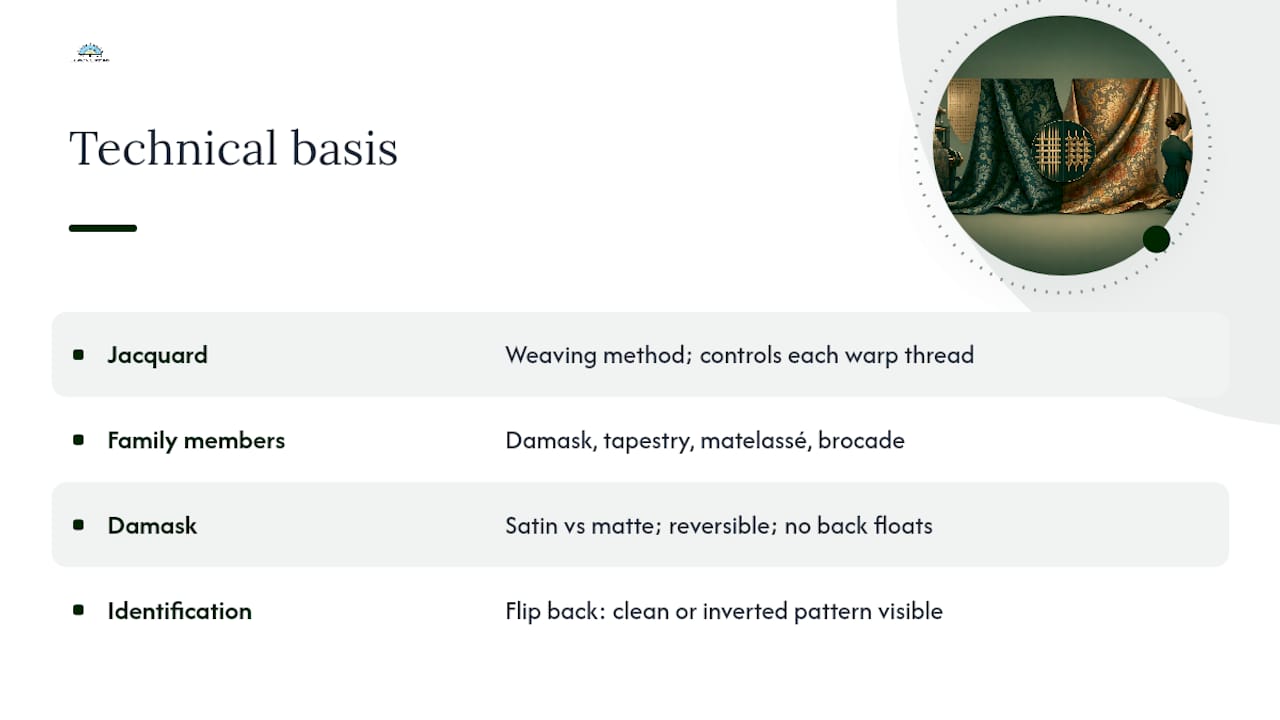
Jacquard isn’t a fiber, a finish, or even a single fabric. It’s a weaving method, named after the Jacquard loom, that controls individual warp threads independently instead of raising them in uniform groups the way a simpler loom does. That control lets a weaver build intricate, integrated patterns directly into the structure of the cloth, rather than printing or embroidering a design on top of it afterward.
Because the Jacquard loom governs each warp thread on its own, it can produce an entire family of figured fabrics, not just one look. Damask, tapestry, matelassé, and brocade all fall under the jacquard umbrella. That’s why “jacquard” on a bolt tag or product listing tells you almost nothing about weight, fiber, or hand feel until you actually touch the fabric. A jacquard could be a crisp cotton shirting with a subtle woven stripe, or a heavy polyester upholstery textile with a bold floral repeat. The mechanism is shared; the results vary enormously.
Damask sits closest to the “plain” end of the jacquard family. It builds its pattern by alternating satin-faced and matte weave areas within the same cloth, which is why damask reads as reversible and comparatively flat compared to a fabric like brocade. There’s no extra yarn floating on the back. The pattern exists because of how the base weave itself changes direction and finish across the surface.
If you’re trying to identify a jacquard weave by hand, flip it over first. Many jacquards, including damask, show a clean or gently inverted version of the front pattern on the reverse, with no loose threads and no obvious “right side, wrong side” distinction. That clean back is your first clue you’re holding a jacquard weave that isn’t brocade. Brocade behaves very differently, and the next section explains exactly why.
What Makes Brocade Different From Other Jacquard Fabrics
Brocade gets its raised, sculptural quality from a construction technique called supplementary weft. Extra weft threads, separate from the ones weaving the fabric’s base structure, get woven in only where the pattern calls for them. Where those threads aren’t needed on the front, they float across the back of the fabric instead of cutting off.
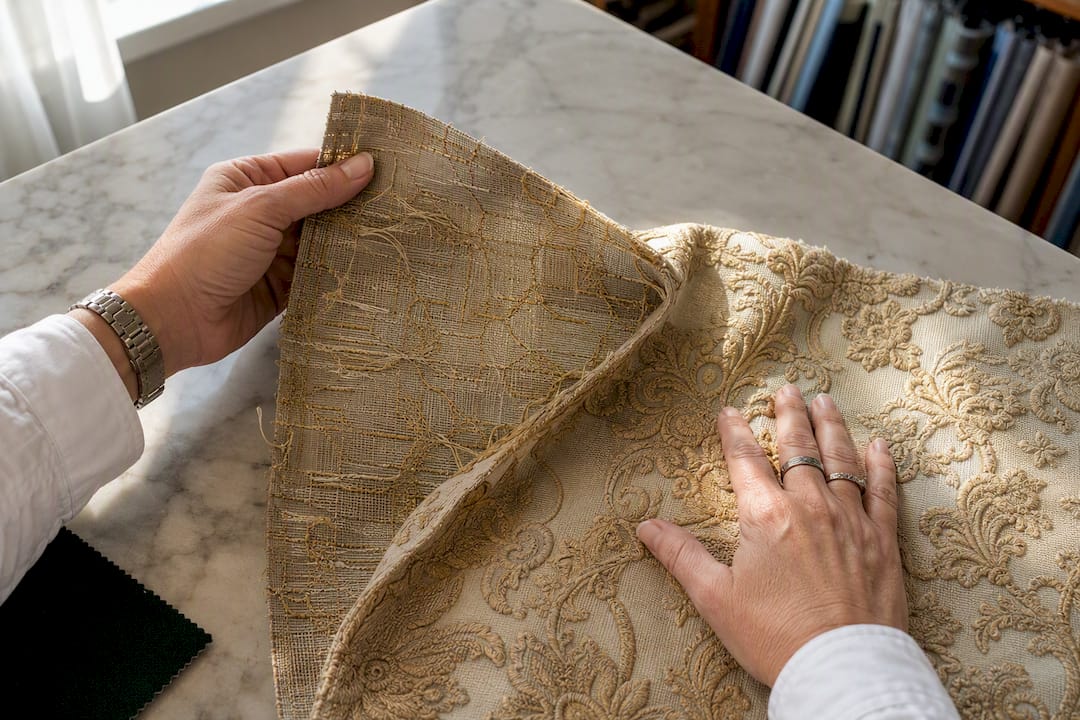
That’s the mechanical root of brocade’s whole personality. Those floating threads show up plainly on the reverse), which is exactly why brocade doesn’t work as a reversible fabric the way damask sometimes can. Run a finger across the back of a genuine brocade and you’ll feel loose strands and loops rather than a tidy woven surface.
On the front, those same supplementary threads sit slightly above the base cloth, which is what gives brocade its embossed, almost sculpted look. Historically, brocade was woven in silk, often with metallic gold or silver threads worked into the supplementary yarns for ceremonial robes, ecclesiastical vestments, and formal drapery in wealthy households. Modern brocades still lean toward that ornate identity, but production has expanded well past silk. You’ll find brocade in polyester, rayon blends, and synthetic metallic yarns, which brings the price down and makes the fabric more practical for everyday upholstery and drapery work.
To identify brocade in a fabric store, do two things. First, turn the swatch over and look for those loose floating threads. Second, press your thumb into the pattern area on the front. If you can feel a genuine raised relief, distinct from the background weave, rather than just a printed or subtly textured surface, you’re almost certainly holding brocade rather than a flatter jacquard cousin like damask. Retailers and shoppers mix these terms up constantly, which is part of why checking the reverse is the single most reliable identification habit you can build.
How Jacquard and Brocade Compare Side by Side
Once you know the mechanism, the practical differences line up predictably. Here’s how the two compare across the factors that actually affect a sewing or décor project.
| Factor | Jacquard (general/damask) | Brocade |
|---|---|---|
| Production method | Jacquard loom varies weave structure or float pattern | Jacquard loom plus supplementary weft threads |
| Pattern formation | Woven into the base structure itself | Extra threads floated on top of the base weave |
| Surface texture | Smooth to subtly textured, flat plane | Raised, embossed, dimensional relief |
| Reverse side | Often clean or a soft mirror of the front | Visible thread floats, distinct wrong side |
| Typical fibers & weight | Cotton, silk, rayon, poly blends; light to mid-weight | Silk historically; poly, rayon, metallic blends; mid to heavyweight |
| Common uses | Shirting, dresses, drapery lining, light upholstery | Formal wear, statement drapery, upholstery accents |
| Care & durability | Generally sturdier, less snag-prone | More prone to snagging; often needs gentler handling |
| Cost feel | Moderate, wide range | Tends toward the higher end, especially with metallic yarns |
A few takeaways worth carrying to the fabric counter:
- Best for versatility: general jacquard weaves like damask handle everyday apparel and drapery linings better because they lie flatter and resist snagging.
- Best for drama: brocade wins when the goal is a formal, textured statement piece, like an accent chair or a set of ceremonial drapery panels.
- Watch for: brocade’s floating threads catch on jewelry, pet claws, and rough handling more easily than a tightly woven jacquard.
- Watch for: because “jacquard” covers so many fabrics, always check weight and fiber content rather than assuming one jacquard behaves like another.
Reading the Fabric on Your Body or in Your Room
Jacquard’s visual range is part of its appeal. On garments, a well-woven jacquard gives you crisp pattern definition without the bulk of embroidery, and it drapes closer to the body than a heavily textured fabric would. Because many jacquards have a clean reverse, some designers use them for reversible jackets, wrap details, or unlined vests where both sides show. In home textiles, a subtle jacquard, think a tone-on-tone geometric or a soft floral, reads as texture from across the room rather than as a loud pattern, which makes it useful for pillows, light drapery, and furniture that needs to blend rather than dominate.
Brocade reads formal from ten feet away. The raised motifs catch light and shadow in a way flat prints never can, which is exactly why it shows up so often in evening wear, bridal accents, and holiday-season décor. In a living room, a single brocade throw pillow or a pair of statement drapery panels can anchor an entire color scheme without needing to cover every surface. Upholsterers often reserve brocade for accent chairs or headboards rather than high-traffic sofas, since the supplementary threads take more wear than a flat weave.
A few practical scenarios:
- A dining room set for holiday entertaining: brocade drapery panels paired with simpler jacquard dining chair cushions balance drama and comfort.
- A tailored blazer with a woven stripe: a mid-weight jacquard gives structure without the stiffness brocade would add.
- A bedroom refresh on a budget: one brocade accent pillow does the visual heavy lifting while jacquard bedding keeps the rest of the room wearable and washable.
Choosing Between Jacquard and Brocade for Your Project
Start with intended use, not with which fabric looks prettiest on the bolt. A cushion that gets sat on daily needs something that resists abrasion; a formal drapery panel that hangs mostly for show can afford a fabric with more delicate floats. Because brocade’s supplementary weft threads are more prone to snagging, it’s usually a better fit as an accent than as the main upholstery on a heavily used piece of furniture.
Next, inspect the actual swatch in your hand rather than trusting the label alone. Flip it over. If you see loose floating threads and a distinct wrong side, you’re looking at brocade or a brocade-style weave. If the back looks clean or only softly mirrors the front, you’re likely holding a flatter jacquard like damask.
Care requirements and budget follow naturally from construction. Brocade, especially with metallic yarns, usually calls for dry cleaning and gentler handling, while many jacquards tolerate more routine care. Budget for brocade to run higher, particularly with silk or metallic content, though modern synthetic brocades have narrowed that gap considerably.
Before you commit to yardage, work through this checklist:
- Assess the use. Decide whether the piece needs structural durability (upholstery, high-traffic drapery) or decorative impact (accent pillows, formal panels).
- Inspect the swatch. Turn it over, feel for floats, and check whether the pattern is woven into the structure or riding on top of it.
- Test the drape. Hold a generous sample up and let it fall; brocade tends to hold more body and structure, while jacquard often falls softer.
- Check the care label. Confirm whether dry cleaning is required, especially with metallic threads, before you buy enough yardage for an entire room.
- Consult a professional if unsure. A drapery workroom can tell you in seconds whether a swatch will perform the way you’re hoping.
Pro Tip: Order two swatches of anything you’re seriously considering: one to keep in your workspace and one to hold up against your existing furniture or wall color in natural daylight. Fabric that looks perfect under store lighting can shift dramatically once it’s home.
Sewing, Cleaning, and Handling Both Fabrics the Right Way
Inspection comes first, every time. Check the back for floats, run your hand across the surface to feel for relief, and drape a generous length off the edge of a table to see how it falls before you cut a single piece.
For sewing, jacquard generally behaves like a well-mannered mid-weight fabric: a universal or microtex needle, a lightweight stabilizer for structured pieces, and standard seam finishes usually suffice. Brocade asks for more patience. Because it’s stiffer and prone to snagging, it benefits from sharper needles, French seams or bound edges to contain fraying, and a fusible interfacing when you’re building anything structured.
Cleaning follows the same logic as sewing. Many cotton or synthetic jacquards tolerate a gentle test wash on a hidden corner, but brocade, particularly with metallic threads, almost always calls for dry cleaning and a cool iron kept away from direct contact with any metallic yarn. When in doubt, treat any fabric with visible metallic content as dry-clean only until a swatch test proves otherwise.
- Always float-test the back before committing to a project.
- Use a press cloth on brocade to protect metallic threads from heat damage.
Pro Tip: Marrion’s swatch-tested advice for both fabrics: baste a seam on a scrap first. Brocade’s floats can shift feed under a machine foot, and a two-minute test seam saves you from unpicking stitches on your good yardage. For more sewing-specific guidance, see Marrion’s swatch-tested tips for jacquard satin.
What Drapery Workrooms Actually Recommend
Most workrooms follow a simple rule: reach for damask or a flatter jacquard when a room needs subtle, livable pattern, and save brocade for the piece that’s meant to be the room’s focal point. That’s the perspective that guides Marrion’s swatch-tested notes and the fabric consultations run for drapery and upholstery clients. If a swatch feels ambiguous, or a project involves heavy use, a quick consultation with a professional workroom saves far more time than guessing.
— Marrion
Order Swatches and Get Expert Guidance From Beautiful Windows Elgin
Reading about floats and supplementary weft only gets you so far. Once you know whether your project calls for a flatter jacquard or a raised brocade, the next step is holding real yardage in your hands.

Beautiful Windows Elgin, based in Columbia, SC, carries a curated selection of designer jacquard satin, embroidered textiles, and upholstery fabric by the yard, alongside custom drapery making services and nationwide shipping. Instead of guessing from a listing photo, you can order swatches, feel the hand and the back of each fabric yourself, and browse categories like upholstery and drapery fabric before you buy a single yard. For readers weighing broader interior decisions alongside fabric choices, this guide on choosing the best interior doors is a useful companion resource.
If your project involves custom drapery, a design consultation takes the guesswork out of pairing the right weave with your windows and room. Book a measurement and design consultation today to get personalized guidance on fabric choice, yardage, and installation.
Sources
- Damask | Britannica
- What Is Jacquard? Weave, Fabric, Brocade & Damask – ADORNO DESIGN
- Brocade pattern explained | Architectural Digest
- Brocade or Jacquard? - Threads
FAQ
What’s the difference between jacquard and damask?
Damask is a specific type of jacquard weave that builds its pattern using alternating satin and matte finishes within the base structure, making it flatter and generally reversible, unlike raised brocade.
What are the downsides of jacquard fabric?
Because “jacquard” covers such a wide range of fabrics, weight and durability vary widely from one jacquard to the next, and heavier or more elaborate jacquards can be pricier and less forgiving to sew than a plain weave.
Is brocade an expensive fabric?
Brocade tends to sit toward the higher end of the price range, especially with silk or metallic threads, though modern synthetic and blended brocades have brought more affordable options into the market.
What fabric is similar to brocade?
Damask and other jacquard-family weaves share brocade’s woven-in patterning, but they lack the raised supplementary weft floats that give true brocade its embossed, three-dimensional surface.
Can you wash brocade at home?
Most brocade, particularly anything with metallic threads, should be dry-cleaned rather than washed; test wash a hidden swatch first if you’re unsure and the care label doesn’t specify.