


How fabric samples elevate custom interiors and upholstery
TL;DR:
- Selecting fabric samples is essential for accurately visualizing color, texture, and quality in your specific environment.
- Relying solely on digital images risks mismatched expectations, costly errors, and project delays; tactile evaluation is irreplaceable.
Selecting fabric for custom window treatments or upholstery is one of the most consequential decisions in any interior project, yet it’s also one of the most misunderstood. Many homeowners and even experienced designers assume that a well-photographed swatch on a website, or a small catalog image, will be sufficient for choosing the right material. In practice, color calibration differences between screens, compressed photography, and the complete absence of tactile information make digital-only selection a risky shortcut. Ordering physical fabric samples remains the single most reliable method for ensuring your finished project meets the vision you have in mind.
Table of Contents
- Why fabric samples are essential for successful projects
- How to evaluate and compare fabric samples effectively
- Common pitfalls when skipping fabric samples
- Special considerations for premium textiles and luxury projects
- Why digital swatches aren’t enough: An expert’s perspective
- Transform your next project with premium fabric samples
- Frequently asked questions
Key Takeaways
| Point | Details |
|---|---|
| Color and texture accuracy | Fabric samples ensure you see the genuine color, texture, and quality in your own home. |
| Error prevention | Sampling prevents costly mistakes from digital misrepresentation and enhances satisfaction. |
| Premium project success | Handling samples is crucial for luxury textiles, where subtle differences matter most. |
| Professional guidance | Designers and experts rely on physical samples for optimal coordination and performance. |
Why fabric samples are essential for successful projects
After underscoring what many miss about fabric selection, let’s detail why getting samples is foundational.
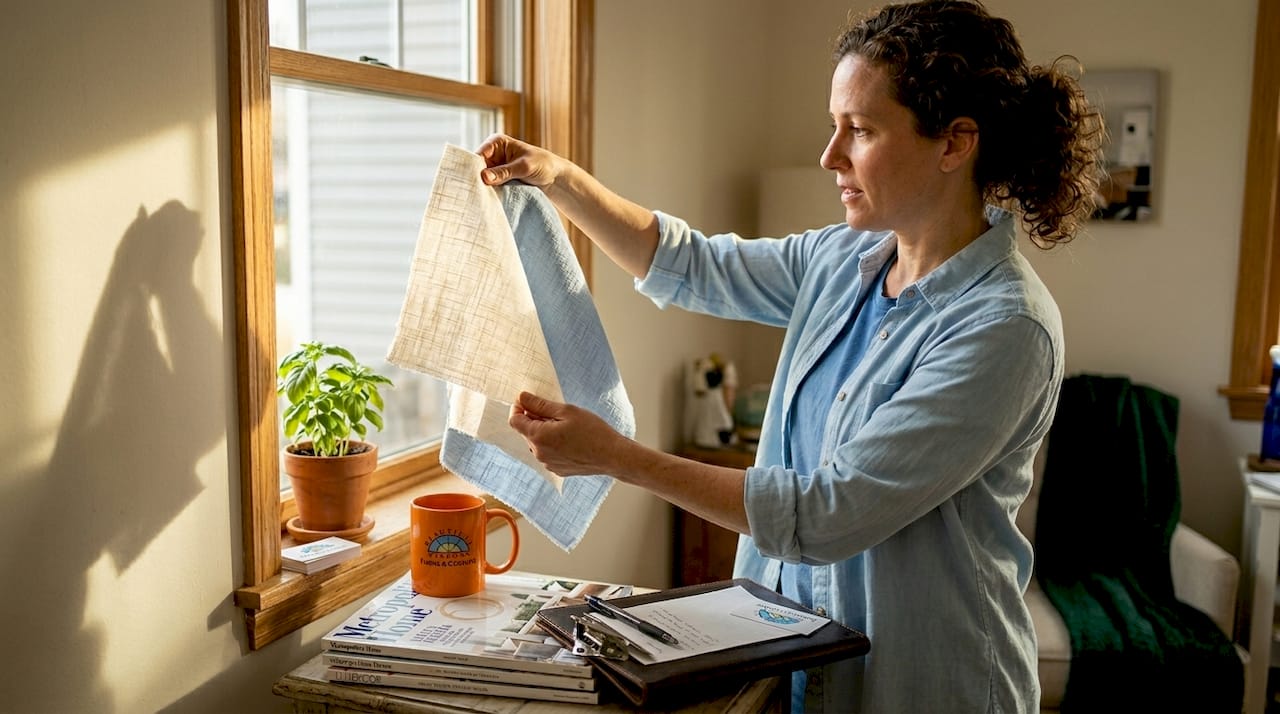
Fabric samples’ importance cannot be overstated: homeowners use them to visualize and coordinate home décor elements across a room’s full range of lighting conditions, materials, and furnishings. A sample pinned next to your existing sofa, under both morning sunlight and an evening lamp, tells you far more than any digital image ever could.
Here is what a physical sample genuinely delivers:
- Color accuracy in your specific environment. Paint finishes, flooring tone, and ambient light all shift how a fabric reads in a room. A taupe that looks warm and golden on a laptop screen may appear cool and gray against hardwood floors.
- Texture and hand feel. The weight and drape of a fabric directly affect how it hangs at a window or stretches over a cushion. A medium-weight jacquard satin, for instance, produces a graceful, structured drape that a lightweight alternative simply cannot replicate.
- Coordination with existing furnishings. Holding a fabric sample against your current upholstery, drapery, or wall color confirms whether the tone, pattern scale, and sheen work together.
- Assessment of quality and construction. Pulling a sample gently between your fingers reveals thread density, surface stability, and whether the weave is prone to snagging or pilling.
- Reduced risk of costly errors. Custom orders are rarely returnable. A few minutes spent evaluating samples at home can prevent expensive reorders and weeks of delay.
“The most reliable way to protect a design investment is to put the actual material in the hands of the person making the decision. No screen, no matter how high-resolution, replicates the experience of fabric in real light and real space.”
Pro Tip: Compare samples at three distinct times of day, early morning, midday, and evening under artificial light. Fabric color and luster shift more than most people expect, and discovering this before ordering protects you from unpleasant surprises.
How to evaluate and compare fabric samples effectively
With the “why” covered, it’s time to learn the “how” of truly evaluating samples like a pro.
Tips for window treatment fabrics consistently point to a structured evaluation process as the factor that separates confident purchase decisions from regrettable ones. Follow these steps to assess each sample with care:
- Observe under multiple light sources. Position the sample near your window, then move it under your room’s overhead lighting and any task lamps. Note whether the color shifts significantly.
- Touch and flex the fabric. Fold it gently to test stiffness. For drapery, a fabric that falls into smooth, even folds is ideal. For upholstery, you want resistance and recovery.
- Place it against your existing materials. Lay the sample on your furniture, hold it against the wall, and set it beside other fabrics you’re considering. Evaluate undertones, pattern scale, and sheen together.
- Perform a simple stress test. For upholstery fabrics especially, press a fingernail lightly against the surface and check whether the weave shifts or distorts. Tug gently along the bias to test stability.
- Assess pattern repeat and scale. For textured or patterned fabrics, consider how the design will look when repeated across a large window or over a full sofa. A pattern that is striking in a small swatch can become overwhelming at scale.
- Live with it for a few days. Pin the sample where the finished piece will live. Revisit it at different times and in different moods before committing.
Consulting a drapery fabric guide can further sharpen your ability to match fabric properties to the functional demands of each room.
Sample comparison overview
| Evaluation factor | What to look for | Why it matters |
|---|---|---|
| Color accuracy | Consistency across light types | Prevents post-installation color shock |
| Texture and drape | Smoothness, fold behavior | Determines how drapery hangs |
| Durability | Weave tightness, surface stability | Affects long-term wear |
| Light filtration | Opacity when held to light | Controls privacy and ambiance |
| Ease of cleaning | Surface resistance to lint and dust | Affects ongoing maintenance |
Pro Tip: Do not rush the sample evaluation process. Order your shortlisted options, live with them in your space for at least three to five days, and revisit your decision fresh each morning. The fabric that still looks right on day five is almost always the correct choice.
Common pitfalls when skipping fabric samples
While proper evaluation brings confidence, skipping samples opens the door to real and avoidable headaches.
Custom drapery selection process guidance consistently confirms that viewing and feeling fabric samples before ordering bespoke window coverings is among the most valuable steps a homeowner can take. When that step is bypassed, several predictable problems emerge.
- Unexpected color shifts in natural versus artificial light. A fabric described as “ivory” online may read as distinctly yellow in your south-facing living room and nearly white in your north-facing bedroom. Without a sample, this discrepancy only surfaces after installation.
- Pattern overwhelm at full scale. A bold geometric or floral pattern can look refined in a thumbnail but dominate an entire room when repeated across six drapery panels. Seeing the sample in place is the only way to judge proportional impact accurately.
- Texture mismatch with existing materials. A shiny polyester satin placed alongside matte linen furniture creates visual tension that is difficult to articulate in theory but immediately obvious in person.
- Reorder costs and project delays. Custom window treatments are typically cut and sewn to order. Returning or replacing them because the fabric looked different online is expensive, and reorder lead times can add weeks or months to a project timeline.
- Durability surprises. A fabric that appears substantial in a product photograph may feel thin and flimsy in hand, signaling that it won’t hold up to daily use on upholstered seating or frequently opened drapery panels.
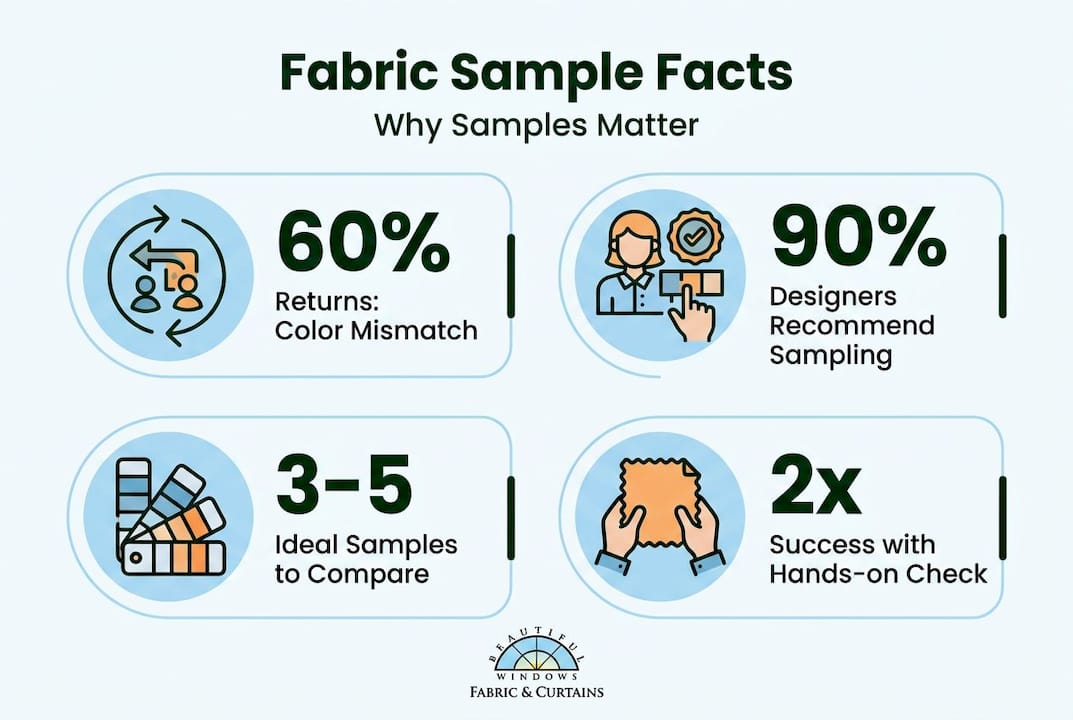
Studies show that over 60% of returns on custom window treatments are due to color and material mismatch, a statistic that underscores how consistently digital representation falls short of the real product. The cost of a few fabric samples is negligible compared to the cost of replacing an entire custom order.
Special considerations for premium textiles and luxury projects
For those opting for premium projects, the importance of hands-on sampling only increases.
When the materials involved are velvet, silk, embroidered jacquard, or high-end synthetic blends, the difference between a digital image and a physical sample becomes even more pronounced. Knowing how to choose upholstered fabrics for luxury interiors requires more than visual matching. It requires tactile judgment.
Luxury fabrics are engineered with specific performance characteristics, a silk’s luminous sheen behaves differently in morning light versus candlelight, and velvet’s pile direction creates entirely different color readings depending on the angle of the light source. Only an in-hand sample reveals these qualities with accuracy.
Performance comparison across premium fabric types
| Fabric type | Drape quality | Light interaction | Durability | Maintenance level |
|---|---|---|---|---|
| Velvet | Heavy, structured | Absorbs and shifts with pile direction | Moderate to high | Moderate, requires gentle care |
| Silk | Fluid, soft | High sheen, reflects strongly | Delicate | High, dry clean only |
| Linen | Medium, relaxed | Matte, filters gently | High | Low to moderate |
| Synthetic blends | Variable, structured | Consistent, low sheen | Very high | Low, easy to clean |
| Embroidered jacquard | Structured, weighted | Textured light reflection | High | Moderate |
“Premium fabric selection is where tactile judgment becomes irreplaceable. The weight, the resilience, the sheen direction: these are details that exist only in the physical world.”
When evaluating designer fabric examples for high-end applications, ask these questions while holding your sample:
- Does the fabric have a consistent weave with no visible irregularities or pulls?
- How does the surface respond to gentle friction? Does it resist or pill immediately?
- When held up to natural light, does it reveal appropriate opacity for its intended application?
- Does the hand feel match the grade you are paying for? Premium textiles should feel substantial and refined.
- How does the pattern register edge to edge? Misaligned patterns indicate lower manufacturing precision.
- Does the fabric have any odor that may indicate chemical treatment or moisture exposure?
These are not questions you can answer from a product page. They require the sample in your hands, in your space, under your conditions.
Why digital swatches aren’t enough: An expert’s perspective
Even the most experienced designers and workroom professionals have stories about being surprised by a fabric when it finally arrived, despite having studied every available digital image beforehand. This is not a failure of expertise. It is simply the limit of what any screen can convey.
High-resolution photography captures color fairly well on calibrated monitors, but it fundamentally cannot communicate weight, drape, texture, or the way a fabric interacts with ambient light in three dimensions. A velvet photographed flat under studio lighting looks nothing like that same velvet gathered on a drapery rod, where the pile direction creates deep shadows and subtle color variation across every fold. A jacquard satin with an intricate raised pattern may look flat and graphic in a product image, but in person it catches light in ways that make the design feel almost dimensional.
Color calibration between screens adds another layer of uncertainty. A fabric described as “deep teal” may display as blue-green on one monitor, blue on another, and nearly navy on a third. Even when a manufacturer provides Pantone color codes, those codes only describe the dye batch, not how the color reads in your specific environment.
The honest lesson, one that professionals often learn through costly experience, is that no prior relationship with a supplier, no matter how trusted, removes the need to sample new materials. Fabric compositions, dye lots, and weave structures change between production runs. A fabric you ordered successfully eighteen months ago may look or feel subtly different today. Insisting on current samples, every time, for every new project, is not excessive caution. It is sound professional practice.
Understanding how fabric’s impact on home comfort extends beyond aesthetics reinforces why this step deserves the same seriousness as any other design decision. The right textile in the right space contributes to how a room feels to live in, not just how it photographs.
Transform your next project with premium fabric samples
With best practices in mind, now is the time to secure the right samples and partnerships for your next project.
At Beautiful Windows, we offer a carefully curated selection of premium textiles, including jacquard satin, embroidered fabrics, and upholstery materials, all available for sampling before you commit to a yard. Our team supports homeowners, interior designers, and drapery workrooms with personalized consultations, helping you match the right fabric to your specific project requirements. Whether you are designing custom drapery for a formal dining room or reupholstering a set of statement chairs, our fabric selection and expert guidance are here to support informed, confident decisions. Explore our available samples, request a consultation, and experience the reassurance that comes from choosing fabric you have seen and felt in your own space.
Frequently asked questions
Do fabric samples show true color and texture?
Yes, fabric samples provide the most accurate representation of color and texture under your home’s lighting conditions, far more reliably than digital visualization of home décor elements.
How many fabric samples should I order before making a decision?
It is wise to order at least three to five samples so you can compare color, texture, and weight side by side, as selecting the right treatments for your interiors benefits from direct comparison.
Can a designer help me interpret fabric samples?
Yes, working with a designer provides insights on quality, coordination, and performance tailored to your project, and reviewing designer fabric examples together helps align selections with your vision.
Are fabric samples free from most providers?
Some providers offer free samples, though high-end or specialty textiles may have a small fee applied to reflect the material value and shipping cost involved.
How do I best compare samples at home?
Place samples side by side in your space under varying light conditions, including natural daylight, overhead lighting, and task lamps, and evaluate them alongside your existing furnishings before making a final decision.
Recommended
- Why fabric samples matter for custom window treatments – Fabric Store in Columbia, SC | Drapery Making Services
- Top designer fabrics for custom drapery and upholstery – Fabric Store in Columbia, SC | Drapery Making Services
- How fabric shapes your home’s comfort and style – Fabric Store in Columbia, SC | Drapery Making Services
- Decode designer fabric terminology: a guide for homeowners – Fabric Store in Columbia, SC | Drapery Making Services
- Pourquoi choisir des textiles haut de gamme pour son intérieur – CXL by Christian Lacroix Maison