

How to Choose Between a Workroom and a Fabric Store in 2026
Last Updated: October 31, 2026
Quick Summary
The workroom vs fabric store decision comes down to whether you want finished goods or raw material. A fabric store sells textiles by the yard, while a drapery workroom measures, cuts, sews, and finishes window treatments to specification. Some businesses, including Beautiful Windows Elgin, do both.
- A workroom that measures your windows owns the fit; one that asks you to send dimensions does not.
- Ask to see a finished panel, not just a fabric swatch, before committing.
- Get the turnaround in writing with a start date attached, since fabric lead times and workroom queues are separate delays.
- Order physical swatches and view them in the room at both morning and evening light.
- Buy the full yardage in one order because dye lots can vary between production runs.
Table of Contents
- Workroom vs Fabric Store: What the Difference Means for Your Project
- How to Choose a Drapery Workroom That Fits Your Project
- Professional Drapery Workroom Services: What You Actually Get
- Finding the Best Online Fabric Store for Professionals
- Designer Fabric by the Yard: How to Buy With Confidence
- Fabric Quality, Fiber Content, and Color Accuracy Checks
- Select Your Fabric and Start Your Project
- Frequently Asked Questions
Workroom vs Fabric Store: What the Difference Means for Your Project
The workroom vs fabric store decision comes down to one question: do you want finished goods or raw material? A fabric store sells you cloth by the yard and sends you home to figure out the rest. At Beautiful Windows Elgin, we offer both fabric by the yard and custom drapery fabrication.
That distinction sounds obvious until you're standing in a store holding three swatches with no idea how many yards a 96-inch panel actually requires.
Here's what most shopping guides get wrong: they treat these as competing retailers. They aren't. They're different stages of the same project, and picking the wrong one is the single most common reason a curtain project stalls halfway through.
A fabric store is a retail business that sells textiles by the yard, while a drapery workroom is a fabrication shop that measures, cuts, sews, and finishes window treatments to specification. Some businesses, ours included, do both.
If you can sew and you enjoy it, the fabric store route saves money. If you're still weighing the two paths, our workroom vs DIY drapery comparison breaks down cost, fabric math, skill, safety, and timing. If your windows are odd sizes, if you need blackout lining, or if the word "pleat" makes you nervous, the workroom route saves sanity. We'll walk through both paths, the real trade-offs, and how to judge quality before you spend anything.
How to Choose a Drapery Workroom That Fits Your Project
Choosing a workroom is less about the showroom and more about the paper trail. For a deeper walkthrough of picking the right one for interior design projects, see our guide to choosing a drapery workroom. Strong workrooms publish their process, put commitments in writing, and can show you a finished panel before you commit.
Start with a single question: who owns the fit? A workroom that measures your windows owns the fit. One that asks you to send dimensions hands the risk back to you. That distinction determines who pays for a remake when a panel hangs an inch short.
Use this evaluation framework before you sign anything:
| Criterion | Strong Workroom | Red Flag |
|---|---|---|
| Fabrication | Cuts and sews in-house; can show the shop | Subcontracts sewing to a third party |
| Measuring | Sends a professional to measure on site | Asks you to supply dimensions |
| Sampling | Provides a finished panel or mock-up | Shows only fabric swatches |
| Turnaround | Written delivery window with a start date | Verbal "a few weeks" with no date |
| Damage policy | Written process for fabric that arrives flawed | No stated remedy |
| Communication | Single point of contact for the project | Routes you between sales and production |
Ask to see a finished panel, not just a swatch. A swatch tells you how cloth feels; a finished panel shows how the workroom handles pleating, lining, and seams.
Get the turnaround in writing with a start date attached. A delivery window without a start date is meaningless. Ask when fabrication begins, not just when the order is placed, because fabric lead times and workroom queues are separate delays.
Confirm who handles damaged fabric. Ask any workroom whether it inspects yardage on arrival, who files a claim with the mill or retailer, and who covers the cost of a replacement cut.
Professional Drapery Workroom Services: What You Actually Get
Professional drapery workroom services cover the full path from measurement to hardware: on-site measuring, pattern selection, cutting, lining, sewing, pleating, and often installation.
Calculating yardage for drapery depends on finished width, pleat style, and pattern repeat, so it is worth confirming the math before you order.
Beautiful Windows Elgin offers custom drapery services on request. You can browse our pinch pleat panels and tailored drapery collection.
Finding the Best Online Fabric Store for Professionals
A useful online fabric store for professionals publishes the details designers need, such as fiber content, weight, repeat size, minimum order, and return terms. You can browse our designer drapery fabric collection to see how those specifications are presented. Pretty photography is table stakes. Specifications and purchasing terms are the differentiator.
Most retailer roundups list stores without comparing the terms that decide a trade order. This section fills that gap with a decision-ready framework you can apply to any retailer.
Start with swatches, not screenshots. Order a physical swatch before committing to full yardage. View it in the room where the finished piece will live, at both morning and evening light. A monitor renders color differently than daylight does, and a photo shot under warm studio lighting will read cooler in a north-facing room.
Verify weight and fiber in writing. Ask for fiber content as a percentage, not a vague blend name, and weight in a measurable unit. "Medium weight" means something different at every supplier, so a number is the only comparison that holds.
Read the return and exchange terms before checkout. Return policies for cut yardage vary widely. Some retailers accept returns only on uncut bolts; others charge a restocking fee; many treat cut fabric as final sale. Know which applies before you order, because a return that is not allowed is not a policy, it is a hope.
Check minimum orders and shipping timelines. Minimums can turn a small sample order into a full bolt commitment. Shipping timelines matter for project schedules, and cost should be visible before checkout, not revealed at the cart.
Use this checklist before you place a trade order:
- Fiber content listed as a percentage, not a vague blend name
- Fabric weight stated in a measurable unit
- Pattern repeat dimensions published
- Swatches available before full-yardage orders, with cost and shipping stated
- Return or exchange terms written out in plain language, including cut-yardage rules
- Minimum order clearly stated
- Shipping timeline and cost visible before checkout
- Damage and flaw claim process described
Designer Fabric by the Yard: How to Buy With Confidence
Buying designer fabric by the yard rewards preparation. When you're ready to act, our custom-drape fabric sold by the yard is a suitable option to start with. Measure twice, add a margin for pattern repeat and seam allowance, and order swatches before you commit to a full bolt.
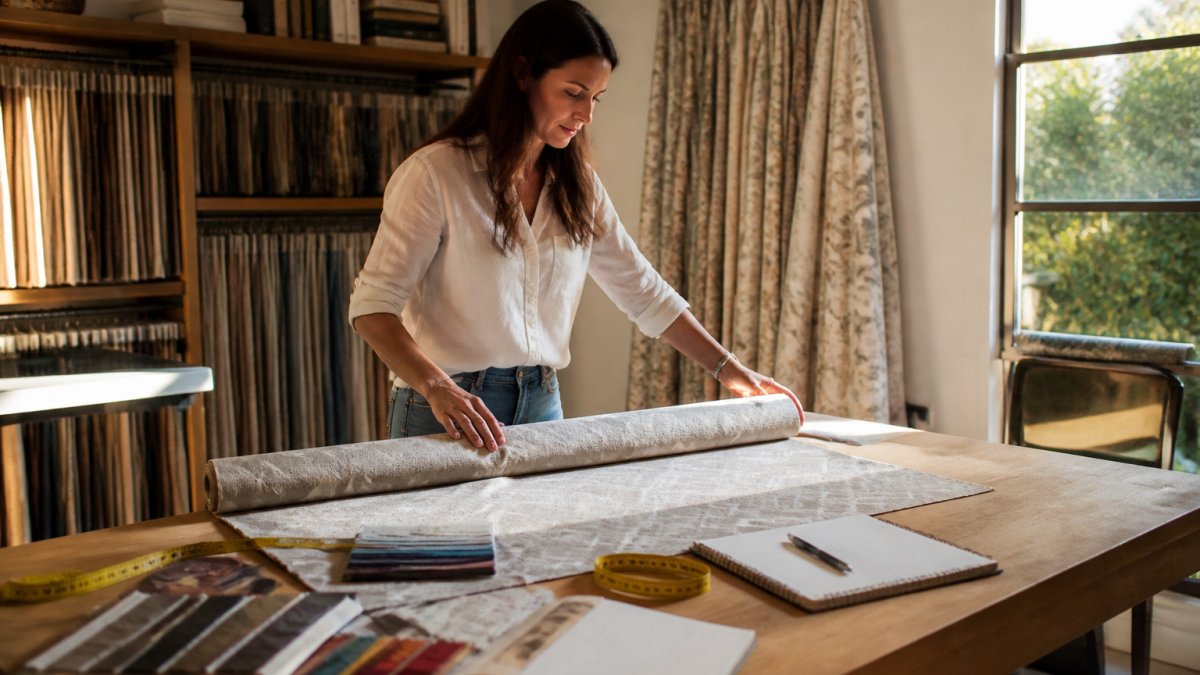
The yardage formula is simpler than it looks. Multiply your finished panel width by the fullness ratio, divide by the fabric's usable width, round up, then add the repeat allowance for each cut. For a pair of panels, double it. Add one extra yard for error.
Ordering too little is the expensive mistake. Dye lots can vary between production runs, so buying the full amount in one order is a sensible precaution.
If you've never ordered by the yard, And when you're ready to buy,
Fabric Quality, Fiber Content, and Color Accuracy Checks
Three checks separate fabric that lasts from fabric that disappoints: fiber content, weight, and color accuracy under real light.
Fiber content determines how a fabric drapes, cleans, and ages. Natural fibers breathe and soften over time. Synthetics resist wrinkling and hold pleats sharply. Blends trade one strength for another. None is inherently better; they suit different rooms and different budgets.
Weight tells you whether the fabric will hang or flop. Lightweight cloth suits sheers and casual panels. Heavier weaves hold structure and block light. Ask for the weight in writing, because "medium weight" means something different at every supplier.
Color accuracy is the hardest to verify remotely. Request a physical swatch, view it in the room where the curtains will hang, and check it at both morning and evening light. Screens lie.
Watch out: a swatch photographed against a white background will always look brighter than the same fabric in a dim hallway. Judge the swatch, not the screen. Browse our embroidered fabric for custom curtains collection.
Select Your Fabric and Start Your Project
The final step is the one people rush: matching fabric to project before ordering a single yard. Quilting wants tight weaves and stable cotton. Apparel wants drape and stretch recovery. Upholstery wants abrasion resistance. Drapery wants weight and light control. Buying drapery fabric for a sewing project, or the reverse, wastes money.
Use this to sort your options quickly:
| Project | Fabric Priority | Common Mistake |
|---|---|---|
| Drapery | Weight and light blocking | Skipping lining |
| Upholstery | Abrasion resistance | Underestimating yardage |
| Apparel | Drape and recovery | Ignoring care instructions |
| Quilting | Tight, stable weave | Mixing fabric weights |
| Bedding | Softness and washability | Overlooking shrinkage |
Once you've matched fabric to purpose, the rest is execution. Browse our bright color drapery panels to start your project. Browse the full fabric range at Shop fabric and build from the cloth up.
Choosing between a workroom and a fabric store isn't really a choice between two shops. It's a choice about how much of the project you want to own. If you'd rather hand off the measuring, the math, and the sewing, custom drapery services are available on request. If you'd rather build it yourself, we offer designer fabric by the yard with nationwide shipping. Get started with Beautiful Windows Elgin and turn a stalled curtain project into finished panels.
Frequently Asked Questions
What is the difference between a fabric store and a drapery workroom?
A fabric store sells material by the yard, while a drapery workroom measures, cuts, and sews that material into finished window treatments. Some businesses, like Beautiful Windows Elgin, do both: they sell designer fabric by the yard online and also offer custom drapery fabrication. Knowing which service you need prevents paying for fabrication you plan to do yourself, or buying yardage you cannot sew into the right panel size.
How do I choose a drapery workroom for custom curtains?
Ask how any workroom handles measuring, lining options, and lead times before you commit. Confirm who is responsible if a panel arrives the wrong size, and check whether they source fabric for you or work with yardage you supply. A workroom that puts timelines in writing is easier to trust than one that only quotes a price.
Where can I buy designer fabric by the yard online?
Look for a retailer that lists fiber content, weight, and repeat size for every fabric, and that offers swatches before you commit to full yardage. Beautiful Windows Elgin sells curated designer fabric by the yard with nationwide shipping, so you can order a sample first and then buy the full amount once the color and hand feel match your project.
How do I make sure the fabric color I order online matches my screen?
Order a swatch before buying full yardage. Screens vary in how they render color, and natural light in your room changes how a fabric reads once it is hung. Compare the swatch against your wall color and flooring in daylight, not under a lamp. If the swatch does not match, you have lost the cost of a sample instead of a full cut of fabric.
