


Why Custom Drapery Costs More Than Ready-Made Panels
Table of Contents
- The Real Reason Custom Drapery Costs More: It Is Made for One Window
- Fabric Yardage Math: Where the Money Actually Goes
- Benefits of Custom Drapery vs Ready Made: Fit, Lining, and Longevity
- How to Measure Windows for Custom Drapery (and Why Guessing Costs You)
- Drapery Hardware and Installation Costs Most Buyers Forget
- DIY vs Professional Labor: What You Save and What You Risk
- Cost-Per-Use: Why Custom Drapery Can Be the Cheaper Choice Over Time
- Frequently Asked Questions
Last Updated: September 28, 2026
The Real Reason Custom Drapery Costs More: It Is Made for One Window
Custom drapery costs more than ready-made panels because every panel is cut, lined, and sewn for a single set of window dimensions. Nothing is mass-produced, so nothing is amortized across thousands of identical units.
The custom drapery market reflects that craftsmanship. According to LS Fabrics market valuation report, the global custom drapery market is valued at $3.27 billion and is projected to reach $5 billion by 2035. That growth tracks a shift toward long-term value over upfront savings, per Q Design Centre industry analysis.
At Beautiful Windows Elgin, we cut every panel to the measurements a customer sends us. A ready-made panel is cut to a factory average. That difference is the whole cost story.
Fabric Yardage Math: Where the Money Actually Goes
Fabric yardage is the largest single line item in any custom drapery quote, and it is also the line item buyers understand least. Fullness, pattern repeat, and header style all multiply the raw yardage a workroom must buy, and each multiplier stacks on the last.
The first multiplier is fullness. A flat panel uses roughly one times the window width. A pinch pleat panel typically needs two to two-and-a-half times the width to drape correctly. A rod-pocket or grommet panel often lands around one-and-a-half to two times. That means a 100-inch rod span can require anywhere from 100 to 250 inches of fabric before you account for anything else.

The second multiplier is pattern repeat. On a solid or small-scale print, panels can be cut side by side with almost no waste. On a large repeat, every panel must start at the same point in the design so the motif lines up across the seam and across the pair. A 24-inch repeat on a 96-inch panel can force the workroom to buy an extra half to full repeat per panel just to position the cut. Multiply that across four panels and the waste is real fabric you pay for and never see.
The third multiplier is the header and hem allowance. Pinch pleats consume fabric inside the pleat folds. A deep bottom hem, a weighted hem bar, and a return to the wall all add inches per panel. None of these show up in a ready-made panel because ready-made panels are cut to a factory average, not to your window.
Here is the practical takeaway: two windows of identical size can carry very different fabric costs. A solid linen in a standard width may need six yards. The same window in a wide-width fabric with a large repeat and a pinch pleat header may need twelve. The window did not change. The math did.
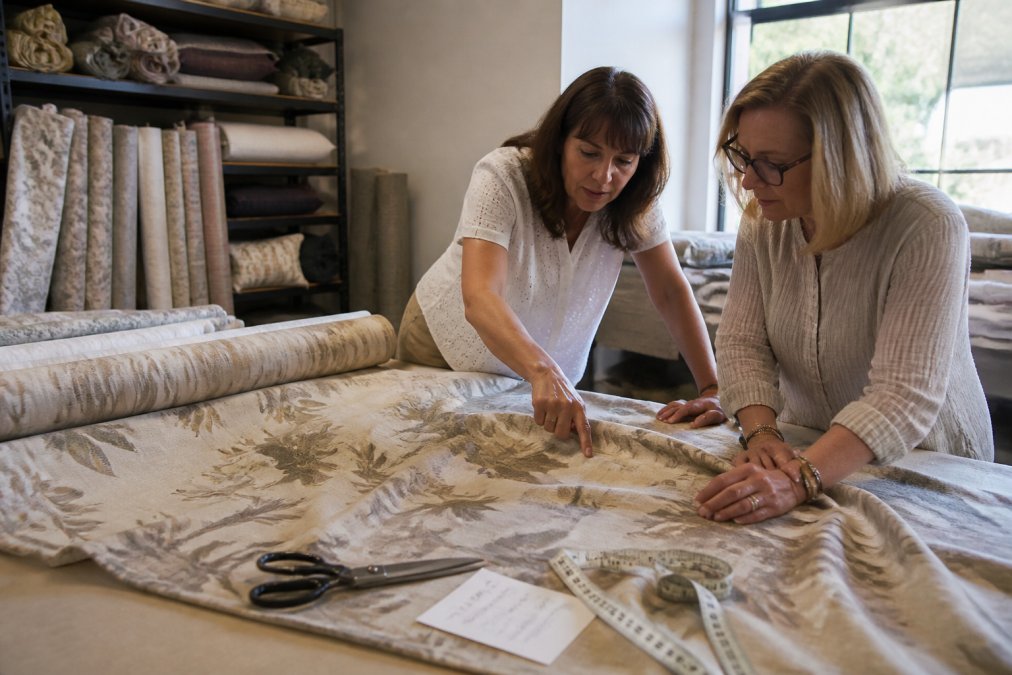
The same math applies when you buy fabric by the yard. Our Shop fabric collection lists width and repeat on every listing so you can calculate yardage before you order.
Benefits of Custom Drapery vs Ready Made: Fit, Lining, and Longevity
The benefits of custom drapery vs ready made come down to three things: fit, lining, and how long the panel lasts. Custom panels close the gaps, block light properly, and hold their shape for years.
Ready-made panels come in a handful of stock lengths. A 96-inch panel on an 89-inch window puddles on the floor; on a 102-inch window it floats. Custom panels are cut to the exact drop.
Lining is the second difference. Blackout lining and interlining are options on custom work, not afterthoughts. A lined panel insulates better and protects the face fabric from sun fade.
Durability follows. Heavier fabric weight, proper header construction, and a real hem mean the panel keeps its shape. As Everhem CEO Haley Weidenbaum told Forbes, "Draping some windows will cost less, depending upon size and materials chosen but some will cost significantly more so this is a good baseline."
| Feature | Ready-Made Panels | Custom Drapery |
|---|---|---|
| Length | Stock sizes only | Cut to your drop |
| Lining | Rarely included | Blackout or interlining available |
| Header | Rod pocket or grommet | Pinch pleat, rod pocket, your choice |
| Pattern matching | Not aligned | Matched across seams |
| Lifespan | A few seasons | Many years with care |
Our Custom-Length Flame-Red Pinch Pleat Curtain Panel shows the difference: a 5-inch header, included lining, and a custom drop, sold as a single panel for $380.00.
How to Measure Windows for Custom Drapery (and Why Guessing Costs You)
Knowing how to measure windows for custom drapery prevents the single most expensive mistake in the process: ordering a panel that cannot be fixed. Measure width at three points and height at three points, then use the smallest width and the longest height.
Custom-Length Flame-Red Pinch Pleat →
Here is the sequence we recommend:
- Mount the rod first, or decide its exact height and projection.
- Measure the rod width, not the glass width.
- Measure from the rod to your desired finished length.
- Measure width and height at the left, center, and right of the opening.
- Record the smallest width and the longest height.
- Note the return to the wall if the rod wraps a corner.
A workroom cannot un-cut fabric. If your measurement is off by two inches, the panel is off by two inches. Ordering a fabric sample first, roughly 4 by 6 inches, lets you check color and scale before committing to yardage.
Drapery Hardware and Installation Costs Most Buyers Forget
Drapery hardware and installation costs are the line items buyers overlook most often. Rods, brackets, rings, and finials are rarely included with a panel, and professional installation is a separate charge.
Hardware scales with window width. A wide span needs a center bracket or a heavy-duty rod that will not bow under the weight of lined panels. Custom panels can weigh several pounds each, so the mounting has to match.
Installation is the other forgotten cost. Hanging a floor-to-ceiling panel set on a tall wall usually takes two people and a ladder. Drilling into masonry or mounting above a window casing adds time. If you hire out the install, budget for it separately from the panel price.
DIY vs Professional Labor: What You Save and What You Risk
DIY labor saves the workroom fee but adds the risk of a ruined cut. Sewing your own panels is realistic if you are comfortable with long seams, lining, and pattern matching.
The trade-off is time and tolerance for error. A single lined panel can take several hours to cut, sew, press, and hem. Multiply that by four panels for two windows, and a weekend disappears.
Professional labor buys precision. A workroom has the tables, the industrial machine, and the experience to match a repeating pattern across a seam. For a straightforward solid fabric on a standard window, DIY is a fair choice. For a large repeat, a blackout lining, or a non-standard window, the workroom earns its fee.
Cost-Per-Use: Why Custom Drapery Can Be the Cheaper Choice Over Time
If you want to control the fabric cost yourself, browse our embroidered fabric for custom curtains and order yardage with nationwide shipping.
Frequently Asked Questions
Why is custom drapery so expensive compared to store-bought curtains?
Ready-made panels are cut in bulk to a handful of standard sizes, so the cost of one pattern is spread across thousands of units. Custom drapery is cut for a single window, which means the full width of fabric, the lining, the interlining, and the workroom hours all land on one order. Add pattern matching, hand-set pleats, and a weighted hem, and you are paying for precision rather than volume.
Is custom drapery worth the investment for long-term home value?
It depends on how long you plan to keep the window treatment. Custom panels hold their shape, resist fading, and can be re-lined instead of replaced, which is why the industry increasingly frames them as an investment rather than a splurge. If you are dressing a difficult window or staying in the home for years, the math usually favors custom.
What factors contribute to the labor cost of custom curtains?
Labor covers measuring, cutting, pattern matching, header construction, lining attachment, hemming, and pressing. A pinch pleat header alone takes far longer to build than a rod pocket or grommet top because each pleat is measured and tacked by hand. Blackout lining and interlining add another pass through the machine, and floor-to-ceiling panels with a 3.5-inch bottom hem take longer to weight and finish. That workroom time, not the fabric, is often the largest single line on a custom quote.
How does fabric quality impact the price of window treatments?
Fabric weight and composition drive both the yardage needed and the price per yard. A heavier cotton blend or silky dupioni drapes in fuller folds and needs more width to look right, while a lightweight poly-cotton can be cut closer to the window dimensions. Patterned fabrics with a horizontal or vertical repeat also require extra yardage so the design lines up across panels. Choosing a fabric with a smaller repeat, or a solid, keeps yardage and waste lower without sacrificing the finished look.
Custom drapery costs more upfront because it is built for one window, one measurement, and one design. The savings show up later in fit, insulation, and years of use. Beautiful Windows Elgin offers designer fabrics by the yard, custom drapery services, and nationwide shipping, so you can source premium materials or have our workroom fabricate the panels for you. Get started with Beautiful Windows Elgin and select your fabric today.