


Linen vs Cotton for Custom Curtains: Which Wins?
Table of Contents
- Linen vs Cotton for Custom Curtains: The Short Answer
- Side-by-Side Comparison Table
- Texture, Color, and Light: How Each Fabric Looks
- Curtain Fabric Weight and Drape: How Each One Hangs
- Durability, Wrinkling, and Shrinkage After Washing
- Privacy, Light Filtering, and Breathability
- Which Linen Is Best for Curtains?
- Linen Cotton Blend Curtains: The Middle Path
- Frequently Asked Questions
Last Updated: October 17, 2026
Linen vs Cotton for Custom Curtains: The Short Answer
The linen vs cotton decision for custom curtains comes down to one trade-off: linen gives you texture, cotton gives you control. Linen is a natural fiber woven from flax, prized for its relaxed drape and visible slub texture. Cotton is a natural fiber spun from the cotton plant, valued for its smoother hand and easier care. At Beautiful Windows Elgin, we cut both every week, and the honest answer is that neither wins outright. Linen suits rooms where you want softness and movement. Cotton suits rooms where you want a tailored look that holds its shape. Below, we'll show you exactly how each fabric behaves on a real window, how they wear over time, and which one we would order for each room in your home.
Side-by-Side Comparison Table
The comparison below summarizes how the two fabrics differ across the factors that matter most for made-to-measure drapery.
| Factor | Linen | Cotton | Edge |
|---|---|---|---|
| Texture | Visible slubs, natural weave | Smooth, even surface | Depends on taste |
| Drape | Soft, relaxed folds | Crisper, structured folds | Depends on style |
| Wrinkling | Wrinkles readily, part of the look | Wrinkles less, presses well | Cotton |
| Shrinkage | Can shrink noticeably on first wash | Moderate, more predictable shrink | Cotton |
| Breathability | High airflow | High airflow | Tie |
| Durability | Strong fibers, weak crease memory | Abrasion-resistant, holds shape | Cotton |
| Cleaning | Often dry clean | Often washable | Cotton |
| Fullness ratio for custom panels | 2.5x rod width reads full and soft | 2x rod width reads full without bulk | Depends on header |
| Best heading styles | Rod pocket, tab top, relaxed pleats | Pinch pleat, goblet pleat, tailored headers | Depends on style |
| Lining compatibility | Lined linen adds body and blocks light | Lined cotton becomes opaque and sun-resistant | Tie |
| Relative fabric cost per panel | Higher per yard, more yardage needed | Lower per yard, less yardage needed | Cotton |
The pattern is clear: cotton takes most of the practical categories. Linen takes the aesthetic ones.
Texture, Color, and Light: How Each Fabric Looks
Linen's texture is the reason people pay more for it. The weave shows small irregular thickenings, and that uneven surface catches light in a way flat fabric cannot. In a bright room, linen panels glow rather than glare. Cotton reads smoother and more uniform, which makes it the better canvas for a precise pattern or a saturated color. Dye takes evenly on cotton, so a custom color match is more predictable. Linen softens color slightly because the texture breaks up the surface.
There is a practical wrinkle here that most guides skip: linen's texture hides soiling better, while cotton's smooth face shows marks sooner. For a dining room or a high-traffic hallway, that matters.
Curtain Fabric Weight and Drape: How Each One Hangs
Fabric weight and drape decide whether a curtain looks expensive or cheap, and this is where the two fabrics diverge most. Linen is lighter per square yard at the same weave density, so it moves with air and falls into soft, irregular folds. Cotton carries more body, so it holds a pleat and forms a crisper, more tailored line. That is why cotton suits pinch pleat panels and formal headers, while linen suits relaxed rod-pocket and tab styles.
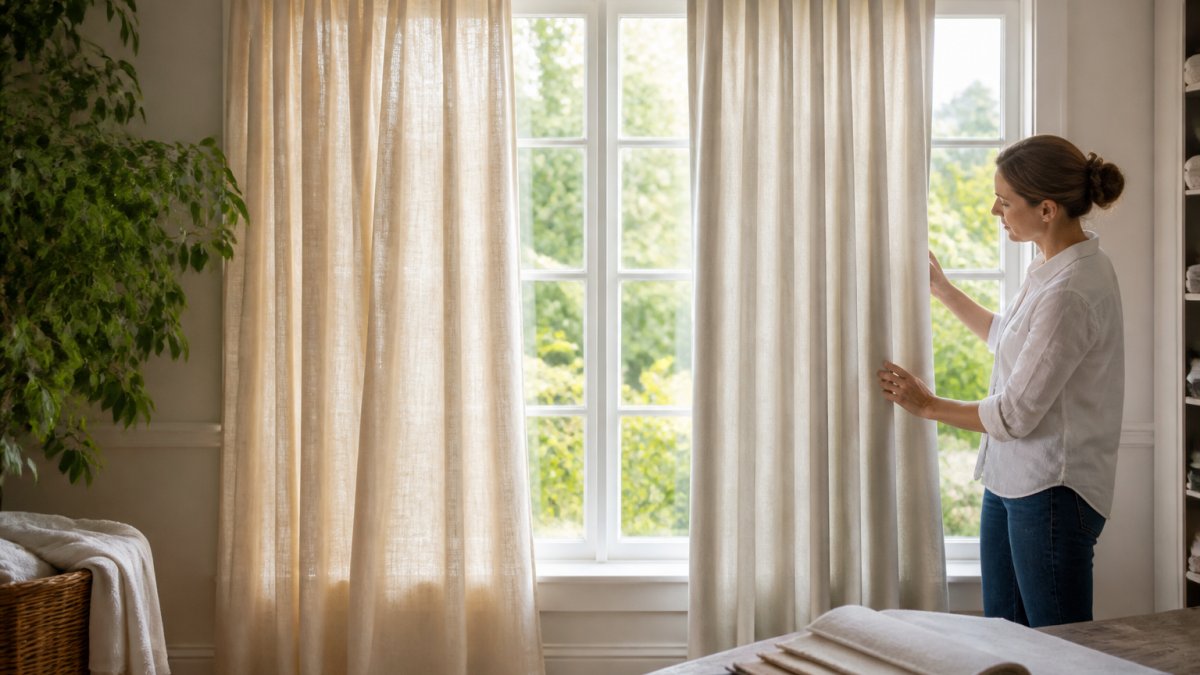
Fullness changes the equation. Ordering the right yardage up front avoids the most common custom-order mistake: coming up short mid-project.
Durability, Wrinkling, and Shrinkage After Washing
Cotton is the more durable choice for daily-use curtains. Its fibers resist abrasion well, and cotton holds up to repeated handling at the leading edge where hands pull panels open. Linen fibers are strong individually but have poor crease memory, so linen creases along fold lines and stays creased. That is charming in a casual room and frustrating in a formal one.
Shrinkage is the bigger risk with linen, and it is the issue most custom-curtain guides gloss over. Natural linen can shrink noticeably on the first wash, and unlined linen panels may lose length. Cotton shrinks too, but usually less and more predictably. The practical fix depends on how the panel is made:
- Prewash the yardage before sewing. Wash and dry the fabric the way you plan to clean the finished curtains, then cut. This is the only reliable way to eliminate first-wash shrinkage in custom panels.
- Order extra length and hem after the first wash. If you cannot prewash, add 2 to 4 inches to the finished length and re-hem after the curtains have been washed once.
- Line the panels. A lining adds body, reduces creasing, protects the face fabric from sun fade, and makes both linen and cotton hang more consistently over time. Lined panels also shrink less at the face because the lining carries some of the load.
- Check the care label before you buy ready-made. Dry-clean-only linen will not shrink in the wash because it never sees the wash. Washable cotton will, so plan for it.
Wrinkling follows the same logic. Linen wrinkles along fold lines and at the leading edge; a linen-cotton blend wrinkles less because the cotton adds crease recovery. Cotton wrinkles less than linen but still creases at the header and where panels are tied back. A hand-held steamer is the gentlest way to refresh either fabric between cleanings, and it is safer than ironing on a hanging panel.

Privacy, Light Filtering, and Breathability
Both fabrics filter light well, and both breathe. Linen and cotton are natural fibers with open weaves, so air moves through them and condensation does not build on the glass. That makes either a good pick for humid rooms and for windows that fog in winter.
Privacy depends on weave density and lining, not on fiber. An unlined linen panel in a light color will glow at night with a lamp behind it. Add a regular lining and both fabrics become opaque enough for a bedroom. If you want full blackout, the lining does the work, not the face fabric.
Chalotte Brown Fabric |100% Cotton—Sold by The Yard →
Which Linen Is Best for Curtains?
A linen-cotton blend keeps the texture while adding stability.
Weight matters. A heavier linen holds a pleat and blocks more light. A lighter linen moves more and suits sheer layering.
For a ready-made option, our Melaina Linen-Cotton Blend Curtains Panel shows how a blend behaves in practice: a soft, breathable drape with gentle structure, a regular lining included, and a dry-clean-only care requirement. That care label is the trade-off you accept for the texture.
Linen Cotton Blend Curtains: The Middle Path
A linen-cotton blend is the practical answer for most custom projects. The blend pairs linen's texture with cotton's smoothness and strength, so the panel wrinkles less than pure linen and feels softer than pure cotton. It also shrinks less than pure linen and presses more easily. Blends are often recommended when a client wants the linen look but does not want to baby the curtains.
If you are sewing your own panels, our Aiden Linen Cotton Fabric for Window Curtains is a good example of a blended drapery fabric sold by the yard, with a soft, structured drape suited to panels and valances. For a pure cotton option with strong durability, the Helmsley 100% Cotton Décor Fabric offers a breathable hand and a crisp fold for tailored headers.


Choosing between linen and cotton for custom curtains is really a choice about how you want the room to feel and how much care you want to give it. If you want soft texture and relaxed movement, go linen or a linen blend. If you want a tailored look that survives daily life, go cotton. At Beautiful Windows Elgin, we sell designer fabrics by the yard with nationwide shipping and offer custom drapery services, so you can order the right yardage and have the panels made to your window. If you would rather skip the sewing entirely, our Pinch Pleat Panels are a natural fit for the crisper, structured fold that cotton does best, and you can browse the full shop fabric selection to compare linen, cotton, and blends side by side before you commit. Select your fabric.
Frequently Asked Questions
Which fabric is better, linen or cotton, for custom curtains?
It depends on the look and the room. Linen brings a relaxed, textured finish and strong breathability, which suits living rooms and bedrooms where you want soft, natural folds. Cotton gives a smoother surface and easier styling, and it costs less per yard, so it works well for high-traffic rooms and tighter budgets. A linen-cotton blend splits the difference, and for many custom orders that blend is the safest pick.
Are linen or cotton curtains better for privacy?
Neither fabric blocks a window on its own. Privacy comes from fabric weight, weave density, and lining, not from the fiber name. A lightweight linen panel lets more light through than a heavier cotton panel, and the reverse is also true. If privacy matters, choose a heavier fabric weight and add a regular lining, which is how made-to-measure panels are typically built for bedrooms and street-facing windows.
Do linen curtains let in more light than cotton curtains?
Linen often filters more light because it is frequently woven in a looser, lighter weight, and its natural texture scatters daylight rather than blocking it. Cotton can be woven denser and heavier, so it filters more. The deciding factor is the fabric weight and whether the panel is lined. An unlined lightweight linen panel glows in daylight, while a lined cotton panel darkens the room considerably more.
Which fabric drapes better for custom curtains?
Linen drapes in soft, irregular folds that read as relaxed and slightly rumpled. Cotton holds a crisper, more structured fold and keeps a tailored look. Fabric weight and drape are linked: heavier fabrics fall in longer, straighter columns, while lighter fabrics gather more tightly. For a formal dining room, cotton or a lined blend gives cleaner pleats. For a casual living room, linen's loose drape is the draw.
Are cotton curtains easier to care for than linen curtains?
Usually yes. Cotton handles water-based cleaning and tolerates washing better, while linen wrinkles more and often needs dry cleaning to keep its shape. Many made-to-measure linen and blend panels are dry clean only. Check the cleaning code on the fabric listing before you order yardage, and plan for shrinkage: natural fibers can shrink after washing, so pre-wash DIY yardage or order a little extra for hems.