


How to Match Fabric Colors Online: A 2026 Guide
Table of Contents
- Why Matching Fabric Colors Online Is Harder Than It Looks
- Calibrate Your Screen for Accurate Color Perception
- Using Fabric Color Matching Tools and Digital Color Pickers
- Understanding Color Theory to Coordinate Fabrics
- Ordering Fabric Swatches Online Before Making a Final Purchase
- Buying Designer Fabric by the Yard with Confidence
- Accessibility Considerations for Color-Blind Fabric Selection
- Frequently Asked Questions
Last Updated: September 25, 2026
Why Matching Fabric Colors Online Is Harder Than It Looks
When you try to match fabric colors online, it's a common challenge: you find a gorgeous fabric on your screen, order it with confidence, and when it arrives, the color looks completely different. The problem isn't you, it's the technology gap between digital displays and physical fabric.
Every screen renders color differently. Your laptop, phone, and monitor each have their own color profile. Add in varying lighting conditions, camera settings, and photo compression, and you're looking at a situation where the fabric image you're viewing may be nowhere close to the actual product. According to Nature Scientific Reports research on digital textile imaging, optimal image acquisition environments and preprocessing strategies are essential to improve the color reliability of digital textile images for textile applications.
Fabric color matching online involves multiple layers of error: the manufacturer photographs under specific lighting, the image gets compressed and uploaded, your monitor displays it based on its own calibration, and the color shifts multiple times before you see it.
Matching fabric colors online is possible with a deliberate approach. You can't rely on your screen alone, the strategies in this guide will help you navigate the digital-to-physical color gap.
Calibrate Your Screen for Accurate Color Perception
Your monitor's calibration directly affects how you perceive fabric colors online. An uncalibrated screen shows inaccurate color values, leading to poor purchasing decisions.
Check your monitor's basic settings: brightness at a comfortable level and contrast around 50%. Most monitors ship with factory settings that are too bright and oversaturated, distorting color perception.
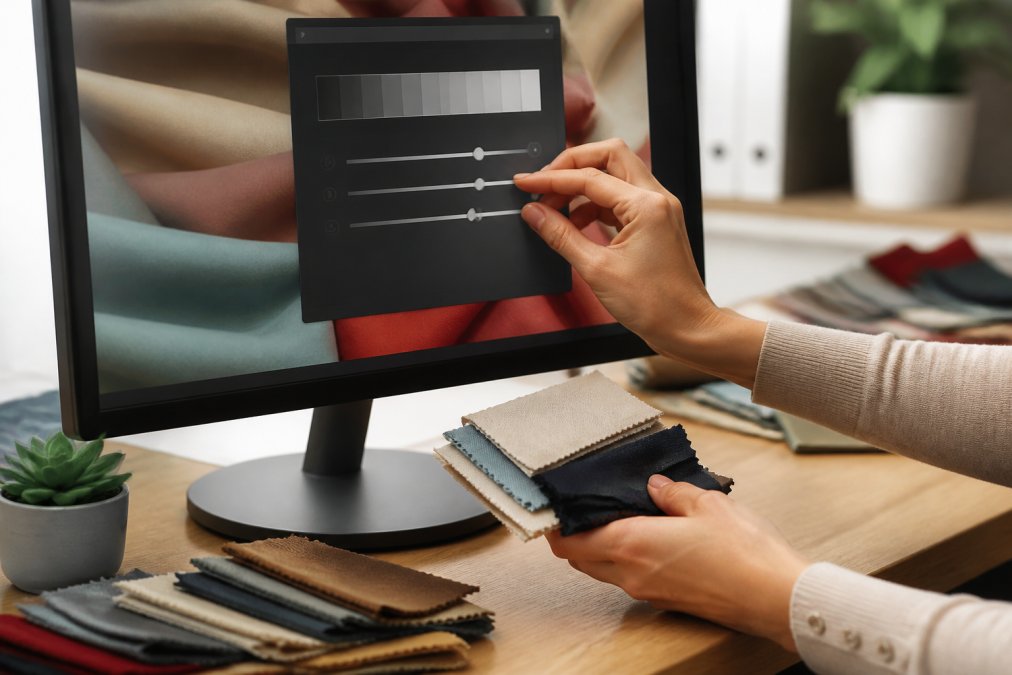
For serious color matching, consider a hardware calibration tool. These devices measure your screen's actual color output and create a color profile for more accurate display. Mid-range tools work well for fabric shopping.
Compare the fabric image on your screen against a physical reference. Place fabric swatches next to your monitor while viewing similar colors online. This side-by-side comparison reveals how much your screen is shifting the colors.
Using Fabric Color Matching Tools and Digital Color Pickers
Digital color pickers extract color values from fabric images, but understanding what those values represent, and what they don't, is critical to avoiding mismatches.
A color picker captures the light values your screen displays. It returns HEX codes (web design), RGB values (0-255 scale), and CMYK values (print percentages). These describe transmitted or reflected light, not the physical properties of dyed fiber, why digital codes fail to match physical fabric.
Why HEX and RGB codes don't translate to fabric:
Fabric color depends on dye chemistry, fiber content, weave structure, and surface texture, none captured by a HEX code. Two fabrics with identical RGB values appear different because of dye lot variation (5-15% shifts between batches), fiber absorption (cotton vs. linen vs. silk reflect light differently), surface finish (matte vs. glossy), and image compression (JPEG loses color data).
Treat HEX and RGB values as a search tool, not a match guarantee. Use them to find similar fabrics across retailers, document preferences, and cross-reference manufacturer color cards. When searching by color code, prioritize fabrics in the same fiber content and finish, a cotton print with RGB (200, 100, 50) matches another cotton print far better than a silk blend with identical numbers.
Many retailers provide their own color codes alongside photos. If shopping on a single retailer's site, their internal color system is more reliable than extracted codes. However, verify all codes with physical swatches before ordering yardage.
Understanding Color Theory to Coordinate Fabrics
Color theory provides a framework for coordinating fabrics, but online shopping shows inaccurate colors. Verify color relationships with physical references before committing.
The color wheel organizes hues by relationships: complementary colors (opposite, high contrast), analogous colors (adjacent, cohesive), triadic colors (equally spaced, balanced), and monochromatic schemes (one color in different values).
ASSORTED WAX PAPER WAX FREE PAPER (5 →
When viewing fabrics on screen, colors are distorted by monitor calibration, lighting, image compression, and retailer photography. A perfect complementary match on screen might be noticeably off in person.
Workflow: (1) Use the color wheel as reference to identify desired relationships. (2) Select 3-5 fabric candidates. (3) Order physical swatches, non-negotiable. (4) Lay swatches flat under your actual lighting in the room where they'll be used. (5) To match fabric colors online effectively, refine your selections based on physical reality, not screen appearance.
Texture matters as much as color. Two fabrics with complementary hues can clash if one is matte and one is glossy. Evaluate how textures interact, a smooth, saturated fabric next to a heavily textured, muted one creates visual interest color theory alone wouldn't predict.
Common mistakes: assuming screen colors are accurate (they're not), forcing fabrics into schemes based on emotional reactions, ignoring lighting effects, and coordinating across retailers without verifying with swatches from each.
Ordering Fabric Swatches Online Before Making a Final Purchase
Physical swatches are your most important tool for matching fabric colors accurately. A swatch shows you the actual fabric material, texture, and true color under various lighting conditions. This is non-negotiable if you're making a significant purchase.
Most fabric retailers offer swatch services. You request small samples of the fabrics you're interested in, and they arrive within 5-10 business days. The cost is usually minimal, often free or a few dollars per swatch. This small investment prevents costly mistakes.
When your swatches arrive, evaluate them under multiple lighting conditions:
- Natural daylight from a window
- Artificial indoor lighting (ceiling lights, lamps)
- The specific lighting in the room where you'll use the fabric
Fabric color shifts under different light sources. A fabric that looks perfect in daylight might look completely different under warm indoor lighting. Testing swatches in your actual environment removes this guesswork.
Compare swatches side by side if you're coordinating multiple fabrics. Lay them flat next to each other under the same lighting. This shows you exactly how colors work together in person, not how they appear on separate screens.
When you're ready to move forward, Curtain Panels and embroidered fabric for custom curtains are available through Beautiful Windows Elgin, making it straightforward to order swatches before committing to full yardage.
Buying Designer Fabric by the Yard with Confidence
Once you've verified colors with physical swatches, buying designer fabric by the yard becomes a straightforward process. You know exactly what color and texture you're getting because you've seen it in person.
Accessibility Considerations for Color-Blind Fabric Selection
Color blindness affects how people perceive fabric colors online and in person. The most common form is red-green color blindness, where reds and greens appear as shades of brown or gray. Blue-yellow color blindness is less common but still affects fabric selection.
| Step | Purpose | Timing |
|---|---|---|
| Calibrate your monitor | Ensure accurate color display | Before shopping |
| Use digital color pickers | Extract standardized color codes | While browsing online |
| Study color theory | Coordinate fabrics intentionally | During selection |
| Order physical swatches | Verify true colors in your space | Before final purchase |
| Calculate yardage | Prevent ordering errors | Before checkout |
| Check dye lot numbers | Ensure color consistency | When ordering additional fabric |
Frequently Asked Questions
How do I know the fabric color I'm ordering online will match what I see on my screen?
Screen calibration is essential. Adjust your monitor's brightness, contrast, and color temperature to neutral settings before viewing fabric images. Physical variance between digital displays and actual fabric is unavoidable, the material's weave, texture, and light absorption affect how color appears in person. This is why ordering fabric swatches online before committing to yardage is the safest approach. A physical swatch in your home's lighting reveals the true color and texture you'll receive.
What are the best tools for matching fabric colors digitally?
Digital color pickers and color matching tools help extract HEX, RGB, and CMYK values from fabric images. However, these tools work best as reference points rather than guarantees. Combine digital color matching tools with color theory principles, using a color wheel to verify harmony and contrast, and always verify your selections against physical swatches. No digital tool fully accounts for material-specific light absorption and texture differences.
Should I order physical swatches before buying fabric by the yard?
Yes. Ordering fabric swatches online is the standard practice for confident purchasing. Physical swatches let you assess color accuracy in your home's natural and artificial lighting, evaluate texture and weight, and verify how the fabric coordinates with existing décor. Many fabric retailers offer swatch libraries or individual swatches for a small fee. This investment prevents costly mistakes when buying designer fabric by the yard, which represents a significant financial commitment.
How can I match fabric colors if I'm color-blind?
Use descriptive color names and HEX codes rather than relying on visual perception alone. Many fabric retailers now include color specifications (HEX, RGB, Pantone) in product listings. Request physical swatches and ask trusted friends or family to verify color combinations. Some digital tools offer color-blind-friendly viewing modes.