

Why Embroidered Textiles Are Worth Choosing for Branding
Embroidered textiles combine lasting durability, a tactile premium appearance, and flexible branding options that outperform many surface-printing methods for garments and home textiles. Whether you are sourcing uniforms, custom drapery, or decorative accents, the advantages of embroidered textiles span well beyond aesthetics.
The headline advantages at a glance:
- Durability: Thread-based stitching resists fading and mechanical wear far better than most surface prints
- Premium appearance: Three-dimensional texture and sheen signal craftsmanship in ways flat printing cannot replicate
- Branding precision: Logos, monograms, and color-matched marks hold their shape wash after wash
- Versatility: Works across apparel, caps, towels, upholstery accents, and drapery headers
- Functional benefits: Dense stitching can reinforce fabric structure and add subtle insulation
- Sustainability levers: Natural base fabrics paired with responsibly sourced threads reduce environmental impact.
The sections below cover each of these points in depth, including stitch types, cost drivers, fabric compatibility, and when a different decoration method is the smarter choice.
Key Takeaways
Embroidered textiles offer a durable, premium-finish decoration method that outperforms surface printing for structured fabrics, branded apparel, and home textiles when fabric weight and motif size are properly matched.
| Point | Details |
|---|---|
| Durability advantage | Thread-based stitching resists fading and wear better than surface prints, especially on medium-to-heavy fabrics. |
| Premium appearance | Three-dimensional satin and fill stitches create tactile depth and sheen that flat printing cannot replicate. |
| Fabric compatibility | Match stitch density and backing type to fabric weight; very thin knits and stretch fabrics need special handling. |
| Cost drivers | Stitch count, digitizing fees, and order volume are the main pricing variables; sample first to control costs. |
| Sustainability | Pair embroidery with GOTS or OEKO-TEX certified natural base fabrics and recycled threads to reduce environmental impact. |
| Beautifulwindowselgin | Offers designer embroidered fabrics by the yard and custom drapery services with sample ordering and nationwide shipping. |
Table of Contents
- What Are the Real Advantages of Embroidered Textiles for Durability?
- How Embroidery Changes Perceived Quality and Brand Image
- What Customization Options Does Embroidery Give You for Branding?
- Where Do Embroidered Textiles Work Best?
- Which Stitch Types Produce the Effects You Want?
- What Determines the Price and Lead Time for Embroidered Textiles?
- When Should You Choose Embroidery Over Printing?
- How Can Embroidery Be Made More Environmentally Responsible?
- Expert Tips for Coordinating Motif Size, Fabric Weight, and Stitch Choices
- Why Beautifulwindowselgin Recommends Embroidered Textiles for Selected Applications
- Beautifulwindowselgin Offers Designer Embroidered Fabrics and Custom Drapery Services
- Sources
What Are the Real Advantages of Embroidered Textiles for Durability?
Embroidery typically outperforms surface prints on wash-and-wear durability when executed correctly on a compatible fabric. The reason is structural: thread is woven into the base fabric rather than bonded on top of it, so there is no coating to crack, peel, or fade under repeated laundering.
Three technical factors determine how long an embroidered textile will last:
- Thread type. Polyester thread resists moisture, UV exposure, and high-temperature washing better than cotton thread. Cotton thread is softer and more natural-looking but absorbs water and can weaken with frequent industrial washing. For uniforms and workwear, polyester is generally the more durable choice.
- Stitch density and backing. A properly stabilized design, using a cut-away or tear-away backing appropriate to the base fabric, prevents puckering and keeps the motif flat over time. Under-stabilized embroidery distorts after a few washes and loses edge clarity quickly.
- Fabric weight and weave. Medium-to-heavy fabrics, such as piqué polo, canvas, denim, and terry cloth, hold embroidery securely. Lighter fabrics require additional stabilization and are more prone to distortion if the design is dense.
Embroidery typically resists fading and mechanical wear better than many surface prints and can tolerate higher washing temperatures when applied correctly to suitable fabrics. For home textiles, this translates to drapery panels and upholstery accents that retain their decorative detail through years of use.
Care guidelines that extend lifespan:
- Wash embroidered garments inside out on a gentle cycle in cool-to-warm water
- Avoid high-heat dryer settings; air-dry or tumble on low
- Iron on the reverse side or use a pressing cloth to protect raised stitches
- For minor thread pulls, trim loose ends cleanly rather than pulling them
Quick checklist to evaluate an embroidery job’s expected lifespan:
- Thread type confirmed (polyester for durability, cotton for softness)
- Backing type appropriate to base fabric weight
- Stitch density balanced, not so dense it stiffens the textile
- Placement avoids high-stress seams or fold lines
- Digitizing quality verified with a physical test swatch before full production
For fabric durability guidance specific to home décor, Beautifulwindowselgin provides detailed resources on selecting textiles that hold up in real-world conditions.
How Embroidery Changes Perceived Quality and Brand Image
Embroidery boosts perceived quality and professionalism compared with flat prints, and the difference is immediately tactile. A raised satin-stitch logo on a polo shirt reads as craftsmanship; the same design screen-printed on the same shirt reads as standard merchandise. That gap in perception matters for brands, hotels, corporate gifting programs, and anyone presenting a premium product.
The visual and tactile effects that drive this perception include:
- Three-dimensional relief: Satin and fill stitches create a raised surface that catches light differently from the surrounding fabric, producing natural shadowing and depth
- Thread sheen: High-twist polyester and rayon threads have a subtle luster that flat inks lack, particularly noticeable on dark base fabrics
- Edge definition: A well-digitized border stitch produces clean, crisp outlines that hold their shape far longer than printed edges, which can blur or crack
Embroidered fabrics are widely used in fashion to create premium, decorative, and high-value garments, with embroidery adding texture, depth, and design detail that is particularly valued in luxury and designer collections. The same principle applies to home textiles: embroidered drapery trims, decorative pillow panels, and upholstery accents carry an artisanal quality that elevates an entire room. For more visual examples of how embroidery transforms home décor, the Beautifulwindowselgin blog covers specific applications with photos.
Common applications where the premium effect is most pronounced:
- Corporate uniforms and hospitality staff attire
- Embroidered caps and structured hats
- Luxury bath towels and robes
- Drapery header trims and decorative panel borders
- Monogrammed table linens and napkins
Pro Tip: Match stitch style to brand positioning. A bold, dense fill stitch reads as strong and modern; a delicate running-stitch outline reads as artisanal and refined. Choosing the wrong style for a brand’s visual identity can undercut the premium effect embroidery is meant to create.
What Customization Options Does Embroidery Give You for Branding?
Embroidery is the preferred method for logos, monograms, and long-lasting brand marks because the stitched design becomes part of the textile rather than sitting on its surface. For corporate branding and uniforms, embroidery’s 3D texture and colorfast threads produce a longer-lasting professional look compared with many printing methods.
Thread palettes typically offer hundreds of colors, but color matching works differently than in print. Embroidery uses Pantone-referenced thread colors from systems such as Madeira or Isacord, and the closest available thread may not be an exact Pantone match. For brand-critical colors, always request a physical thread card comparison before approving a digitized file.
Multi-color stitching is fully achievable, but each color change adds production time and cost. Designs with more than eight to ten thread colors become progressively more expensive per piece. Gradients and photographic color blending are not reproducible in standard embroidery; those effects require printing.
Placement checklist for common embroidery locations:
- Left chest: Standard for polos, jackets, and dress shirts; keeps the motif visible without dominating the garment
- Cap front: Structured caps support dense fill stitching well; keep motif width within 2.5 inches for legibility
- Sleeve: Works for secondary logos or text; avoid curved seam placement
- Towel corner or hem: Low-stitch-count monograms work well; dense fills can stiffen terry cloth
- Drapery header: Decorative motifs near the top pleat line add visual interest without affecting drape
Fine detail, thin serifs, and very small text (below roughly 0.25 inches in height) tend to lose legibility in embroidery because individual stitches have a minimum physical width. When a design contains fine line work or small type, request a digitized test sample at actual production size before approving the full order.
Pro Tip: Always digitize and sample first. A digitized proof costs a fraction of a full production run and reveals scaling problems, color inconsistencies, and stitch-density issues that are invisible in a flat artwork file.
Where Do Embroidered Textiles Work Best?
Embroidery performs best on medium-to-heavy fabrics and can be adapted for lighter fabrics with proper stabilization. Embroidered fabric is adaptable across base materials and is popular for dresses, blouses, accessories, and home décor, with the technique executed by hand for artisan work or by machine for consistent, scalable production.
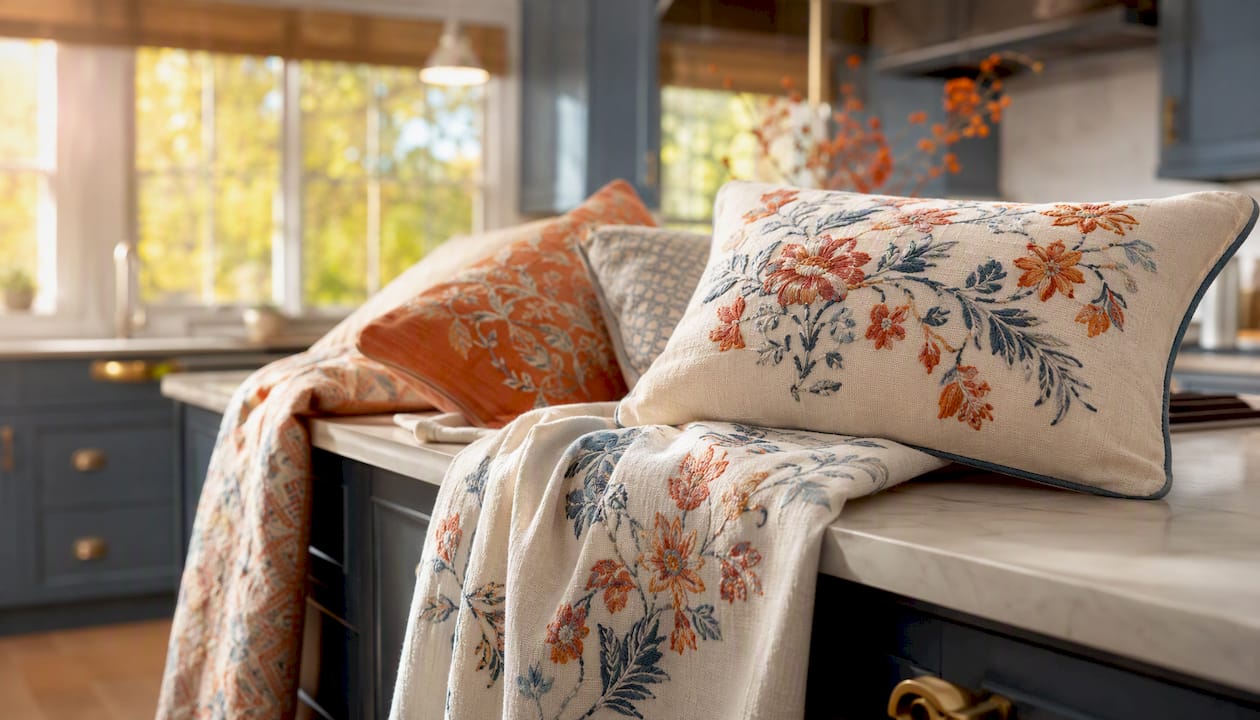
Common applications include uniforms, corporate apparel, structured caps, bath and beach towels, upholstery accent panels, drapery headers, and decorative pillows. For interior designers working on full-room schemes, embroidered textiles for home interiors offer a way to introduce texture and pattern that coordinates with other decorative elements.
| Base Fabric | Recommended Stitch Density | Backing Approach |
|---|---|---|
| Cotton piqué / polo | Medium to high | Cut-away stabilizer |
| Canvas / denim | High | Cut-away stabilizer |
| Terry cloth (towels) | Low to medium | Cut-away, topping recommended |
| Linen | Medium | Tear-away or cut-away |
| Silk / lightweight wovens | Low | Tear-away, water-soluble topping |
| Polyester blend (drapery) | Medium | Cut-away, test for heat sensitivity |
| Upholstery fabric | Medium to high | Cut-away, reinforce backing layer |
Very thin knits, stretch jersey, and some performance fabrics require specialized stabilization, and dense fill stitches on these substrates can restrict stretch and cause puckering. For these materials, a lower stitch count, a floating stabilization method, or an alternative decoration technique is worth considering. Cotton embroidery fabric combines breathability and comfort with decorative stitchwork, making cotton-based substrates a reliable starting point for most embroidery projects.
Which Stitch Types Produce the Effects You Want?
Stitch style controls texture, sheen, and edge clarity; the right choice depends on the desired visual effect and the fabric’s weight. Here are the four most common stitch types and what each does best:
- Satin stitch: Long, parallel stitches that lie flat and produce a smooth, high-sheen surface. Best for bold text, clean borders, and simple shapes. Loses definition if the fill area is wider than roughly 0.5 inches without a split or underlay.
- Fill stitch (tatami/running fill): Short stitches laid in rows or patterns to cover large areas. Lower sheen than satin but more stable on wide fills. The standard choice for large logo backgrounds and solid color blocks.
- Running stitch: A single line of stitches used for fine outlines, detail work, and lightweight designs. Minimal fabric impact, which makes it suitable for lighter textiles.
- 3D / puff embroidery: A foam underlay raises the stitching above the fabric surface for a bold, sculptural effect. Popular on structured caps and promotional headwear; not suitable for soft or draped fabrics.
Design limitations worth knowing before you commit to embroidery:
- Gradients and photographic color blending are not achievable with standard thread
- Very fine line work below 1.5mm width tends to merge into a solid mass at production scale
- Small text below 0.25 inches in cap height loses legibility
- When photographic detail, large coverage areas on thin T-shirts, or complex gradients are required, printing is the more appropriate method
Dense, large-area embroidery can stiffen fabric and reduce drape. Practitioners advise balancing motif density and fabric weight to preserve comfort — a heavily filled chest design on a lightweight woven shirt, for example, can create a rigid patch effect that affects how the garment hangs and feels against the body.
What Determines the Price and Lead Time for Embroidered Textiles?
Stitch count, digitizing fees, thread type, patch versus direct embroidery, and order volume are the primary cost drivers. Understanding each one lets you budget accurately and avoid surprises.
Digitizing is the process of converting artwork into a machine-readable stitch file. It is typically a one-time setup fee per design, ranging from modest charges for simple logos to higher fees for complex, multi-color artwork. Once a design is digitized, that file is reused for all subsequent runs, so the per-piece cost of digitizing falls sharply with volume.
Stitch count is the single largest variable in per-piece pricing. A simple left-chest logo might use 5,000 to 8,000 stitches; a full-back jacket design can exceed 50,000. Higher stitch counts mean longer machine time and more thread, both of which increase cost.
| Cost Factor | Effect on Price | Effect on Lead Time |
|---|---|---|
| High stitch count | Increases per-piece cost | Increases production time |
| Specialty threads (metallic, glow) | Increases material cost | May increase setup time |
| Patch embroidery vs. direct | Adds patch production step | Adds 1–3 days typically |
| Low order volume | Higher unit cost | Standard lead time |
| High order volume | Lower unit cost | May extend queue time |
| Complex backing / stabilizer | Minor cost increase | Minimal time impact |
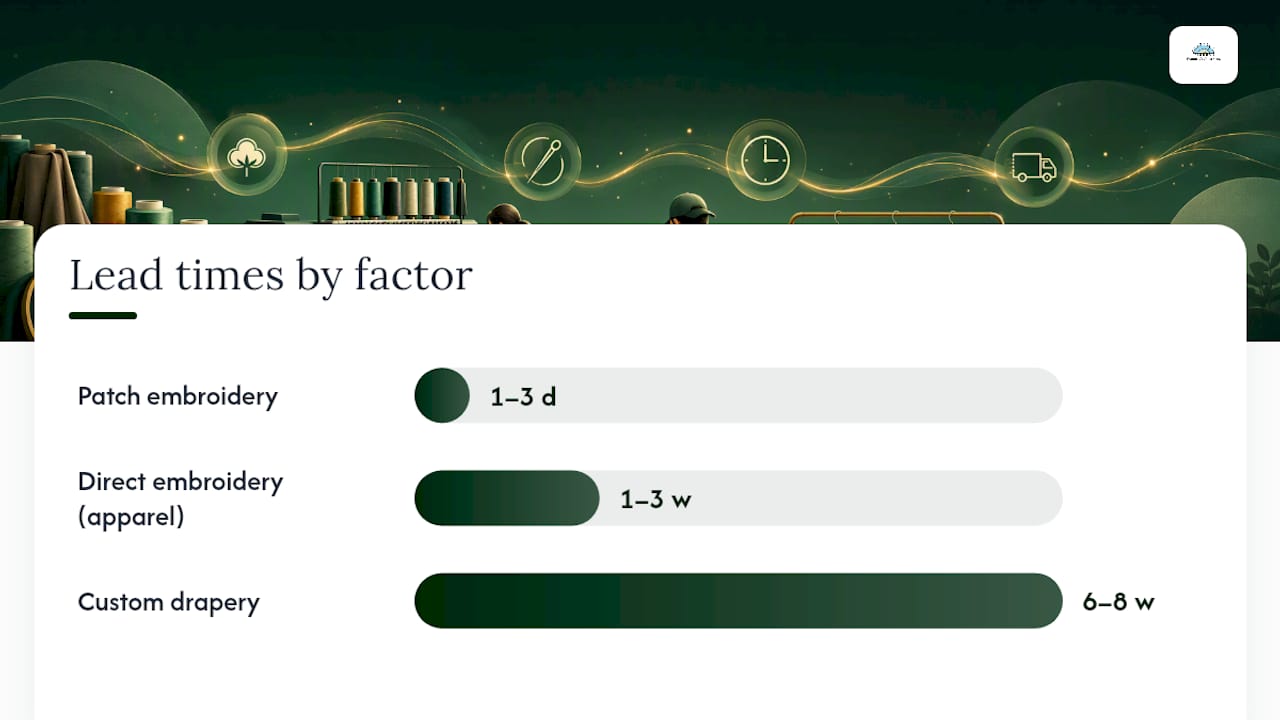
Standard production lead times for direct embroidery on apparel typically run one to three weeks after artwork approval, depending on order size and supplier capacity. Custom drapery projects with embroidered elements often require longer lead times; custom drapery workrooms commonly quote six to eight weeks for complex projects.
Pro Tip: Request a digitized proof and a single physical sample before approving full production. The sample cost is small relative to the risk of discovering a scaling or density problem across an entire order.
When Should You Choose Embroidery Over Printing?
Choose embroidery for durability and texture; choose printing for fine detail, photographic images, and very large coverage areas on thin fabrics. Neither method is universally superior. The right choice depends on the visual goal, the base fabric, and the expected service life of the textile.
Embroidery wins when:
- The textile will be washed frequently (uniforms, towels, workwear)
- A three-dimensional, tactile finish is part of the brand identity
- The design is a logo, monogram, or bold graphic with limited colors
- The base fabric is structured (caps, polo shirts, jackets, drapery)
- Long-term color retention is a priority
Printing wins when:
- The design includes photographic detail, gradients, or more than ten colors
- The base fabric is a thin, lightweight T-shirt or performance knit
- The coverage area is very large (full-back prints, all-over patterns)
- Budget is the primary constraint and the item has a short service life
Quick decision checklist:
- Will this textile be washed frequently? Favor embroidery.
- Does the design include gradients or photographic color? Favor printing.
- Is the base fabric structured and medium-to-heavy weight? Embroidery is compatible.
- Is the design smaller than a business card? Verify legibility with a digitized sample before committing.
- Is long-term brand recognition on uniforms the goal? Embroidered customization improves brand visibility and long-term recognition on uniforms and promotional textiles.
How Can Embroidery Be Made More Environmentally Responsible?
Embroidery can be environmentally responsible when paired with natural base fabrics and responsibly sourced or recycled threads. The sustainability profile of an embroidered textile depends on decisions made at the material-selection stage, not just the stitching process itself.
Key sustainability levers:
- Choose natural base fabrics. Organic cotton, linen, and silk are biodegradable and carry lower synthetic chemical loads than petroleum-based synthetics. Embroidered fabric’s sustainability profile improves when paired with natural base fabrics, and certifications such as GOTS (Global Organic Textile Standard) or OEKO-TEX Standard 100 provide third-party verification of fiber and processing standards.
- Select certified or recycled threads. OEKO-TEX certified polyester threads and recycled polyester (rPET) thread options are available from several thread manufacturers and reduce virgin plastic consumption.
- Minimize overproduction. Ordering only what is needed, using modular embroidered patches that can be transferred between garments, and planning quantities carefully all reduce waste.
- Avoid heavy metallic or specialty threads where not needed. Metallic threads often contain non-recyclable composite materials and are harder to process at end of life.
- Opt for low-impact dyes. When selecting base fabrics, prioritize suppliers who use reactive or fiber-reactive dyes with lower water and chemical consumption.
Expert Tips for Coordinating Motif Size, Fabric Weight, and Stitch Choices
Successful embroidery results from balancing motif size, stitch density, and fabric weight together, not independently. A design that looks correct on screen can produce a stiff, puckered result on fabric if those three variables are not evaluated as a system. B2B textile experts stress the importance of technical advice at the design stage to avoid common mistakes such as oversized motifs on light T-shirts or dense fills on drapery without reinforcement.
Concept-to-production checklist for designers and buyers:
- Define the motif’s actual production size before digitizing, not after
- Confirm the base fabric weight and weave structure with the supplier
- Select backing type based on fabric: cut-away for stretch and medium-weight wovens, tear-away for stable wovens, water-soluble topping for textured surfaces like terry cloth
- Request a digitized proof and review stitch paths, underlay, and pull compensation settings
- Order a physical test swatch on the actual production fabric before approving the full run
- Check placement relative to seams, pleats, and stress points; avoid placing dense fills directly over seams
For drapery and upholstery projects specifically, additional considerations apply:
- Account for pleat allowance when positioning a motif on a drapery header; the design must remain visible when the fabric is pleated
- Use a cut-away backing reinforced with a woven interfacing on upholstery panels to prevent long-term distortion under tension
- Keep embroidered motifs away from the leading edge of curtain panels, where fabric experiences the most mechanical stress from daily opening and closing
- For lined drapery, confirm that the lining does not compress or distort the embroidered surface when the panels are hung
Pro Tip: For drapery projects, always hang a sample panel before approving full production. Embroidery that looks balanced flat on a workroom table can shift visually once the fabric is gathered or pleated on a rod.
For a deeper look at custom drapery fabric selection and how embroidered textiles fit into window treatment design, Beautifulwindowselgin’s resources cover the full range of considerations.
Why Beautifulwindowselgin Recommends Embroidered Textiles for Selected Applications
Embroidery is not the right choice for every textile project, and that is precisely why it is worth recommending when the conditions are right. After working with interior designers, homeowners, and drapery workrooms across the country, the pattern is consistent: clients who choose embroidered fabrics for structured applications, such as drapery headers, upholstery accent panels, and decorative pillows, consistently report a level of finish that flat-woven or printed alternatives do not match. The texture reads as intentional and refined rather than decorative for its own sake. The recommendation is always to start with the fabric weight and the intended use, then let the embroidery serve the design rather than define it.
Beautifulwindowselgin Offers Designer Embroidered Fabrics and Custom Drapery Services
Beautifulwindowselgin carries a curated selection of designer drapery fabrics by the yard, including embroidered textiles suited for window treatments, upholstery accents, and decorative panels. The collection spans jacquard satin, embroidered wovens, and upholstery-weight textiles that pair well with embroidered trims and accent work.
Beyond fabric sales, Beautifulwindowselgin provides design consultations, fabric sample ordering, and custom drapery services with nationwide shipping. Whether you are an interior designer sourcing fabric for a client project or a homeowner planning custom window treatments, the team can help you match the right embroidered textile to your fabric weight, pleat style, and room design. For interior designers working on full-room schemes, the designer trade program resources available through industry partners can complement your fabric selections with coordinated interior elements. Request fabric samples or book a consultation directly through the Beautifulwindowselgin website to confirm material compatibility before placing a full order.
Sources
- Complete Guide To Embroidered Fabrics For Apparel Manufacturing
- What is embroidery, and what advantages does it offer? – Printify
- Embroidery vs Printing on Fabric: Why Embroidery Stands Out - Danielle’s Embroidery
- Embroidered Fabric – Characteristics, Fashion Applications, and Sustainability
- The Beauty of Cotton Embroidery Fabric: Combining Elegance and Comfort
- Advantages of Embroidery
Recommended
- Why Choose Embroidered Textiles for Home Décor – Fabric Store in Columbia, SC | Drapery Making Services
- Understanding embroidered fabric: Custom décor guide – Fabric Store in Columbia, SC | Drapery Making Services
- Embroidered textiles explained: How stitch art transforms home décor – Fabric Store in Columbia, SC | Drapery Making Services
- Examples of Decorative Textiles for Home Interiors – Fabric Store in Columbia, SC | Drapery Making Services