

Homeowners: 7 Steps to Make Fabric Dye Lots Match Your Curtains
A fabric dye lot is a single batch of material dyed together in one production run, and no two lots come out spectrophotometrically identical, even under the same color name and item number. If your project depends on an exact match, the single most important step is ordering all your yardage from the same lot, or requesting a lab dip and approved sample before the mill cuts a yard.
TL;DR:
- Fabric dye lots are created in one production run, and even slight process variations can cause visible color differences between lots.
- Natural fibers show more lot variation due to uneven dye absorption, while synthetics and yarn-dyed fabrics tend to stay more consistent.
- Requesting a single lot, a lab dip, and shade band information before ordering helps ensure color match accuracy, especially for large or continuous projects.
- The ΔE measurement and spectrophotometer testing help quantify color differences, but metamerism can cause mismatches under different lighting conditions.
- If the fabric arrives off color, immediate documentation and photo evidence are critical for timely claims, before cutting or using the fabric.
Table of Contents
- What Is a Fabric Dye Lot, and How Does Batch Dyeing Create It?
- Why Does Fabric Color Vary Between Dye Lots?
- How to Order Fabric So the Color Actually Matches
- What to Do If Your Fabric Arrives Off Color
- Spectrophotometer Readings, ΔE, and Metamerism Explained
- When Slight Color Variation Is Fine, and When It Isn’t
- Getting a Consistent Match Without the Guesswork
- Sources
- FAQ
What Is a Fabric Dye Lot, and How Does Batch Dyeing Create It?
A dye lot refers to a specific quantity of fabric processed together in one dye bath, using one set of chemicals, water, and timing. The Association for Contract Textiles defines it plainly: a quantity dyed in one production run. Everything from that run gets the same lot number, and everything outside it, even fabric made an hour later on the same machine, technically counts as a different lot.
Mills use several types of batch dyeing equipment, each with its own quirks:
- Jet dyeing machines circulate fabric through a jet of dye liquor, common for synthetics and blends.
- Winch machines pull fabric through an open dye bath on rollers, often used for looser knits.
- Beam dyeing wraps fabric tightly on a perforated beam and forces dye through it, good for even penetration on woven goods.
- Jigger machines roll fabric back and forth through a shallow dye trough, a traditional method for wovens.
Each machine type has a different liquor ratio, agitation pattern, and temperature curve, and those small process differences are exactly why two batches of the “same” color rarely match with laboratory precision.
Why Does Fabric Color Vary Between Dye Lots?
Color shift between lots almost always traces back to process variables that shift slightly every time a mill runs a new batch. Water quality changes with the season and the source. Temperature ramps up faster or slower depending on machine load. The ratio of water to fabric, how long dye is held at peak temperature, and even pH swings all nudge the final shade one direction or another.
Fiber type plays a bigger role than most buyers expect:
- Natural fibers like cotton and linen absorb dye unevenly and shift more visibly between lots.
- Solution-dyed synthetics, where color is added to the fiber before it’s spun, hold consistency far better across runs.
- Yarn-dyed fabrics, where individual threads are colored before weaving, can show lot variation in only one direction of the weave, making a mismatch look like a stripe instead of a solid shift.
Finishing treatments, sun exposure during storage, and even how a bolt is folded on a warehouse shelf can add another layer of drift. Deep saturated colors and warm hues, like burgundy, navy, and rust, tend to show lot variation most obviously, because the eye catches small hue shifts in dark, dense pigment faster than in light neutrals. Pale grays and off whites can hide meaningful differences until you see them side by side.
Pro Tip: Hold your fabric samples together outdoors in natural daylight, not under store fluorescents. Warm artificial light flattens subtle color differences that become obvious the moment sunlight hits both pieces.
How to Order Fabric So the Color Actually Matches
Getting a clean color match starts before you ever place an order, not after the fabric shows up at your door.
- Request single lot fulfillment. Tell the seller you need every yard cut from one dye lot, and ask for the lot number in writing before you commit to a quantity.
- Ask for a lab dip or an approved sample. A lab dip is a small-dyed swatch the mill produces to confirm a color before running a full batch. Reviewing one against your existing fabric, paint, or trim catches problems while they’re still cheap to fix.
- Check the sample under your actual room lighting, not the lighting in a showroom. This matters because of metamerism, the effect where two colors match under one light source and visibly diverge under another. A curtain that matches your sofa under LED bulbs can look off under afternoon sun.
- Put a ΔE tolerance in your order when the seller can accommodate it. ΔE, or Delta E, is the numeric measurement of color difference. Specifying a tolerance turns “close enough” into an enforceable number instead of a guess.
- Ask about shade bands. Mills often sort finished rolls into shade bands, groupings of rolls that are visually consistent with each other, so you can request rolls from the same band even across production runs.
- Order a buffer of extra yardage. Guidance from fabric suppliers suggests adding roughly 7% to 20% extra depending on your project size, which covers repairs, pattern matching, and cutting mistakes without forcing a second order from a different lot.
- For custom drapery, request a cutting for approval (CFA). A CFA is a swatch cut from the actual roll assigned to your order, sent for your sign-off before the workroom proceeds. It’s your last checkpoint before scissors touch the bolt.
Reading up on why fabric samples matter for custom window treatments before you order gives you a clearer sense of what a proper sample review should look like.
What to Do If Your Fabric Arrives Off Color
Fabric that doesn’t match your sample needs a specific, fast response, because most suppliers only honor claims made inside a defined window.
- Do not cut the fabric. Cutting is typically treated as acceptance of the shipment, and it can void your ability to claim a mismatch.
- Photograph the fabric next to your approved sample under consistent, natural lighting, ideally daylight near a window.
- Record the lot number, roll number, and invoice number printed on the packaging or delivery slip.
- Request a ΔE reading or a lab comparison if the supplier offers one, especially for large upholstery or drapery orders where the cost of a mismatch is high.
- Contact the supplier immediately, within whatever inspection window their terms specify, and request a replacement or credit.
- Keep a written record of every email and photo if the issue needs to escalate beyond a first response.
Spectrophotometer Readings, ΔE, and Metamerism Explained
A spectrophotometer measures how a surface reflects light across the visible spectrum, then converts that into a value on the CIE Lab* color scale, where L stands for lightness and a/b represent position on red green and blue yellow axes. Comparing two readings on that scale produces ΔE, a single number describing how different two colors are.
- ΔE tolerances can be set to define color difference thresholds, with stricter limits preferred for premium projects and looser limits acceptable for less critical uses, reflecting how visible color differences are to the human eye under controlled lighting conditions, according to Datacolor’s tolerance guidance.
Metamerism complicates all of this, because a fabric that scores well under one light source can still look mismatched under another once it’s hanging in your living room. Mills manage this by grouping finished rolls into shade bands soon after dyeing, so a buyer who asks for rolls “from the same shade band” gets a tighter match even across separate production runs.
When Slight Color Variation Is Fine, and When It Isn’t
Not every project needs laboratory-grade matching, and treating every yard of fabric like it does wastes time and money you don’t need to spend.
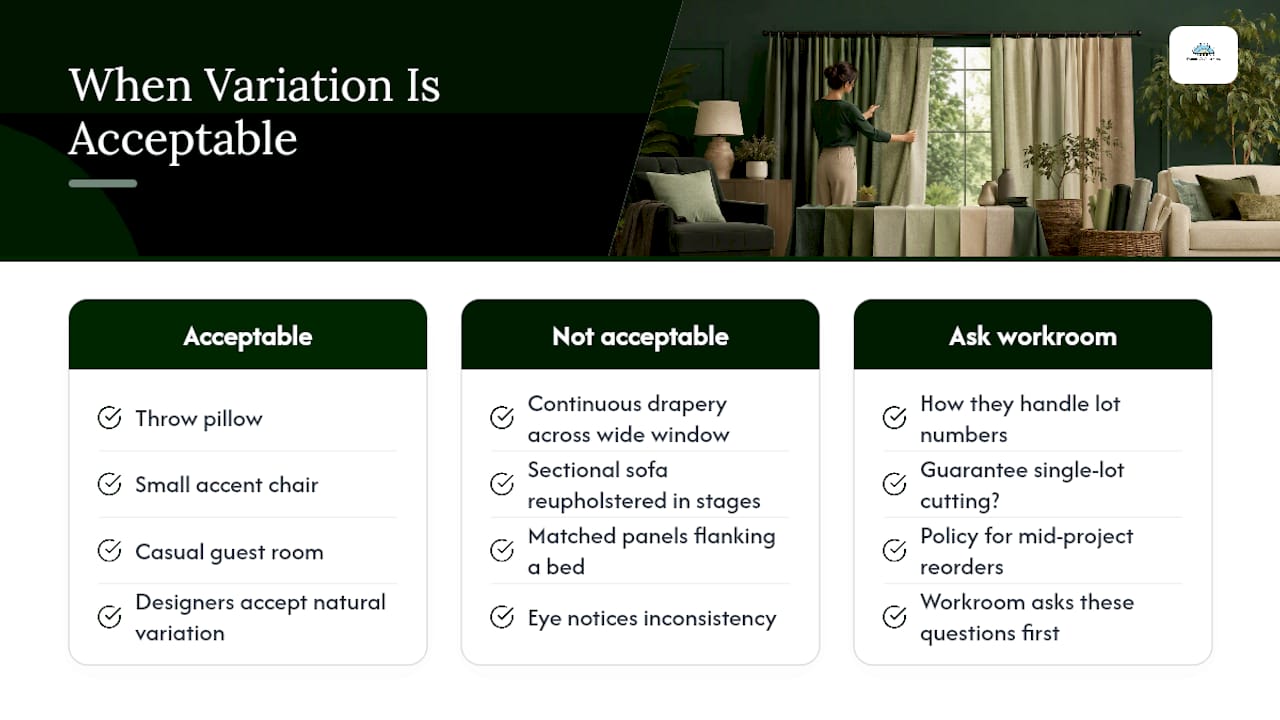
A single throw pillow, a small accent chair, or a casual guest room can absorb a little dye lot drift without anyone noticing. Continuous drapery across a wide window wall, a sectional sofa reupholstered in stages, or matched panels flanking a bed are a different story entirely, because the eye catches inconsistency instantly when fabric runs edge to edge. Designers often treat mild variation in natural fibers as part of their character rather than a flaw, but insisting on a perfect match across a large yardage order adds real cost and lead time you should plan for upfront.
Before committing to a large custom order, ask your designer or drapery workroom how they handle lot numbers, whether they can guarantee single-lot cutting, and what happens if a reorder is needed mid-project. A workroom that already asks these questions before you do is usually one that understands the stakes. Reviewing a few window treatment fabric tips for homeowners can help you know which questions matter most for your specific project.
Getting a Consistent Match Without the Guesswork
A careful workroom handles dye lot consistency by cutting custom drapery and panels from the same roll, checking fabric samples against actual room lighting before anything gets sewn, and addressing metamerism concerns during a design consultation rather than after the fact. If you’re ordering yardage for continuous drapery or matched upholstery, that single-lot handling protects the finished look far more than hoping two separate orders happen to align.
Start by requesting a physical sample through the fabric sampling process, so you can check the color against your walls, trim, and lighting before committing to yardage. From there, browse the full custom drapery and upholstery fabric collection or reach out through Beautifulwindowselgin to book a design consultation and confirm lot numbers before your order gets cut.
Sources
Readers who want the technical background behind lab dips, ΔE tolerances, and shade sorting can review the batch dyeing overview on Wikipedia, Datacolor’s ΔE tolerance guidance, and Metro Dyeing’s explanation of metamerism. Anyone weighing renovation timelines against interior finish choices may also find value in 121 Group’s interiors resources.
- Metamerism explained — Metro Dyeing
- Batch dyeing — Wikipedia
- Best practices for ΔE tolerances — Datacolor
- Dye lot variance: prevent fabric color mismatches — Global Fabric Wholesale
FAQ
What Is a Fabric Dye Lot?
A fabric dye lot is a specific batch of fabric dyed together in one production run, sharing the same dye bath, water, and timing. The Association for Contract Textiles defines it as a quantity dyed in a single run, and fabric from two different lots can show a visible color shift even under the identical color name.
What Is the Best Fabric Dye on the Market?
There’s no single “best” dye across all fabric types, since the right choice depends on the fiber, whether it’s cotton, polyester, or a blend, and the dyeing method the mill uses. What matters more for buyers is consistency control: asking whether the mill uses spectrophotometer measurement and shade sorting to keep rolls within a tight color range, regardless of which dye chemistry is behind it.
Where Can I Find the Dye Lot Number on Fabric?
The dye lot number is usually printed on the label attached to the bolt, roll, or skein, along with the color name or number. For custom fabric orders, ask your supplier to confirm the lot number in writing on your invoice or order confirmation before the fabric ships.
What Does “Dye Lot” Mean on a Fabric or Yarn Label?
It means every unit sharing that number came from the same dyeing batch, and pieces with different lot numbers, even in the same color name, may not match exactly. This is why buyers assembling drapery, upholstery, or any project needing continuous fabric should always confirm all their yardage carries a single matching lot number before cutting begins.