


Homeowners: 9 Embroidered Curtains Styles That Photograph Best by Room
Floral, botanical, geometric, sheer, blackout, velvet, vintage, minimalist, and cafe embroidery each solve a different problem for a window, from filtering light to blocking it entirely. Sheer embroidered panels suit rooms that need daylight and softness, while lined or blackout embroidered drapes fit bedrooms and media rooms where privacy and light control matter more. Custom drapery is built around whichever style fits your room, so the choice starts with function, not just pattern.
TL;DR:
- Embroidered sheer fabrics are ideal for rooms that need daylight and softness, while lined or blackout embroidered drapes provide privacy and light control for bedrooms and media rooms.
- Floral embroidery suits living and dining rooms, whereas botanical patterns work well in sunrooms and offices, with geometric embroidery fitting contemporary spaces.
- Proper fabric selection is critical, with linen, cotton, and organza bases offering different light, texture, and drape effects, and many textiles requiring dry cleaning due to delicate embroidery.
- Hardware and heading style significantly affect how embroidery appears, with eyelet for modern minimalism and pinch pleats for traditional, formal looks.
- Cost varies from lower-priced sheers to luxury velvet options, with custom drapery often costing 20-30% more to ensure pattern matching and tailored fit.
Table of Contents
- Embroidered Curtains Styles: A Room-By-Room Shortlist
- Which Fabrics Work Best For Embroidered Curtains?
- How Headings And Hardware Change The Way Embroidery Looks
- Caring For Embroidered Curtains Without Damaging The Stitching
- A Simple Checklist For Choosing Embroidered Curtains
- Choosing Embroidery Thread Colors And Textures
- Coordinating Embroidered Curtains With Your Room’s Decor
- What Embroidered Curtains Typically Cost
- Why Embroidery Still Earns Its Place On A Window
- Order Samples And Start Your Custom Drapery Project
- Sources
- FAQ
Embroidered Curtains Styles: A Room-By-Room Shortlist
Embroidery reads differently depending on the stitch scale, the base cloth, and the room it hangs in. Here are nine styles worth considering, along with where each one earns its keep.
-
Floral embroidery. Rose, peony, and vine motifs in mid-to-large scale stitching work best on cotton or linen blends, where the thread sits raised against a matte ground. Living rooms and dining rooms suit this style, especially layered over a plain Roman shade for contrast.
-
Botanical and foliage patterns. Leaf and branch motifs in a smaller, more graphic scale tend to appear on sheer bases, often across multiple colorways aimed at modern interiors. They work well in sunrooms or home offices where you want texture without heaviness. Pro Tip: Hang botanical sheers on a slim rod pocket rather than large rings; the motif reads cleaner without hardware competing for attention.
-
Geometric embroidery. Diamonds, lattice, and trellis stitching suit contemporary spaces and pair naturally with clean-lined furniture. Because the repeat is regular, geometric patterns are more forgiving to match across multiple panels than florals with irregular spacing.
-
Embroidered sheer or voile. This is the lightest option, built on organza or voile so daylight passes through the embroidered motif itself. Double-drop voile constructions create a soft, rounded movement that plain flat panels don’t achieve, according to fabric maker Camengo. Best for kitchens, breakfast nooks, and any room where you want privacy from direct sightlines but not from light.
-
Embroidered blackout or lined drapes. Here the embroidery sits on the face fabric while a blackout or thermal lining hides behind it, so the room gets full light control without sacrificing the decorative surface. Bedrooms and media rooms are the obvious fit. Pair with a wand-operated track for a cleaner stack when the panels are floor length.
-
Velvet or luxury embroidered drapes. Heavier stitching, often metallic or tonal thread, sits on velvet or velvet-blend bases for formal dining rooms and primary bedrooms. The pile of the velvet adds depth to the stitch shadow, which is part of why this style photographs so well in evening light.
-
Vintage or heritage panels. Damask-inspired scrollwork and paisley motifs, usually in a muted or tonal thread color, suit older homes or rooms with traditional millwork. These tend to look best in longer lengths that puddle slightly rather than break at the sill.
-
Minimalist or linear embroidery. A single line, a thin border, or a subtle dot pattern gives texture without pulling focus from other decor. This style works in small bedrooms and apartments where a bold print would overwhelm the space.
-
Cafe or short embroidered curtains. Hung at sill height, these work in kitchens and bathrooms where full-length panels aren’t practical. Because they cover less window, a bolder embroidery scale reads well without dominating the room.
Current trends favor full-length panels and cafe curtains at opposite ends of the spectrum, with prints and textured fabrics making a comeback after several seasons of plain linen. Embroidery gives you that pattern without the visual weight of a printed heavy drape, which is part of why it works in both traditional and contemporary rooms.
Which Fabrics Work Best For Embroidered Curtains?
The base fabric determines how the stitching reads, how much light passes through, and how the panel drapes at the floor. Choosing the wrong base is the most common reason embroidered curtains look flat in photos but disappointing on the wall.
- Linen: Textured and slightly irregular, linen gives embroidery a handmade look and holds structure well in mid-weight panels.
- Cotton: A stable, budget-friendly base where stitches sit crisp and even, good for floral and geometric patterns.
- Organza, voile, and sheer: Lightweight and translucent, these bases let light filter through the embroidered motif itself, creating a shadow effect on the floor and walls.
- Polyester blends: More resistant to fading and wrinkling, often used where embroidered panels see direct sun exposure.
- Velvet: Dense and heavy, velvet grounds the embroidery in shadow and texture, best suited to formal rooms rather than sheer applications.
Embroidered sheer fabric deserves its own mention because it behaves so differently from a lined panel. A sheer base is the right call when you want daylight and a decorative silhouette; a lined panel is the right call when privacy or insulation matters more than light transmission. Many premium embroidered sheers and mixed-fiber embroidered textiles carry a dry clean recommendation from the manufacturer, since delicate threadwork and mixed-fiber substrates can shrink or snag in a home washing machine. That single label on a fabric swatch tells you more about long-term care than almost anything else on the tag.
How Headings And Hardware Change The Way Embroidery Looks
The heading style you choose changes how a pattern reads across the width of the window, not just how the panel hangs.
- Eyelet (grommet) headings create soft, even folds and work well with geometric or minimalist embroidery, where consistent spacing matters more than dramatic fullness.
- Pencil pleat headings gather fabric into a tighter, more traditional fold, suited to floral and vintage embroidered panels.
- Double pinch pleat gives a tailored look with visible embroidery between folds, good for mid-weight linen or cotton bases.
- Triple pinch pleat adds more fullness and a more formal silhouette, often chosen for velvet or luxury embroidered drapes in dining rooms.
Pleat and heading choice materially affects how much fullness a curtain shows and how continuous a pattern appears across multiple widths. A rod tends to show off eyelet headings and their consistent folds, while a track disappears behind pinch-pleated panels for a cleaner ceiling-to-floor line. If you want the technical side of pleat selection, the guide on pleat styles for every room breaks down which heading suits which fabric weight, and the curtain heading guide covers hardware pairing in more depth.
Caring For Embroidered Curtains Without Damaging The Stitching
Delicate threadwork on mixed-fiber bases, like linen-rayon blends, is prone to shrinkage and stitch distortion in hot water or high-heat drying. That is why professional textile finishers frequently recommend dry cleaning for these constructions rather than home laundering. If a fabric care label lists dry clean only, treat that as a real constraint, not a suggestion, especially on beaded or heavily raised embroidery.
For washable embroidered panels, gentler handling protects the stitching:
- Use a cold, gentle machine cycle or hand wash in cold water.
- Place the panel in a mesh laundry bag to reduce friction against the embroidery.
- Lay flat or hang to air dry rather than using a dryer, which can loosen stitches.
- Treat stains immediately with a mild detergent and cold water rather than letting them set.
Pro Tip: Keep any leftover fabric swatch from your order and test cleaning methods on it first. A hidden corner of the actual panel works too, but a saved swatch means you’re not risking the curtain itself.
A Simple Checklist For Choosing Embroidered Curtains
Before you order fabric or book a custom drapery consultation, work through these steps in order:
- Define the primary function. Decide whether you need light control, privacy, insulation, or purely decorative texture, since that determines sheer versus lined.
- Measure carefully. Account for both length and fullness; embroidered panels typically need 2 to 2.5 times the rod width to hang properly.
- Match embroidery scale to window size. Small windows suit fine or linear embroidery; large windows can carry bolder floral or botanical motifs without looking busy.
- Choose lining or blackout backing if the room needs light control, and confirm this before ordering yardage.
- Request a fabric sample before committing to yardage, since thread color and stitch detail often look different under real window light than on a screen.
- Consult a fabric specialist for large windows or intricate repeats, since pattern matching across multiple panels can require extra yardage depending on the repeat size.
Choosing Embroidery Thread Colors And Textures
Thread color does more work than most homeowners expect. A tonal thread, meaning a shade close to the base fabric color, gives a subtle, textural effect that reads as sophisticated rather than busy. A contrasting thread, like cream embroidery on a deep navy ground, turns the curtain into a focal point rather than a background element.
Metallic threads catch light and add formality, which makes them a natural fit for dining rooms and evening-lit spaces, but they can look out of place in a casual sunroom. Matte cotton or rayon threads sit quieter and suit everyday rooms like kitchens and home offices. Texture matters as much as color: raised satin-stitch embroidery casts a visible shadow and reads as more dimensional, while flat stitching stays closer to the surface of the fabric and photographs more subtly.
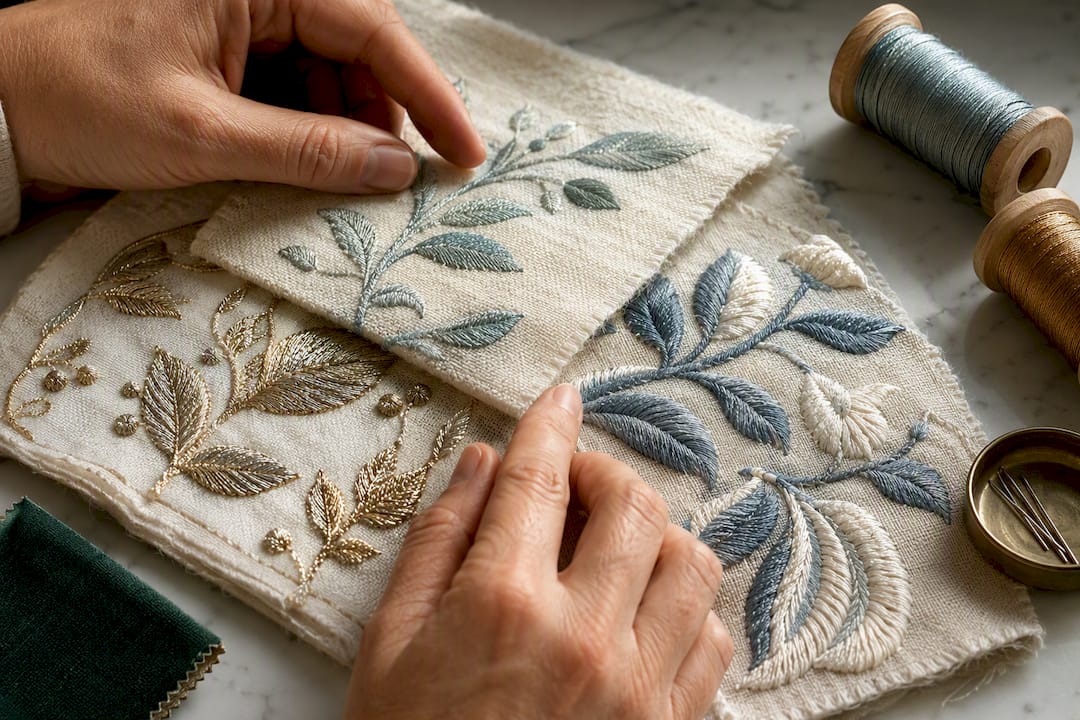
If you’re torn between two thread colors, hold the sample against your existing curtain rod, trim, and wall color at different times of day. Thread that looks perfect under a showroom light can shift noticeably under warm evening lamps or cool north-facing daylight. Designers frequently recommend ordering a swatch rather than a full panel specifically to check how thread color and light interact before committing to yardage.
Coordinating Embroidered Curtains With Your Room’s Decor
The safest coordination rule is to let the embroidery repeat one color already present in the room, whether that’s a throw pillow, a rug border, or an accent wall. This keeps the curtain connected to the rest of the space instead of looking like an afterthought. If your furniture and walls are already patterned, a smaller-scale or tonal embroidered curtain avoids visual competition; if your room leans minimal, a bolder floral or botanical panel can become the room’s signature piece.
Pattern matching goes beyond color. A geometric embroidered curtain works with a room full of straight lines and modern furniture, while a vintage scrollwork panel fits better against traditional molding, wood furniture, or an antique rug. Mixing a heavily patterned embroidered curtain with a heavily patterned upholstery fabric usually overwhelms a room, so pick one dominant pattern and let the other elements stay simpler.
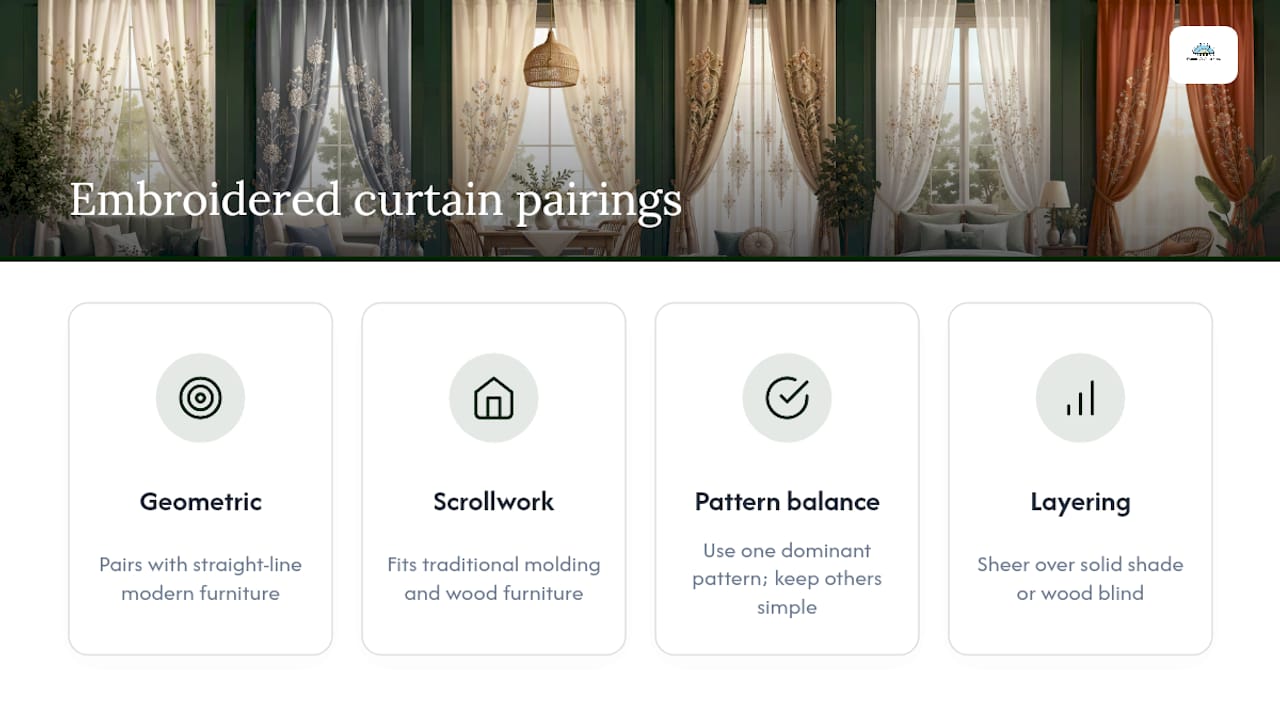
Layering also plays into coordination. Pairing an embroidered sheer with a solid roman shade or wood blind behind it gives you privacy control without hiding the embroidery, and it lets the sheer’s pattern stay the visual highlight rather than competing with a second patterned layer.
What Embroidered Curtains Typically Cost
Price varies with base fabric, embroidery density, and whether you buy off-the-shelf panels or commission custom drapery. Sheer embroidered voile tends to sit at the lower end of the range since the base fabric itself is lightweight and less material intensive. Cotton and linen embroidered panels cost more as stitch density increases, since dense floral or botanical embroidery takes longer to produce than a simple linear pattern.
Velvet-based luxury embroidered drapes sit at the top of most budgets, driven by both the heavier base fabric and typically more elaborate stitching. Lined or blackout embroidered panels also cost more than an unlined equivalent, since you’re paying for two layers of fabric and construction instead of one.
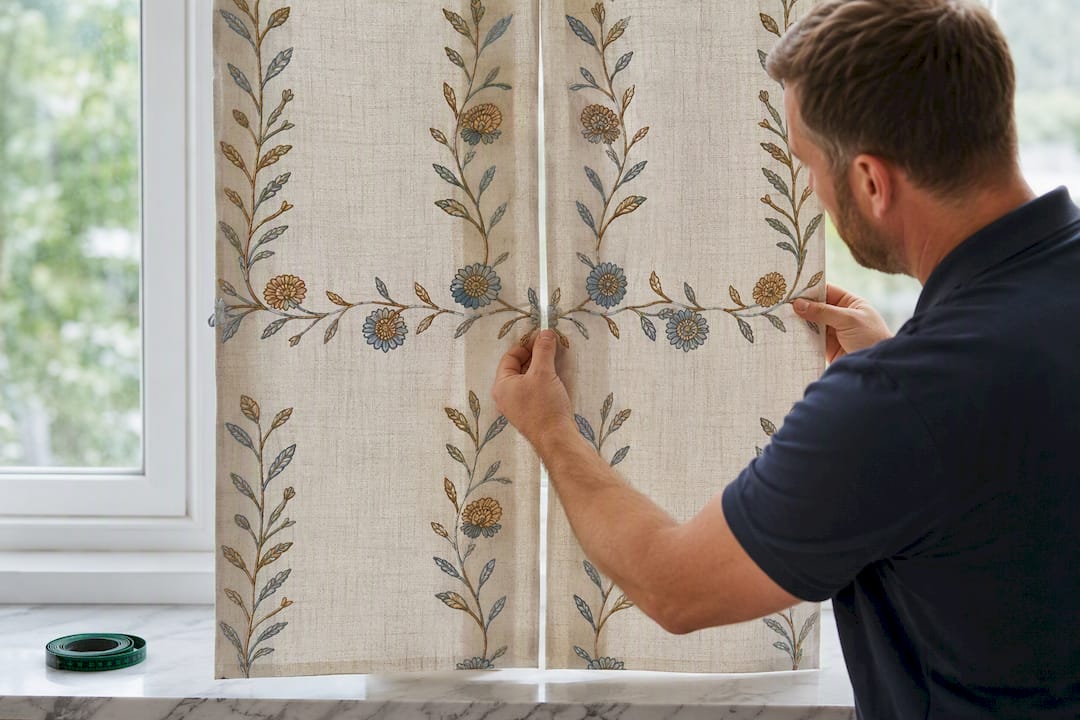
Custom drapery service adds cost over ready-made panels, but it solves problems ready-made curtains can’t, like large windows that need extra yardage for pattern matching or nonstandard drop lengths. If a large window means matching horizontal and vertical repeats across multiple panels, budget for up to 20 to 30 percent more yardage than the window measurement alone suggests. That extra material cost is almost always cheaper than a mismatched seam running down the middle of your window.
Why Embroidery Still Earns Its Place On A Window
Embroidered curtains hold up as a style choice because the pattern comes from thread and structure, not printed dye that can fade unevenly over years of sun exposure. The base fabric decision matters more than most homeowners realize going in. A stunning floral motif on the wrong sheer will look thin and cheap, while the same motif on a well-chosen linen blend looks intentional and lasting.
Beautifulwindowselgin’s embroidered fabric collection includes fabric samples, custom drapery services, and nationwide shipping, which matters when you’re trying to judge thread color and stitch detail before committing to a full order. Getting that base fabric right, with proper care after installation, is what separates curtains that still look sharp in five years from ones that fade into background clutter.
— Marrion
Order Samples And Start Your Custom Drapery Project
This retailer offers a curated collection of designer embroidered fabrics by the yard, with one-on-one design consultation rather than a generic online cart experience. That personal guidance matters most when you’re choosing between sheer and lined embroidered options, or trying to match a repeat across a wide bay window.
Start by browsing the embroidered fabric collection to see available patterns, from botanical sheers to floral eyelet designs like the Embroidery Eyelet Floral Fabric. From there, request fabric samples to check thread color and light transmission in your own room before ordering yardage. If your project involves a large window, an irregular repeat, or a specific pleat style, the custom drapery service includes design consultation and professional installation guidance, so pattern matching and hardware selection get handled by someone who works with these fabrics daily. Visit the Beautifulwindowselgin site to request a consultation and get your project moving.
Sources
- Curtain ideas: 16 styles and tips for every room in the home | Homes and Gardens
- Gabriella Embroidered Sheer | Ivory – Schumacher Italia
- Camengo Limpide Embroidered Sheer Curtain Fabric | Studio198 London
- Botanical Embroidered Sheer Fabric » Kingdom Of Curtains
FAQ
What is the curtain trend for 2026?
Full-length panels and cafe-style curtains are both trending at opposite ends of the spectrum, with a notable return to prints and textured fabrics after several seasons dominated by plain linen.
What are the different types of embroidery design?
Common design categories include floral, botanical or foliage, geometric, vintage scrollwork, and minimalist linear embroidery, each suited to different stitch scales and base fabrics.
What is trending in curtains right now?
Textured and embroidered fabrics are trending because they add pattern without the visual weight of a printed heavy drape, working equally well in traditional and contemporary rooms.
What are the different types of curtain styles?
Beyond embroidery, curtain styles are generally categorized by heading type (eyelet, pencil pleat, pinch pleat), by length (full length, cafe, sill length), and by function (sheer, lined, blackout).
Are embroidered curtains hard to clean?
Many embroidered sheers and mixed-fiber embroidered fabrics carry a dry clean recommendation from the manufacturer, though some sturdier cotton-based panels tolerate a gentle cold-water wash when air-dried.
Does Beautifulwindowselgin offer custom embroidered curtains?
Yes, Beautifulwindowselgin sells embroidered fabric by the yard through its embroidered fabric collection and offers custom drapery making with design consultation and installation guidance.