

Railroaded Fabric: Workroom Checklist for Homeowners & Designers
Railroaded fabric runs its pattern across the roll, selvage to selvage, instead of down its length. Choose it when a project calls for a horizontal pattern flow or when you need to cover a wide surface, like a sofa back or a sectional face, without piecing seams into the design. For most drapery projects, the standard “up the roll” orientation still wins, but always confirm orientation with swatches before you cut.
TL;DR:
- Railroaded fabric runs pattern or stripes across the width of the roll, making it ideal for wide upholstery surfaces like sofas and sectionals to avoid seams.
- Confirm fabric orientation beforehand by examining the selvage and pattern, asking vendors directly, or requesting detailed swatches with pattern arrows.
- Large pattern repeats can increase waste and matching complexity when rotated sideways, especially if the pattern’s scale and repeat size are not carefully measured.
- Upholstery benefits from railroaded yardage when pattern continuity enhances the visual flow, while most drapery projects prefer up-the-roll orientation for verticality.
- Proper planning and explicit communication with the workroom about fabric orientation can prevent costly mistakes and ensure the pattern flow matches the project’s design intent.
Table of Contents
- What Does Railroaded Mean in Fabric?
- Why and When Should You Choose Railroaded Fabric?
- How Can You Tell If a Fabric Is Railroaded Before You Buy?
- How Does Railroading Affect Yardage and Seams?
- Upholstery vs. Window Treatments: How Orientation Changes the Look
- What Should You Tell the Workroom When You Order?
- How Beautifulwindowselgin Helps You Avoid Orientation Mistakes
- Caring for Railroaded Fabric After It’s Installed
- What the Research Actually Supports
- Ready to Confirm Your Fabric’s Orientation?
- Sources
- FAQ
What Does Railroaded Mean in Fabric?
Railroaded fabric has its pattern or stripe running perpendicular to the selvage, meaning it travels across the width of the roll rather than down its length. Most decorator fabrics run the opposite way, called “up the roll,” where the pattern moves parallel to the selvage, the same direction the fabric was woven and printed on the loom.
You can spot the difference by looking at how a stripe or motif sits relative to the fabric edges:
- Up the roll: Stripes and motifs run vertically, parallel to the selvage, the traditional orientation for most yardage.
- Railroaded: Stripes and motifs run horizontally, perpendicular to the selvage, so the pattern reads sideways when the bolt is unrolled flat.
- Directional naps: Velvet, chenille, and other pile fabrics have a nap direction that changes how light reflects off the surface, so orientation on these materials affects appearance and feel, not just the pattern.
Reading a bolt takes practice at first. Once you know to check the selvage edge against the pattern direction, you’ll never mistake one orientation for the other again.
Why and When Should You Choose Railroaded Fabric?
Railroading solves a specific problem: wide surfaces that would otherwise need pieced seams to cover. Here’s how to decide which orientation fits your project.
- Choose railroaded for upholstery on wide furniture. Sofas, sectionals, and headboards benefit because railroading removes the need for seams across broad pieces, keeping a stripe or pattern flowing cleanly across the entire face.
- Stick with up-the-roll for most drapery. Floor-to-ceiling curtains and Roman shades usually look better with a vertical pattern flow, since up-the-roll orientation prevents awkward horizontal seams in tall panels.
- Consider railroaded drapery only for very wide windows. If a single window or a wall of glass exceeds standard fabric width, railroading can occasionally deliver a seam-free panel where up-the-roll would force a horizontal join instead.
- Watch pile direction on velvet and chenille. Even when the pattern favors railroading, a directional nap can look shaded or off-color if it’s turned the wrong way, so check both factors before committing.
Every project has its own math. A tufted bench seat and a bay window curtain rarely call for the same answer.
How Can You Tell If a Fabric Is Railroaded Before You Buy?
Product listings don’t always spell out orientation clearly, so you’ll need to check a few details before you order.
- Search the product description or spec sheet for the word “railroaded” or “railroad,” since vendors sometimes label this directly but often bury it in fine print.
- Zoom in on listing photos to see which way the selvage runs relative to the printed or woven pattern.
- Request a swatch large enough to show both the selvage and a full pattern repeat, not just a small cutting.
- Ask the vendor directly: “Does this bolt run up the roll or railroaded?” A specific question gets a specific answer faster than a general inquiry.
- Confirm the fabric’s usable width and pattern repeat measurement at the same time, since both affect your yardage math later.
Pro Tip: If a vendor’s answer feels vague, ask them to snap a photo of the bolt with an arrow drawn on it showing which way the pattern runs. It takes them thirty seconds and eliminates almost all guesswork.
How Does Railroading Affect Yardage and Seams?
Orientation changes how much fabric you actually need, sometimes by a wide margin.
Railroaded fabric can reduce total seams on wide upholstery pieces because one continuous run covers the entire width of a sofa back or cushion face without piecing. That’s a real savings in labor and a real gain in appearance, since a pattern that flows unbroken across a piece looks intentional instead of stitched together.
But railroading isn’t automatically more efficient. When a fabric’s pattern repeat is large, turning it sideways can force extra matching at seams that wouldn’t have been necessary running up the roll, which increases offcuts and waste. A wide stripe that repeats frequently, for instance, behaves very differently once it’s rotated 90 degrees.
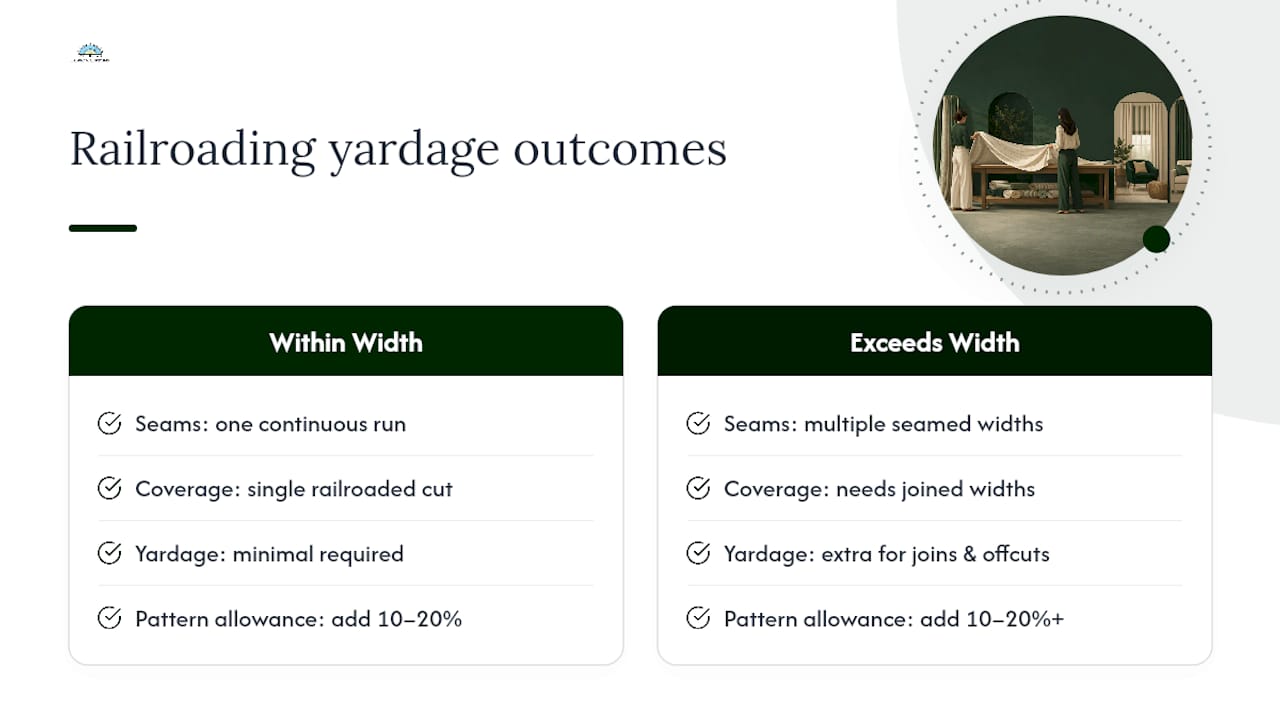
A simple rule of thumb helps here: measure the total horizontal coverage your project needs, whether that’s the width of a sofa back or the span of a window wall, and compare it to the fabric’s usable width. If your horizontal measurement is close to or under the fabric width, one railroaded cut may cover the whole surface. If it exceeds the fabric width, you’ll need multiple widths seamed together, plus extra yardage for pattern matching at each join. Add 10% to 20% for repeat allowance on any patterned yardage, more for large-scale prints.
Upholstery vs. Window Treatments: How Orientation Changes the Look
The same bolt of fabric can look like two different products depending on which way it’s turned.
- Sofas and sectionals read best railroaded when the piece is wide and the pattern is directional, since the stripe or motif carries across cushions and the front rail without interruption, creating a clean horizontal line across the entire seating face.
- Headboards and wide cushions benefit the same way. A pattern that flows continuously across a headboard face looks custom, while a seamed one looks assembled.
- Curtains and floor-length drapery generally look taller and more formal up the roll, since a vertical stripe or motif draws the eye upward and emphasizes ceiling height, which is exactly what most drapery clients want.
- Roman shades and valances follow the same logic as drapery in most cases, though a railroaded fabric with a strong horizontal stripe can work well on a shade that stays mostly flat against the window.
A wide sectional in a bold stripe almost always calls for railroaded yardage. Floor-to-ceiling panels in a formal living room almost always call for up-the-roll. Everything in between deserves a second look at the pattern scale and the room’s proportions.
What Should You Tell the Workroom When You Order?
Miscommunication here is the single most common cause of costly cutting mistakes. A clear order sheet protects your project and your budget.
- State the orientation explicitly: “railroaded” or “up the roll,” never left to assumption.
- List the fabric’s usable width and pattern repeat measurement in inches.
- Note nap direction if the fabric has a pile, so the workroom cuts every panel the same way.
- Describe the desired visual flow in plain language, such as “stripes run left to right across the sofa face.”
- Attach an annotated swatch or photo showing exactly which direction the pattern should run.
- Confirm final yardage including pattern-match allowance before any cutting begins.
Pro Tip: *Get written sign-off on orientation before the workroom cuts a single yard. Standard workroom practice puts the final call on the designer or client, and a five-minute confirmation email costs nothing compared to re-ordering fabric after a cutting error.
How Beautifulwindowselgin Helps You Avoid Orientation Mistakes
A specialized retailer stocks designer fabrics by the yard and supports custom drapery projects from consultation through installation. This structure matters here because orientation questions are easiest to solve before fabric ever gets cut.
Swatches from Beautifulwindowselgin let you check selvage direction and pattern repeat in hand, not just on a screen, before committing to yardage. The site’s design consultations walk through orientation, width, and repeat matching as part of the ordering process, and nationwide shipping means homeowners and workrooms outside Columbia get the same swatch-first approach. Installation guidance can help readers who want a second set of eyes before cutting begins.
Caring for Railroaded Fabric After It’s Installed
Orientation affects how a fabric wears just as much as how it looks. On upholstery, a railroaded pattern often runs across the highest-friction zones, like the front edge of a cushion or the arm of a sofa, so those areas can show wear or fading unevenly compared to a fabric run up the roll. Rotate reversible cushions periodically to even out sun exposure and abrasion, since a horizontal stripe will telegraph any fading faster than a busy print would.
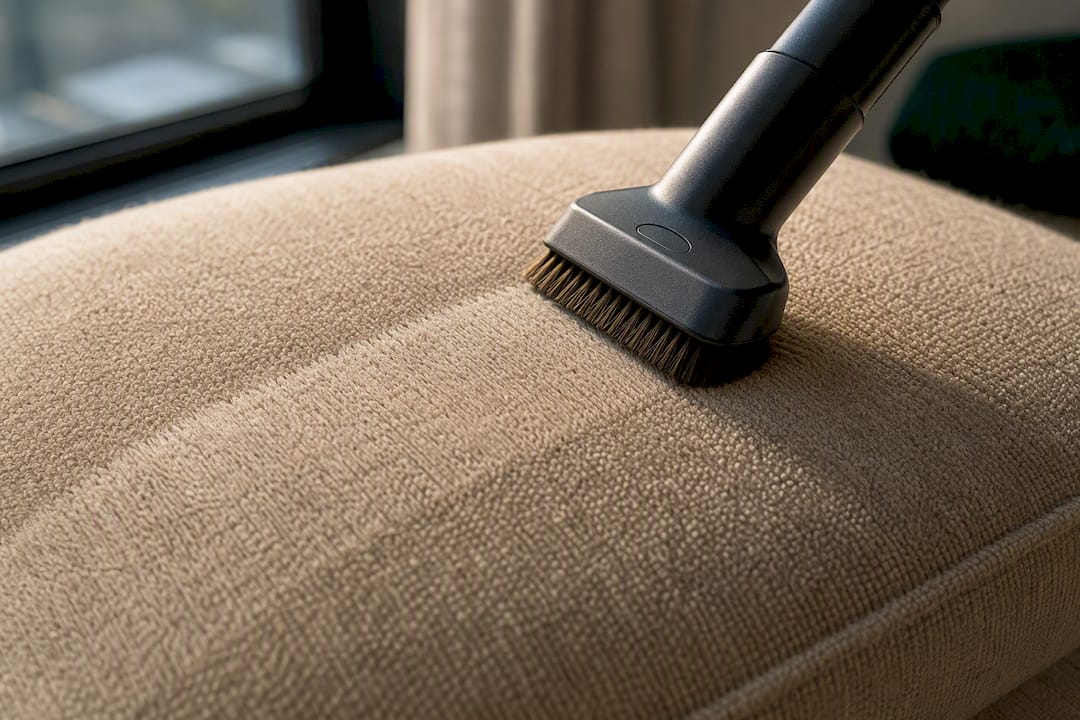
Vacuum upholstery with a soft brush attachment in the direction the fibers lie, especially on velvet or chenille where the nap was chosen deliberately for a railroaded layout. Brushing against the nap on these materials can leave visible streaks that look like discoloration but are really just crushed pile catching light differently.
For window treatments, railroaded panels on very wide windows carry more visible fabric per panel than a seamed alternative, which means dust and sun exposure show up across a larger continuous surface. Vacuum drapery panels regularly with a low-suction attachment, and rotate or swap panels between rooms with different light exposure if your budget allows it, since UV fading happens unevenly depending on window orientation.
Always check the care label rather than assuming all railroaded fabrics clean the same way. A railroaded cotton print and a railroaded chenille upholstery weight can call for entirely different cleaning methods, regardless of how similar the pattern looks on the bolt.
What the Research Actually Supports
Most articles on railroaded fabric treat it like a trivia fact: here’s a term, here’s a definition, good luck. That undersells how much orientation decisions cost when they go wrong. A sofa cut with the wrong orientation isn’t a small fix. It’s yards of fabric, workroom labor, and weeks of lead time, gone.
The conventional advice to “just check if it’s railroaded” misses the harder part: pattern scale and nap direction change the calculus project by project. A small check print behaves nothing like a 30-inch stripe repeat once you rotate it 90 degrees, and no generic checklist accounts for that automatically. You have to look at your specific fabric and your specific piece.
If you take one thing from this, prioritize the swatch-and-confirm step over speed. Homeowners and even experienced upholsterers rush past this because it feels like a formality. It isn’t. Confirming orientation in writing before cutting is the cheapest insurance in the entire project, and it’s the step most likely to get skipped under deadline pressure.
— Marrion
Ready to Confirm Your Fabric’s Orientation?
The retailer provides a direct path to check orientation before committing to yardage, instead of guessing from a listing photo and hoping for the best. Requesting a swatch lets you see the selvage and pattern repeat in hand before a single yard gets cut.
Browse designer drapery fabrics for room-high, seam-reducing options, or check the upholstery fabric collection if your project calls for a wide sofa or sectional run. If you’re not sure how much yardage your project needs once orientation is factored in, the window treatment measurement guide walks through exactly what to measure before you order. Request a swatch or book a consultation today to confirm orientation and yardage before you cut.
Sources
Technical claims in this article draw on the Pindler educational guide to railroaded fabric, the Eastern Accents comparison of up-the-roll and railroaded fabric, and Materialised’s explanation of railroading and wide-width fabric. Each source addresses orientation, wide-width considerations, or workroom practice in more depth than covered here.
- Pindler — Railroaded (educational PDF)
- Eastern Accents — What are ‘Up the Roll’ & ‘Railroaded’ Fabrics?
FAQ
What Does It Mean for a Fabric to Be Railroaded?
Railroaded means the pattern or stripe runs across the roll, perpendicular to the selvage, rather than down its length. It’s commonly used in upholstery to avoid seams on wide pieces like sofas and sectionals.
What Does It Mean When Fabric Is Not Railroaded?
A fabric that isn’t railroaded runs “up the roll,” with the pattern parallel to the selvage. This is the standard orientation for most drapery and bedding, since it maintains vertical flow and avoids horizontal seams in tall panels.
What Type of Fabric Is Commonly Shown Railroaded?
Striped and patterned upholstery fabrics are shown railroaded most often, since designers prefer this orientation for wide furniture faces. Velvet and chenille are also frequently railroaded, though their nap direction needs separate confirmation from the pattern orientation.
What Is the Difference Between Up-the-Roll and Railroaded Fabric?
Up-the-roll fabric has its pattern running parallel to the selvage, the traditional direction for most yardage. Railroaded fabric runs perpendicular to the selvage, creating a horizontal emphasis that suits wide upholstery better than tall drapery.
Can I Use Railroaded Fabric for Curtains?
Yes, though it’s less common. Railroaded fabric works for curtains mainly on very wide windows where a single panel needs to span more width than height, but most floor-to-ceiling drapery still looks better up the roll.