


Flat Panel Curtains: Definition, Styles, and How to Hang Them
TL;DR:
- Flat panel curtains are unpleated fabric panels that showcase full pattern and texture visibility. They offer a minimalist silhouette, require precise measurement, and are customizable with various hanging systems. Their simplicity allows for easy adjustments, tailored fabric choices, and flexible layering options.
A flat panel curtain is a single, hemmed fabric panel with a plain front header that forms its pleats on the rod or track rather than being sewn in at the factory. The front face reads completely smooth, which means the fabric’s pattern, weave, and texture stay fully visible from top to bottom. That uninterrupted surface is the defining quality that separates flat panels from pinch-pleated, goblet, or pencil-pleat styles.
Choose flat panels when you want to:
- Showcase a pattern or textured weave without pleats interrupting the design
- Achieve a clean, minimalist silhouette that suits contemporary and transitional interiors
- Reduce stack-back so panels clear the glass more fully when drawn open
The practical benefits are equally clear: flat panels are straightforward to measure, easy to adjust after hanging, and compatible with a wide range of hardware from simple rings to concealed track systems.
Table of Contents
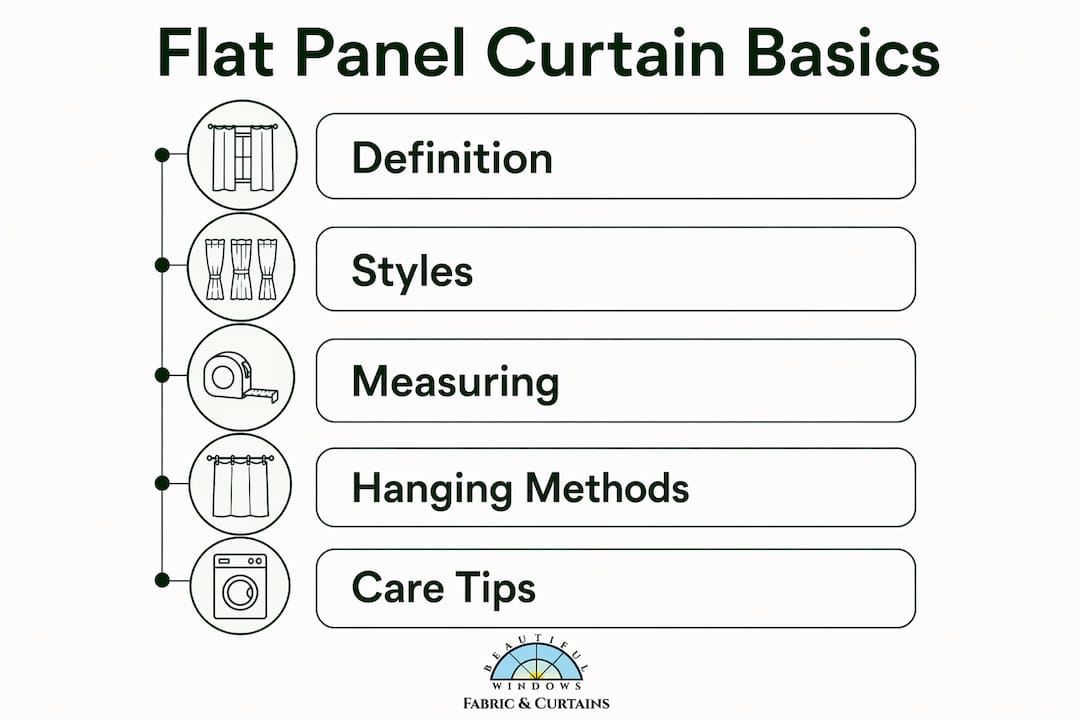
- What are flat panel curtains, and how do they read on a window?
- How flat panel curtains are made — anatomy and construction
- Four ways to hang flat panel curtains
- How to measure for flat panel curtains
- How to hang flat panel curtains — step-by-step installation
- Choosing fabric and lining for flat panel curtains
- Care, alterations, and what to expect after ordering
- Beautifulwindowselgin — how we help with custom flat panel curtains
- Key Takeaways
- Why flat panels are worth getting right
- Order samples or see your fabric before you commit
- Useful sources and further reading
What are flat panel curtains, and how do they read on a window?
A flat panel curtain hangs from a rear header tape or concealed fastening, keeping the front face entirely smooth. Unlike pinch-pleated panels, which have fabric folded and stitched into fixed groupings, flat panels distribute their fullness evenly across the rod or track. The result is a soft, continuous wave rather than structured, repeated folds.
Common configurations include:
- Single panel covering one window or used as a room divider
- Paired panels hung on a double bracket, one per side, meeting at center
- Sheer under flat panel on a double track, layering light filtration with a decorative face fabric
- Double-track setups that allow independent operation of two layers
Compared to pleated styles, flat panels use less fabric per finished width, stack back more compactly when open, and keep pattern repeats readable across the full panel width. Grommet-top curtains share the flat-front look but create fixed, evenly spaced loops rather than a freely adjustable gather. For window treatment terminology that covers all header types in one place, that reference is worth bookmarking before you order.
How flat panel curtains are made — anatomy and construction
Every flat panel is built from the same core components, and understanding each one helps you specify a custom order accurately.
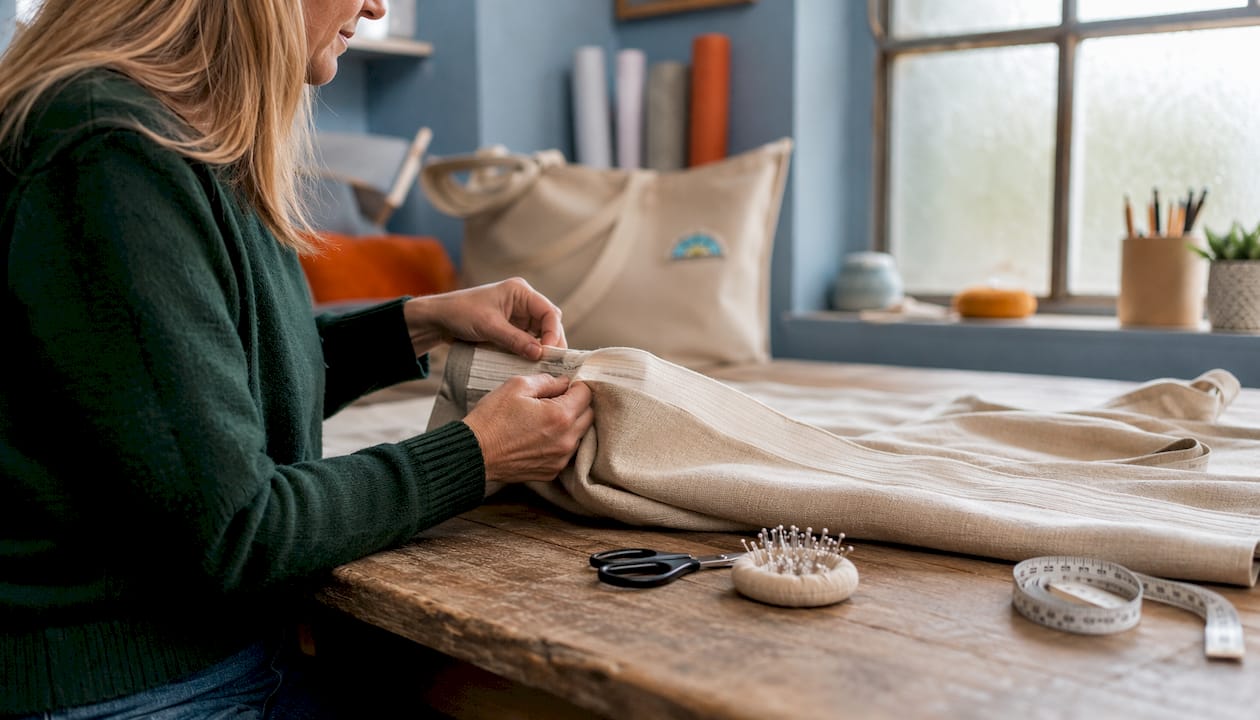
Anatomy at a glance:
| Component | Description | Effect on hang and look |
|---|---|---|
| Front header | Plain, unstitched top edge | Smooth face; no visible pleating |
| Rear header tape | Woven tape sewn to back of top hem | Accepts hooks or pins; sets pleat spacing |
| Top hem | Folded and stitched top edge | Stabilizes header; hides raw edge |
| Side hems | Narrow turned and stitched edges | Prevents fraying; frames panel width |
| Bottom hem | Deep blind-stitched or weighted hem | Adds weight for clean drape |
| Chain weights | Optional lead or steel chain in bottom hem | Keeps lightweight fabrics hanging straight |
Construction choices that change the result:
- Unlined panels are lighter and let more light through; best for sheers or casual rooms
- Privacy lining adds opacity and a modest degree of thermal insulation
- Thermal interlining (a layer of bump or domette between face and lining) produces a fuller, more luxurious drape and meaningfully improves energy performance; see how thermal linings affect energy savings for specifics
- Blackout lining blocks nearly all light and is the standard choice for bedrooms
The rear header tape type also matters. Standard pencil-pleat tape creates shallow, even gathers. Heading tape with wider hook pockets allows deeper, more spaced pleats. Because pleat depth is adjustable by changing hook or pin spacing on the rear tape after the panel is made, you can fine-tune the look at install time without re-cutting fabric.
Pro Tip: When inserting drapery pins, separate the rear header tape from the face fabric and weave the pin through the tape only. A pin that pierces the front fabric will show as a visible puncture and can permanently damage delicate weaves.
Four ways to hang flat panel curtains
The hanging method determines how the panel moves, how it stacks, and what hardware you need.
1. Drapery pins and rings Pins insert into the rear header tape at measured intervals, then hook onto curtain rings on a rod. This is the most common DIY method, produces a clean gathered look, and works on virtually any pole diameter. The main limitation is that the rod must be accessible from the front to thread rings.
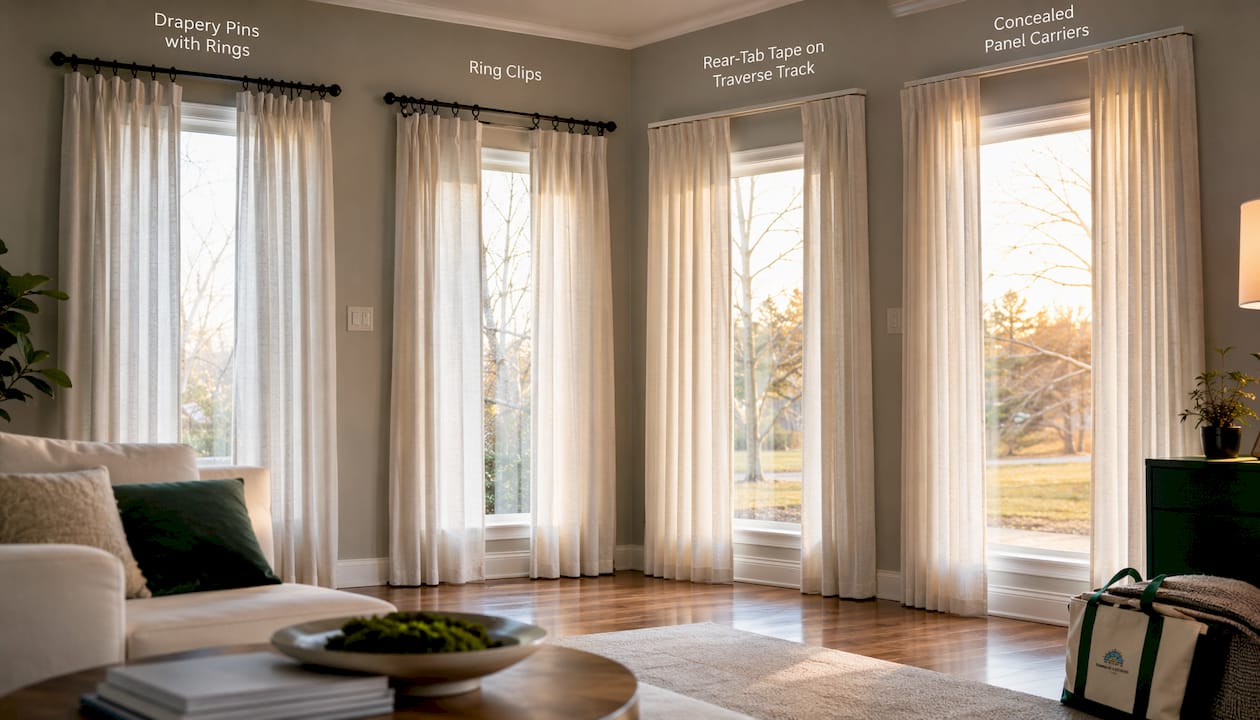
2. Ring clips Clips grip the top edge of the panel directly, no header tape required. They suit lightweight fabrics and panels without a sewn tape, and they’re easy to reposition. The trade-off is that clips can distort a thin top hem over time if the fabric is heavy.
3. Rear-tab or pencil-pleat tape on a traverse track The panel’s header tape hooks directly onto carriers inside a traverse or corded track. This method is ideal for wide windows, heavy fabrics, and situations where you want the panel to draw with a cord or wand rather than by hand. Stack-back is compact because the carriers slide within the track profile.
4. Concealed panel carriers Systems like Interstil’s F1 use a carrier that sits behind the rail, attaching to the panel via Velcro or a sewn channel. The carrier stays completely hidden, producing a continuous, minimalist look with no visible hardware. These systems can be ceiling- or wall-mounted and include weighting options to keep panels falling straight, making them the preferred choice for room dividers and long sliding applications.
Pro Tip: For panels wider than 60 inches or used as room dividers, space carriers every 10–12 inches rather than the standard 15–20 inches. Closer spacing prevents the panel from sagging between support points, especially with heavier drapery-weight fabrics.
How to measure for flat panel curtains
Accurate measuring prevents the two most common ordering mistakes: panels that look sparse because they’re too narrow, and panels that puddle awkwardly because the length is off.
Width formula:
- Measure the pole or track width in inches
- Multiply by your chosen fullness multiplier (1.5x to 2x) to get total fabric width
- Divide by the number of panels to get the cut width per panel
- Add 4 inches per panel for side hem allowances
Example: A 72-inch window with 2x fullness needs 144 inches of fabric total. Two panels means 72 inches each, plus 4 inches for hems = 76-inch cut width per panel.
Length options:
| Style | Measurement rule |
|---|---|
| Sill length | Measure from rod to sill; subtract an inch for clearance |
| Below-sill | Measure from rod to 4–6 inches below sill |
| Floor length | Measure from rod to floor; subtract an inch |
| Puddle | Measure from rod to floor; add 4–8 inches |
| Ceiling to floor | Mount rod 4–6 inches from ceiling; measure to floor |
Pin and clip spacing:
Standard spacing runs 10–20 cm. Spacing of 10–15 cm produces shallower, denser gathers; 17–20 cm creates deeper, more pronounced waves. For most residential windows, 10–15 cm is a reliable starting point that balances visual rhythm with fabric consumption.
Pro Tip: Always measure each window individually, even when windows appear identical. Frame widths and floor levels vary by fractions of an inch that compound into visible differences once panels are hung.
How to hang flat panel curtains — step-by-step installation
Hardware checklist:
- Rod or track with brackets
- Curtain rings (if using pin method) or ring clips
- Drapery pins or Velcro tape (for concealed carrier systems)
- Screws and wall anchors rated for the bracket load
- Level, measuring tape, and pencil
Step-by-step process:
- Mark bracket positions at equal heights on both sides of the window, using a level to confirm alignment.
- Drill pilot holes and install wall anchors if mounting into drywall; drive screws and attach brackets.
- Lay the panel face-down on a clean, flat surface. Locate the rear header tape.
- Insert drapery pins into the header tape at your chosen spacing (4–6 inches is standard), weaving each pin through the tape only, never through the face fabric.
- Hook each pin onto a curtain ring, then slide all rings onto the rod before mounting it on the brackets.
- Mount the rod, then distribute the rings evenly across the span.
- Adjust pin spacing to fine-tune gather depth, then dress the folds by hand and let the panel hang for 24–48 hours to set.
A
is available for anyone who prefers a video reference alongside these steps.
Common issues and fixes:
- Visible pins on the front: Remove and reinsert through the tape only
- Uneven gathers: Re-space pins at consistent intervals; use a ruler
- Fabric catching on brackets: Add a ring or carrier at each bracket position to keep fabric clear
Pro Tip: When transporting pinned panels, fold them loosely with the pins facing inward to prevent snagging. If using ring clips, close the clip eyelet fully before hanging to stop the clip from riding off the rod end.
Choosing fabric and lining for flat panel curtains
The flat-panel silhouette rewards fabric with character. Because the front face is unbroken, every texture, sheen, and pattern repeat is on full display.
Best fabric choices:
- Linen and linen blends: Natural drape, slight texture, and a relaxed elegance; works unlined or with a privacy lining
- Medium-weight cotton: Crisp hang, easy care, and excellent for printed patterns
- Jacquard and woven patterns: The flat header is the ideal setting for a refined woven pattern because pleats would interrupt the design repeat
- Drapery satin and jacquard satin: Heavier weight produces a luxurious wave; the satin finish reads beautifully in living rooms and formal dining spaces
For fabric weight guidance and a broader curtain fabric types list, that reference covers weights, weaves, and practical uses in one place.
Lining by room:
- Living room: Privacy lining for daytime opacity; thermal interlining for a fuller, more structured drape
- Bedroom: Blackout lining is the standard; pair with a sheer on a double track for flexibility
- Kitchen: Unlined or light privacy lining; choose a washable fabric like cotton or a cotton-poly blend
Pattern repeat note: When ordering patterned fabric, add one full repeat per panel to the cut length to allow for matching at seams. A 12-inch repeat on a 96-inch panel requires roughly 8 inches of extra fabric per panel to align correctly.
For design inspiration, the CXL by Christian Lacroix curtain collection shows how refined textiles read on flat-panel silhouettes in high-end interiors.
Care, alterations, and what to expect after ordering
Typical finishing details on a custom flat panel:
- Blind-stitched bottom hem (standard on most workroom-made panels)
- Weighted hem with chain or corner weights for heavier fabrics
- Sewn rear header tape with hook pockets at standard spacing
- Hooks or pins included with custom orders from most workrooms
Alteration options:
- Shortening: A workroom can re-hem a panel to a new length; allow 4 inches of hem allowance in the original order if you anticipate adjustments
- Adding lining: A lining can be sewn in after the fact, though it’s more cost-effective to specify it at the time of order
- Re-spacing header tape: No alteration needed; simply reposition hooks or pins on the existing tape
Care by fabric type:
- Linen and cotton panels: machine wash on a gentle cycle in cold water, then hang immediately to minimize wrinkles
- Jacquard and satin-face fabrics: dry clean only to preserve the weave structure and surface finish
- Steaming is safe for most drapery fabrics and is the preferred method for removing fold lines after delivery
- Avoid pressing a hot iron directly on satin or embroidered faces; use a pressing cloth
Pro Tip: For minor length corrections of 1–2 inches, a fabric-safe hem tape (such as iron-on fusible web) applied inside the existing hem fold is a clean, no-sew fix that holds well on most woven fabrics.
Beautifulwindowselgin — how we help with custom flat panel curtains
Beautifulwindowselgin offers the full range of services a homeowner or designer needs to go from measuring to finished, hung panels.
What’s available:
- Designer drapery fabrics sold by the yard, including jacquard satin, embroidered textiles, and drapery-weight upholstery fabrics
- Custom panel sewing to your specified width, length, lining, and header type
- Fabric sample ordering so you can confirm color, weight, and texture in your own light before committing
- A dedicated window treatment measurement service that walks customers through the exact dimensions needed for a custom order
- Installation guidance and professional fitting support, with nationwide shipping available
When you order through Beautifulwindowselgin, the measuring formulas in this guide map directly into the order form: finished panel width, cut length, fullness ratio, and lining type are all specified fields. The measurement service is particularly useful if you’re working with an unusual window shape, a ceiling-to-floor install, or a room-divider application where precise sizing is critical.
Key Takeaways
Flat panel curtains deliver the cleanest, most pattern-forward window treatment available, provided you measure for the right fullness ratio and match the fabric weight to your chosen hanging system.
| Point | Details |
|---|---|
| Fullness ratio matters most | Use 1.5x–2x the track width; below 1.5x looks sparse, above 2x yields a soft, luxurious wave. |
| Pin spacing sets the gather | Space pins or clips 10–15 cm apart for balanced gathers; closer spacing produces denser, shallower folds. |
| Fabric choice drives the look | Jacquards, linens, and drapery satins suit flat panels best; the plain header keeps patterns fully readable. |
| Match hardware to fabric weight | Heavy fabrics need drapery pins and rings or a traverse track; concealed carriers work best for room dividers and long spans. |
| Beautifulwindowselgin for custom orders | Offers fabric by the yard, custom panel sewing, sample ordering, and a professional measurement service with nationwide shipping. |
Why flat panels are worth getting right
The flat panel curtain is the most forgiving style to order and the least forgiving to hang carelessly. That sounds contradictory, but it holds up: because there are no factory-sewn pleats to hide imprecise measuring, every inch of fullness and every centimeter of pin spacing shows directly in the finished result. A panel ordered at 1.5x fullness and hung with consistent 5-inch pin spacing looks deliberate and refined. The same panel ordered at 1.2x fullness and clipped unevenly looks like an afterthought.
What most guides understate is how much the rear header tape does. It’s not just a place to put hooks. It’s the mechanism that lets you tune the drape after the panel is made, adjust for a new rod diameter, or recover from a minor measuring error without re-ordering. Adjusting hook spacing on the tape is a low-cost way to change pleat depth without cutting new fabric, and that flexibility is genuinely useful when you’re working with an expensive jacquard or an embroidered textile where re-cutting isn’t an option.
The other underrated decision is lining weight. Most homeowners focus on blackout versus non-blackout, but the real variable is interlining. A thermally interlined flat panel hangs with a body and fullness that an unlined panel simply cannot replicate, regardless of how heavy the face fabric is. If a panel looks flat or limp after hanging, interlining is almost always the fix.
Order samples or see your fabric before you commit

Ordering a fabric sample before cutting custom panels is the single most reliable way to avoid a costly re-order. Color on a screen rarely matches color in your room’s light, and fabric weight is impossible to judge from a photograph. Beautifulwindowselgin makes sample ordering straightforward: choose from a curated selection of drapery-grade fabrics, receive swatches at your door, and confirm the weight, drape, and color before placing a custom panel order.
For readers who want professional sizing rather than self-measuring, the measurement service at Beautifulwindowselgin provides accurate dimensions for custom orders, with guidance on fullness ratios, header tape selection, and lining options. Nationwide shipping means the service is available regardless of location. Request your samples or book a measurement to move from planning to finished panels with confidence.
Useful sources and further reading
The sources below were used for technical details in this guide. For hardware specifications, the Interstil and The White Window references are the most detailed. For measuring formulas and pin spacing, The White Window and Stay Home Style are the clearest practical guides. For fabric selection, James Dunlop Textiles provides authoritative header-type guidance.
- Flat panel drapes — The White Window: fullness multipliers, pin spacing, and adjustable header tape
- How to choose the right curtain header — James Dunlop Textiles: header types and pattern continuity guidance
- How to hang curtains using drapery pins and ring clips — Stay Home Style: step-by-step pin insertion and spacing tutorial
- F1 flat panel curtain system — Interstil: concealed panel carrier specifications and ceiling-mount options
- F1 flat panel curtain — Architonic: system mounting and weighting details
- How to hang flat panel curtains — YouTube: visual walkthrough for pin insertion and ring-clip hanging
- Window treatment measurement service — Beautifulwindowselgin: professional measuring guidance for custom orders
- Designer drapery fabrics — Beautifulwindowselgin: fabric-by-the-yard selection for custom flat panels
Recommended
- What Is a Patterned Curtain Panel? A Complete Guide – Fabric Store in Columbia, SC | Drapery Making Services
- What Is a Sheer Curtain Panel? A Homeowner’s Guide – Fabric Store in Columbia, SC | Drapery Making Services
- Why Compare Curtain Panel Sizes: A 2026 Sizing Guide – Fabric Store in Columbia, SC | Drapery Making Services
- Curtain Installation Guide: Achieve Perfect Window Dressing – Shop Designer Fabrics by the Yard | Curtains & Drapery