


Sliding Glass Door Drapery: Best Curtain Systems Explained
The best sliding glass door drapery pairs a panel-track system for wide or modern openings with a two-panel grommet or pinch-pleat set on a ceiling-mounted track for everyday use, layered with sheers behind blackout for full control over light and privacy. The deciding factor isn’t fabric or color. It’s whether your hardware and measurements match the door’s actual swing, width, and traffic pattern.
Ready-made panels work fine for standard 6-foot and 8-foot sliders where budget matters more than exact fullness. Custom drapery earns its cost when you need precise width, designer fabric, or motorized operation, situations where an eighth of an inch off on stack-back means panels that snag the door handle every time someone walks through. Guides like the MAWEB patio door buying guide and The Spruce’s sliding door covering roundup back this up, and Beautiful Windows Elgin builds its custom drapery service around exactly this logic.
- Panel-track systems: best for wide, modern, or floor-to-ceiling openings.
- Grommet or pinch-pleat panel pairs on ceiling track: the balanced, everyday choice for standard sliders.
- Sheer plus blackout layering: use when you want daytime views and nighttime privacy in the same room.
Key Takeaways
Sliding glass door drapery works best when hardware capacity, accurate measurement, and fabric weight are matched to the door’s actual traffic pattern before you buy anything.
| Point | Details |
|---|---|
| Match system to opening width | Panel-track suits wide or modern openings; grommet or pinch-pleat pairs suit standard sliders. |
| Hardware decides performance | Ceiling-mounted tracks with ball-bearing carriers handle heavy lined panels better than simple rods. |
| Fullness ratio drives the look | Total fabric width should run roughly two to three times the track width for proper drape. |
| Lining adds function, not just style | Thermal linings can improve a window assembly’s effective insulation noticeably; lined fabric can also cut noise significantly. |
| Custom fills the gaps ready-made can’t | Beautiful Windows Elgin offers consultations, designer fabric by the yard, and measurement support for non-standard sliders. |
Table of Contents
- What Curtain Styles Work Best For Sliding Glass Doors?
- Which Hardware And Hanging Method Should You Choose?
- Which Fabric And Lining Work Best For Patio Doors?
- How Do You Measure For Sliding Door Curtains?
- How Do You Keep Sliding Door Curtains From Snagging?
- Should You Buy Ready-Made Panels Or Order Custom Drapery?
- How Do You Maintain Sliding Door Drapery Over Time?
- How Does Beautiful Windows Elgin Help With Sliding Door Drapery?
- Where Conventional Advice On Sliding Door Curtains Falls Short
- Get Custom Sliding Door Drapery From Beautiful Windows Elgin
- Sources
What Curtain Styles Work Best For Sliding Glass Doors?
Sliding doors present a specific challenge that standard windows don’t: the panel that covers them has to move out of the way, repeatedly, without becoming a nuisance. That rules out some pretty curtain styles right away and points you toward a smaller set of systems that actually hold up.
Panel-track systems are the closest thing to a purpose-built solution. Fabric panels glide along a track mounted above the frame, stacking neatly to one side, similar to a vertical blind but with soft fabric instead of slats. They’re the right call for openings wider than 8 feet, for floor-to-ceiling glass walls, and for anyone chasing a clean, modern look without visible rod hardware.
Grommet and pinch-pleat panel pairs remain the most common choice for standard-width sliders, and for good reason. A pair splits open at the center, giving you the classic drapery look while keeping both sides accessible. Grommet headers glide with less noise and less pull force, which matters if kids or pets use the door often. Pinch-pleat headers look more tailored and formal, better suited to dining rooms and primary suites where the door doesn’t see constant traffic.
Single-panel or asymmetrical setups solve a problem the two-panel approach doesn’t: doors where only one side ever opens. If your slider’s operable leaf is always on the right, hanging one wide panel that stacks fully to the left keeps the walkway clear and skips the extra fabric you’d never move anyway.
Sheer and blackout layering gives you two functions from two separate treatments. A sheer layer nearest the glass keeps the view soft during the day while blocking direct sightlines from outside. A blackout or thermal panel layered behind it closes off completely at night. This combination shows up constantly in bedrooms and media rooms where light control needs vary by time of day.
Hybrid pairings work when you want function from one treatment and style from another. Cellular shades or plantation shutters handle insulation and privacy at the glass itself, while drapery panels frame the opening and add the softness a bare shade can’t provide. This costs more than a single treatment but solves both problems better than either one alone.
- Panel-track: wide or modern openings, minimal hardware visibility.
- Grommet/pinch-pleat pairs: standard doors, everyday use.
- Single-panel asymmetrical: doors where only one leaf operates.
- Sheer plus blackout: rooms needing both daytime privacy and nighttime darkness.
- Shutters or shades paired with drapery: when insulation and softness both matter.
Which Hardware And Hanging Method Should You Choose?
Fabric choice gets most of the attention, but hardware is what determines whether your drapery actually functions for years instead of months. Get this wrong and even beautiful panels become a daily irritation.
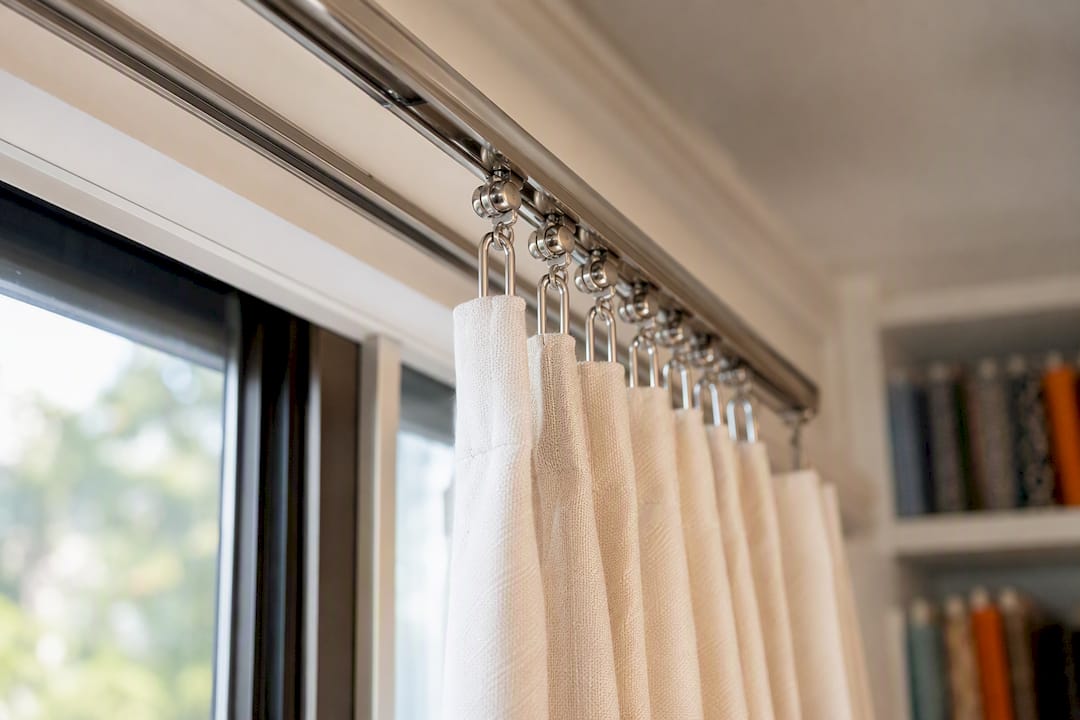
Traverse rods use a cord or wand mechanism to open and close panels without touching the fabric directly, which extends the life of delicate materials. They work well for lighter panels but can bind under the weight of lined or heavy fabric.
Simple rods are the easiest to install and the cheapest option, but they require you to pull the fabric itself to open and close it. That’s fine for occasional-use doors in a guest room. It’s a poor fit for a kitchen slider that opens 20 times a day.
Ceiling-mounted tracks solve both problems at once. They give a continuous floor-to-ceiling appearance that designers favor for a seamless look, and they conceal the hardware almost entirely. Ceiling tracks with ball-bearing carriers handle heavy, lined panels far more smoothly than a basic rod, which matters once you add thermal or blackout backing to your fabric.
Motorized systems pay off in two specific situations: very heavy panels that are tiring to operate by hand, and high-traffic doors where the same person opens and closes drapery multiple times daily. Wired motorized tracks handle large fabric loads more reliably than battery-powered units, which can struggle to sustain heavy payloads over repeated cycles.
Stack-back, the amount of wall space your panels occupy when fully open, deserves attention before you order anything. Measure how far your panels need to travel to clear the glass completely, and check whether that space is available on both sides of the frame or only one.
Pro Tip: Position your track so panels stack past the door handle, not over it. This one adjustment prevents the single most common complaint we hear about sliding door drapery: fabric snagging on hardware every time the door opens.
- Traverse rods: lighter fabric, cord-operated, gentle on delicate materials.
- Simple rods: lowest cost, best for low-traffic doors.
- Ceiling-mounted tracks: heavy panels, high-traffic doors, cleanest look.
- Motorized wired tracks: very heavy fabric or frequent daily use.
Which Fabric And Lining Work Best For Patio Doors?
The fabric you choose determines how much light, heat, and sound your drapery actually blocks, not just how the room looks. Sliding glass doors lose more heat and let in more noise than a standard window simply because of their size, which makes lining choice more consequential here than almost anywhere else in the house.
Thermal and blackout linings matter most in bedrooms and any room facing direct afternoon sun. Foam or acrylic-backed thermal curtains can improve a window assembly’s effective insulation value noticeably, a meaningful gain when a sliding door is your largest single source of heat loss in winter. Beautiful Windows Elgin’s own testing on lined drapery fabrics shows noise reduction of up to 70 percent alongside measurable energy savings, which makes lining a practical upgrade rather than a cosmetic one.
Sheer fabrics solve daytime privacy without sacrificing your view entirely. They let diffused light through while breaking up direct sightlines from a backyard or patio. Pairing a sheer layer with a blackout or thermal panel behind it gives you both functions on the same track, switching between them as the day changes.
Outdoor-grade and solution-dyed fabrics belong on doors exposed to direct sun, humidity, or salt air, think covered patios, sunrooms, or coastal properties. These textiles resist fading and moisture damage in ways standard drapery fabric can’t match, at the cost of a slightly less soft hand.
Weight is the tradeoff nobody mentions until they’re living with it. Heavier lined fabric insulates and blocks light better, but it also demands stronger hardware (see the ceiling-track and ball-bearing carrier note above) and typically needs professional cleaning rather than a home wash cycle.
- Thermal/blackout: bedrooms, sun-facing rooms, winter heat loss.
- Sheer: daytime privacy without blocking the view.
- Outdoor-grade/solution-dyed: sunrooms, covered patios, humid or coastal climates.
- Heavier fabric = better performance but stronger hardware and pro cleaning.
Browse curtain lining fabric options built specifically for light control and insulation, or explore the full upholstery and drapery fabric catalog for designer textiles sold by the yard.
How Do You Measure For Sliding Door Curtains?
Measuring wrong is the single most common reason drapery underperforms on a sliding door. A panel that’s too narrow leaks light at the seam; one hung too low looks squat instead of tall. Work through these steps in order before you place any order.
- Mount height first. Hang your track or rod several inches above the door frame, not directly on it. This single adjustment, recommended consistently across buying guides, makes ceilings look taller and disguises the frame entirely.
- Calculate total fabric width. Practitioners generally recommend total fabric width equal to roughly two to three times your track or rod width for proper fullness. A narrow, flat-hanging panel is almost always a fullness problem, not a fabric problem.
- Divide panels by traffic pattern. Two panels for doors that open from the center; one wide panel for doors where only one leaf ever moves.
- Plan your overlap. Center overlap where panels meet keeps light from leaking through the middle; side overlap against the wall or frame does the same at the edges.
- Measure stack-back space. Confirm the wall area beside your frame can hold the fully open panels without them blocking the operable door leaf.
- Decide floor clearance. A break at the floor (panels puddling slightly) reads as formal and traditional; a clean half-inch clearance reads modern and tailored.
Beautiful Windows Elgin’s window treatment measurement guide walks through each of these steps with the same checklist a professional installer would use on-site.
How Do You Keep Sliding Door Curtains From Snagging?
A sliding door gets used more than almost any other opening in the house, which means the drapery covering it takes more daily wear than a curtain over a stationary window. Choosing hardware built for that traffic pattern from the start saves you a re-hang later.
Independent panels or motorized tracks hold up best under frequent use, since neither requires you to yank fabric to get the door open. If you’re sticking with manual operation, a wand pull or attachable pull tool keeps hands off the fabric entirely and prevents the tugging that eventually pulls seams loose or snags on a door handle.
Check your hardware’s weight rating before you assume it’ll hold up. A track rated for light cafe curtains will sag and drag within a year under a lined panel, even if it looked fine on install day. Periodic maintenance, tightening loose screws, wiping down tracks, checking carriers, catches problems before they become a full re-track job.
If panels start sticking or gliding unevenly, the fix usually isn’t new drapery. Clean the track of dust and debris first, check that carriers haven’t come loose, and confirm the track itself hasn’t warped or pulled away from its mounting. Most uneven gliding traces back to one bent carrier or a buildup of dust, not a fabric problem at all.
Pro Tip: If a single carrier drags along the track, don’t replace the whole hardware set. Ball-bearing carriers are sold individually at most drapery suppliers, and swapping just the problem carrier usually solves uneven gliding in minutes.
- Independent panels or motorized tracks for doors used multiple times daily.
- Wand pulls to keep hands (and snags) off the fabric.
- Match hardware weight rating to actual panel weight, including lining.
- Uneven gliding is usually a carrier or track issue, not a fabric issue.
Matching curtain operation to how the door itself opens matters just as much as hardware choice. If you’re rethinking the door hardware alongside your drapery plan, this guide to modern interior doors from One Day Doors & Closets covers how door style and operation affect the overall look of an opening.
Should You Buy Ready-Made Panels Or Order Custom Drapery?
Ready-made panels make sense in specific, limited situations. If your slider is a standard 6-foot or 8-foot width, your budget is the main constraint, and you’re not picky about exact fullness, retail options like room-darkening grommet panels with a detachable pull wand cover the basics reasonably well. These products are widely sold specifically for patio doors and solve the light-control and snag problems adequately for many homeowners.
Custom drapery earns its higher cost in a few clear scenarios: doors wider or narrower than standard retail sizes, a fullness ratio ready-made panels can’t deliver, designer fabric you can’t find off the shelf, or motorized operation built into the track from the start.
Before ordering from any drapery service, ask these questions:
- Can I get a fabric sample before committing to yardage?
- What’s the lead time from order to installation?
- Is the hardware compatible with my existing track or rod, or does it need replacing?
- Does the quote include installation guidance, or am I hanging this myself?
Custom orders through a service like Beautiful Windows Elgin typically deliver value in three areas: exact fit for non-standard openings, access to designer fabrics sold by the yard rather than limited retail patterns, and a consultation that catches hardware mismatches before you’ve already ordered fabric.
How Do You Maintain Sliding Door Drapery Over Time?
Cleaning frequency and method depend entirely on fabric type. Cotton and polyester blends generally tolerate gentle machine washing on cold; silk, velvet, and heavily lined panels almost always need dry cleaning to avoid shrinkage or watermarking.
Hardware needs its own routine check. Look at mounting screws twice a year, since the constant motion of a sliding door track loosens them faster than a stationary curtain rod. A light silicone lubricant on tracks (never oil, which attracts dust) keeps carriers gliding smoothly.
Uneven hems and puckering usually trace back to the same cause: panels that were hung before the fabric had time to “drop” and settle under its own weight. Rehanging after a week often resolves minor unevenness on its own. Dragging panels almost always mean a bent carrier or a track pulling away from its mount, not a fabric defect.
- Wash cotton/poly blends on cold; dry-clean silk, velvet, and lined panels.
- Check mounting screws twice yearly; lubricate tracks with silicone, not oil.
- Rehang and let fabric settle before addressing minor puckering.
- Call a professional for motor servicing or full re-track jobs.
How Does Beautiful Windows Elgin Help With Sliding Door Drapery?
Getting sliding glass door drapery right depends on three things working together: accurate measurement, hardware that matches your fabric weight, and material chosen for how the room actually gets used. Beautiful Windows Elgin builds its service around exactly that combination, rather than treating fabric and hardware as separate purchases.
The service includes custom drapery consultations, a curated selection of designer fabrics by the yard, from jacquard satin to embroidered and upholstery-grade textiles, and installation guidance that walks through hardware compatibility before fabric gets cut. Fabric samples ship ahead of a full order, so you can check color and weight against your actual room lighting before committing to yardage.
Lined drapery fabric can cut incoming noise by up to 70 percent while improving a room’s energy performance, a benefit that matters most on sliding glass doors, which typically account for more heat loss and sound transfer than any other opening in the house.
- Custom drapery consultations tailored to your door’s width and traffic pattern.
- Designer fabrics by the yard, including thermal and blackout linings.
- Installation guidance covering hardware compatibility before fabric is cut.
- Nationwide shipping with fabric samples available before you order.
Start with the measurement guide to get your numbers right, then request samples before placing a full order.
Where Conventional Advice On Sliding Door Curtains Falls Short
Most curtain advice treats sliding glass doors like oversized windows, and that’s the core mistake. A window never opens 20 times a day with a toddler leaning on the handle. The hardware conversation deserves to come before the fabric conversation, not after it, yet nearly every guide leads with color palettes and pinch-pleat aesthetics.
What the research actually supports is a hierarchy: hardware capacity first, measurement second, fabric third. A gorgeous jacquard panel on an undersized rod will sag and drag within months. A modest fabric on a properly rated ceiling track with ball-bearing carriers will outlast it by years.
If you take one thing from this guide, prioritize the stack-back measurement and hardware rating before you fall in love with a fabric swatch. Custom drapery earns its cost specifically because it lets you solve the hardware problem and the style problem in the same order, which is the sequence that actually holds up over years of daily use.
— Marrion
Get Custom Sliding Door Drapery From Beautiful Windows Elgin
Ready-made panels from a big-box store solve the basics, but they can’t give you exact fullness, designer fabric, or hardware matched to your specific door. Beautiful Windows Elgin fills that gap directly, offering custom drapery consultations alongside a curated catalog of designer fabrics by the yard, from jacquard satin to durable upholstery-grade textiles, so your sliding door gets a treatment sized and weighted correctly the first time.

This matters most if you’ve already found that off-the-shelf panels don’t cover your opening’s width, or the fullness looks flat instead of tailored. Beautiful Windows Elgin’s fabric samples ship before you commit to a full order, letting you check color and hand against your actual room. If insulation or noise reduction is your priority, the curtain lining fabric collection covers thermal and blackout options built for exactly that. For a broader fabric selection, from stripe patterns to jewel-toned textiles, the upholstery and drapery fabric catalog is sold by the yard for custom projects of any size.
Start by using the measurement guide to get accurate numbers for your door, then request a fabric sample or book a consultation to move from measurement to a finished custom order.
Sources
Recommended
- Role of drapery fabrics: Cut noise by 70% & save energy – Designer Fabrics by the Yard | Drapery Making Services
- DIY Curtain & Drapery Installation Guide – Fabric Store in Columbia, SC | Drapery Making Services
- Why Pair Sheers with Drapes for Layered Window Style – Fabric Store in Columbia, SC | Drapery Making Services
- Drapes vs Curtains: Choosing the Best for Your Home – Shop Designer Fabrics by the Yard | Curtains & Drapery