


Best Drapery Workroom for Interior Designers: 2026 Guide
Table of Contents
- What Interior Designers Should Look for in a Drapery Workroom
- Quick Comparison: Top Drapery Workroom Options for Designers
- Beautiful Windows Elgin: Custom Drapery Fabrication Services
- Drapery Workroom Lead Times: What to Expect and How to Plan
- How to Communicate With a Drapery Workroom for Flawless Results
- Trade Pricing Models and Markup Structures Explained
- Quality Control and Common Fabrication Errors to Watch For
- Conclusion
- Frequently Asked Questions
Last Updated: September 30, 2026
What Interior Designers Should Look for in a Drapery Workroom
Interior designers report that clients can expect to spend between $50,000 and $150,000 on custom high-end drapery for an entire home, according to Business of Home's 2026 drapery industry analysis. That figure explains why choosing the right fabrication partner matters so much. A drapery workroom is a specialized sewing and fabrication studio that turns designer specifications and fabric yardage into finished window treatments, from pleated panels to cornices and valances. This guide from Beautiful Windows Elgin breaks down how to vet a workroom, what lead times to expect, and where fabrication errors typically hide.
Vetting Checklist for Trade-Only Workrooms
Most workrooms won't advertise their weak points, so you have to ask directly. A 30-plus-year track record is a common benchmark for established shops, according to Designer Draperies of Boston's workroom standards. Use this checklist before you hand over a single yard of COM fabric:
- Confirm whether the workroom is trade-only or open to retail clients
- Ask for their standard turnaround time and rush-fee policy in writing
- Request photos of pinch pleat work they've completed
- Verify how they handle COM (Customer's Own Material) and whether they inspect for flaws
- Ask who measures: you, their installer, or a third party
- Confirm insurance coverage for fabric in their possession
- Get the exact terms for remakes if a panel arrives wrong
Quick Comparison: Top Drapery Workroom Options for Designers
The best drapery workroom for interior designers depends on whether you need full custom fabrication or a faster ready-to-hang solution.

| Option | Best For | Fabrication Type | Lead Time | Trade Pricing |
|---|---|---|---|---|
| Beautiful Windows Elgin | Designers wanting curated fabric plus finished panels | Custom and ready-to-hang pinch pleat | 10-15 days shipping | Yes, on request |
| Full-service custom workroom | Complex treatments, motorization, cornices | Fully bespoke | 6-10 weeks | Yes |
| Local seamstress | Simple panels, tight budgets | Basic fabrication | 2-4 weeks | Varies |
| Off-the-shelf retail | Quick refreshes, rentals | None | Same day | No |
The tradeoff is speed and simplicity versus full customization. Most designers use both, depending on the client and the room.
Beautiful Windows Elgin: Custom Drapery Fabrication Services
Beautiful Windows Elgin pairs a curated designer fabric library with in-house drapery making, so designers can source yardage and finished panels from one partner. Panels are manufactured in the USA and ship nationwide in 10 to 15 days.
For designers who need consistent, professional-grade fabrication, this removes a step. You're not coordinating a fabric vendor and a separate workroom. The Houzz review data for specialized workrooms shows that shops with high verified review volumes tend to signal reliability, and Beautiful Windows Elgin's ready-to-hang line reflects that same production discipline.
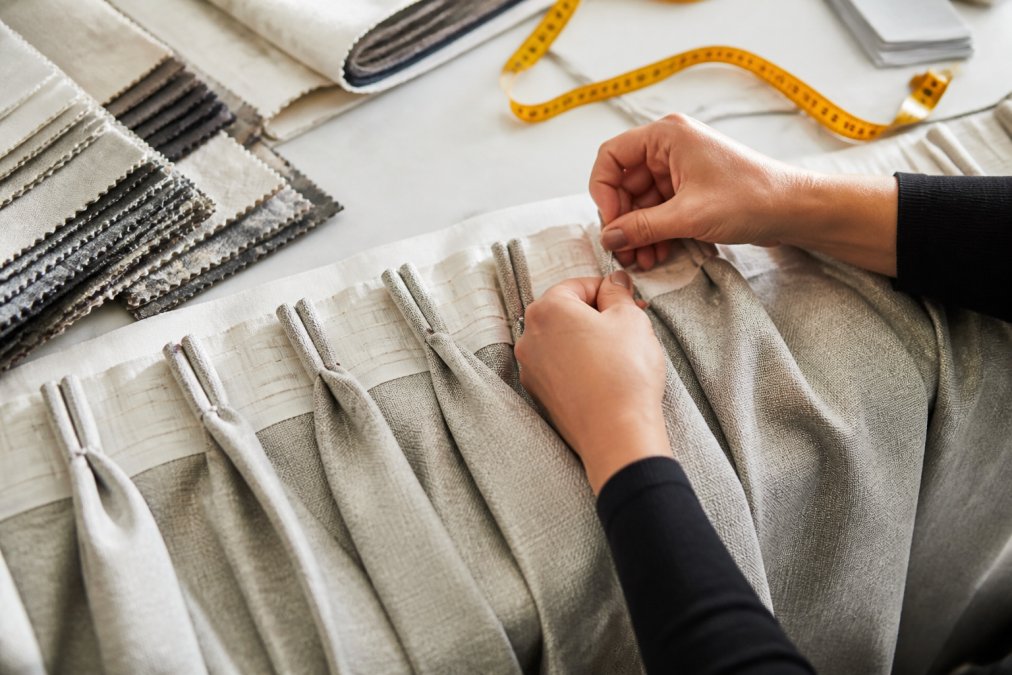
Beautiful Windows Elgin offers pinch pleat panels that arrive finished, lined, and ready to install.
Pinch Pleat Panels That Ship Ready to Hang
Each panel uses a 5-inch structured pinch pleat header with buckram, hand-set pleats, and weighted corners, construction that gives a panel its straight, architectural fall instead of the soft slump of cheap retail drapes.
Consider the Window Fashion VISION Workroom of the Year recognition standard: the most prestigious award a drapery professional can receive.
Drapery Workroom Lead Times: What to Expect and How to Plan
Ready-to-hang panels ship in 10 to 15 days.
Plan backward from your install date, not forward from your order date. A realistic timeline looks like this:
- Fabrication: 10-15 days for ready-to-hang
Logistics and Shipping When You Outsource to a Remote Workroom
Here's how to make remote fabrication work without the horror stories.
Custom Window Creations—Solid Pinch →
Rush Fees and Expedited Timelines
Rush service is almost always available, but terms vary widely. A common pattern is a percentage surcharge on fabrication labor, not fabric, for anything faster than the standard window. Ask three questions before accepting a rush quote: how much faster is the actual delivery date, what happens if the workroom misses it, and whether the rush fee is refundable if the deadline slips.
How to Communicate With a Drapery Workroom for Flawless Results
A written spec sheet prevents almost every fabrication dispute. Verbal instructions and rough sketches are where errors breed.
Include these details on every order:
- Finished width and length, plus return and overlap
- Header style (pinch pleat) and pleat count
- Fullness ratio
- Lining type
- Fabric direction
- Any pattern matching requirements
A Scored Vetting Rubric for Trade-Only Workrooms
Most designers vet a new workroom by gut feel and a phone call. A scored rubric lets you compare three or four candidates and revisit the decision when a project goes sideways.
| Criterion | What to Ask | What a 5 Looks Like |
|---|---|---|
| Trade-only status | Do you sell to retail clients? | Trade-only, with a written trade policy |
| Fabrication range | Which treatments do you make in-house? | Pinch pleat, goblet, roman, cornice, valance, motorized |
| Turnaround | What is your standard lead time, in writing? | Stated in the quote, with a rush policy |
| Communication | Who is my single point of contact? | Named project manager, email and phone |
| COM handling | Do you inspect COM on arrival and document flaws? | Written inspection clause with photo documentation |
| Insurance | Are you insured for fabric in your possession? | Certificate of insurance on request |
| Remake policy | What are the terms if a panel arrives wrong? | Written remake terms with a stated window |
| References | Can you provide two designer references? | Two or more verifiable trade references |
The Questions Designers Forget to Ask
Beyond the rubric, three questions separate a professional workroom from a hobbyist operation:
- Who owns the pattern? If the workroom develops a custom header or pleat for you, confirm in writing that you can reorder it later without re-engineering it.
- What is the fabric yield policy? Ask how they calculate yardage and whether they bill for actual usage or a flat estimate. On large repeats, the difference can be significant.
- What happens to leftover fabric? A good workroom returns unused yardage, labeled, so you can use it for pillows, a bench, or a future repair.
Communication Cadence That Prevents Surprises
Set a check-in schedule at the start of every project: a confirmation email when the spec is received, a photo update when the fabric is cut, and a shipping notification with tracking. If a workroom can't commit to that cadence, that tells you how they'll handle a problem mid-project.
Trade Pricing Models and Markup Structures Explained
A flat discount is simplest to quote but leaves less room to control your margin. Net pricing gives the most flexibility because you set the client-facing number. Cost-plus works best on complex projects where material waste is hard to predict. Ask any workroom which model they use before building a client proposal, and confirm whether the discount applies to fabrication labor or only materials.
Quality Control and Common Fabrication Errors to Watch For
Check these before installation:
- Pattern matching: Stripes and large repeats should align across panels
- Pleat consistency: Every pleat should measure the same depth and spacing
- Lining length: Lining should be slightly shorter than the face fabric to avoid peeking
- Weighted corners: Corners should hang straight, not flare
- Header height: The header should sit level across the full panel width
Conclusion
Custom drapery is a significant client investment, and the workroom you choose determines whether that investment looks flawless or falls flat. Beautiful Windows Elgin offers curated designer fabrics by the yard, custom pinch pleat drapery with professional workroom detailing, and nationwide shipping, all with the option to order samples before you commit. Get started with Beautiful Windows Elgin and give your next project panels that hang right the first time.
Frequently Asked Questions
What criteria should interior designers use to evaluate a drapery workroom?
Look for verified customer reviews and a clear portfolio of pinch pleat work. Ask about turnaround time and quality control steps. A workroom that communicates proactively and provides written specifications for every order is far easier to manage than one that leaves you guessing.
How do professional drapery workrooms differ from retail curtain services?
Professional workrooms fabricate to your exact measurements and design specifications, using structured buckram, hand-set pleats, and weighted corners. Retail services sell pre-made panels in standard sizes. For interior designers, the workroom model means you control the header style, lining, and fullness ratio, and you get consistent results across multiple windows or client projects.
What are the benefits of outsourcing custom drapery fabrication?
Outsourcing lets you focus on design and client relationships while a specialist handles cutting, pleating, and finishing. You avoid investing in industrial sewing equipment and skilled labor. Workrooms also bring fabrication expertise that improves the final drape, such as knowing how different fabrics behave when pleated and how to adjust lining for proper light control.
How do you ensure quality control when working with a remote drapery workroom?
Request photo documentation at key stages: after cutting, during pleating, and before shipping. Specify your measurements in writing and ask the workroom to confirm them. Establish a clear approval process for any substitutions. A workroom that welcomes these checks and provides tracking information is far easier to manage remotely than one that resists transparency.