


How to Measure Windows for Custom Drapery: 2026 Guide
Table of Contents
- Best Tools for Measuring Window Treatments
- Step-by-Step: How to Measure Windows for Custom Drapery
- Inside Mount vs. Outside Mount: Which Measurement Do You Need?
- Calculating the Drapery Fullness Ratio for Your Fabric
- Measuring for Floor Length Curtains and Other Drop Lengths
- Troubleshooting Non-Standard Windows and Hardware Weight Capacity
- Measuring for Motorized Tracks and Visual Worksheets
- Frequently Asked Questions
Last Updated: September 21, 2026
Best Tools for Measuring Window Treatments
You cannot measure for drapes with a flimsy tape. The right tools make the job faster and cut the risk of a costly mistake.
Here is what to gather before you start:
- Metal tape measure: Cloth tapes stretch and give false readings.
- Two-foot level: Checks that your rod sits straight.
- Pencil and paper: Sketch each window and write numbers as you go.
- Step ladder: Gets you to the top of tall windows safely.
- Sticky notes: Label each window so measurements stay paired.
Step-by-Step: How to Measure Windows for Custom Drapery
Measuring for custom drapery is the process of recording the width, height, and squareness of each window, then adding the extra inches your rod and fabric need. Get these numbers right and the panels hang straight the first time.
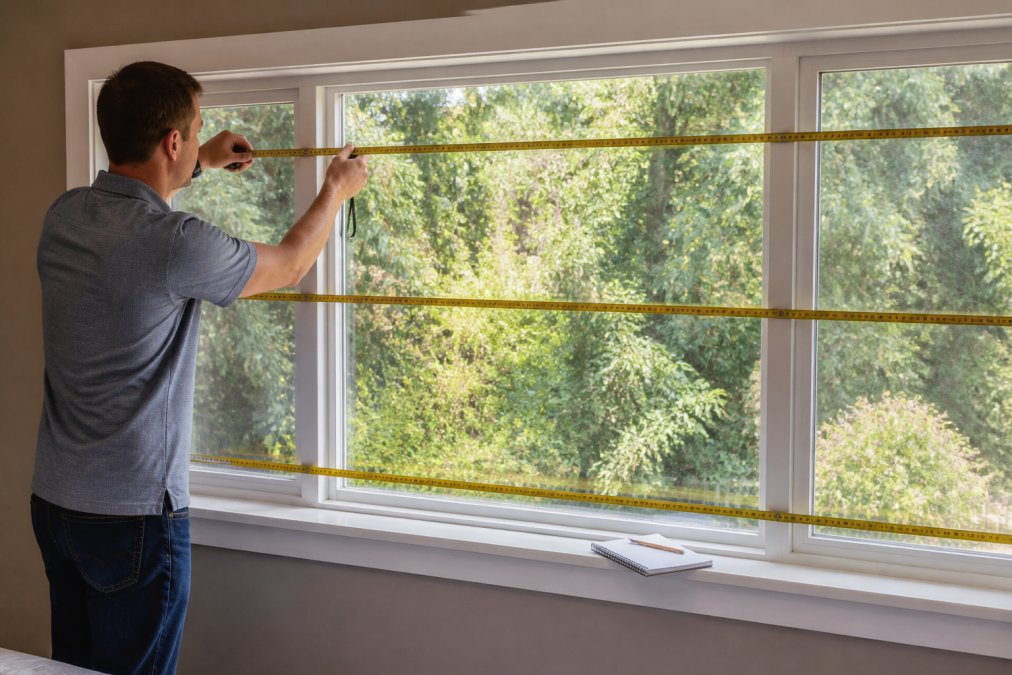
Step 1: Measure Window Width at Three Points
Start with width. Pull your tape across the window at the top, the middle, and the bottom.
Step 2: Measure Window Height and Check for Squareness
Now measure height. Take three readings too: left side, center, and right side.
Step 3: Determine Rod Placement and Projection
Decide where the rod will sit before you order. Rod height sets your finished length.
| Measurement | Where to Take It | Why It Matters |
|---|---|---|
| Width | Top, middle, bottom | Finds the narrowest point |
| Height | Left, center, right | Sets finished length |
| Diagonals | Corner to corner | Checks squareness |
| Rod placement | Above frame | Sets drop length |
| Projection | Wall to rod | Clears obstructions |
Inside Mount vs. Outside Mount: Which Measurement Do You Need?
Inside mount fits the treatment within the window frame. Outside mount sits on the wall or trim and overlaps the frame.
- Inside mount: Measure the window opening itself. Use the smallest width and longest height.
- Outside mount: Measure the window plus the overlap you want. Add extra width for stack back.
Calculating the Drapery Fullness Ratio for Your Fabric
The drapery fullness ratio is the multiplier you apply to your rod width to find the total fabric width the finished panels need. It controls how gathered or flat the drapes look once they are hung.
A higher multiplier means deeper folds and more fabric.
- 1.5x: Light gathering; suits sheers, linen blends, and casual rooms.
- 2x: Standard fullness for most living rooms and bedrooms.
- 2.5x: Rich, formal folds for a designer look.
- 3x: Very dense, hotel-style pleating; rarely needed outside formal spaces.
Turning Rod Width Into Fabric Width
Start with the rod width, not the window width. If your rod spans 60 inches and you want 2x fullness, the total fabric width is 120 inches. Split that across two panels and each panel starts at 60 inches of flat fabric before pleating.
Fabric Width and Seam Decisions
- 54-inch goods: Standard for most prints and solids. Panels wider than about 52 inches need a vertical seam or a wider fabric.
- 60-inch goods: Common in upholstery-weight and some drapery lines. Cuts down on seams for medium windows.
- 110-inch goods: Wide sheers and some linings. Lets you cut full-width panels with no seam, which matters for sheers where a seam shows.
- Railroading: Running the fabric horizontally so the pattern repeats across the width. Only works with fabrics that have a horizontal or non-directional pattern.
A Worked Example
A 96-inch rod at 2x fullness needs 192 inches of fabric width. Across two panels, that is 96 inches per panel. On 54-inch goods, each panel needs two widths seamed together (108 inches of flat fabric, trimmed to 96).
Lining and Interlining Add Width
If you are adding a lining or interlining, cut it to the same flat width as the face fabric. Do not reduce the lining width to save money, a narrower lining pulls the face fabric and creates puckers at the seams.
Measuring for Floor Length Curtains and Other Drop Lengths
Measuring for floor length curtains starts at the rod, not the window. Your finished length runs from the top of the rod to where you want the hem to land.
Pick your drop style first:
- Sill length: Hem sits just above the sill.
- Apron length: Hem falls below the sill trim.
- Floor length: Hem just touches the floor.
- Puddle: Extra fabric pools on the floor.
Troubleshooting Non-Standard Windows and Hardware Weight Capacity
Standard guides assume a rectangular window on a flat wall. Arched, bay, corner, and oversized windows each break that assumption, and the measurement method changes with the geometry. This section covers the shapes most guides skip, then ties the numbers back to whether your rod can actually carry the fabric.
Arched and Radius Windows
An arched window has no single width or height that describes it. Measure the widest point of the arch (usually at the spring line, where the curve meets the vertical sides) and the full height at the center. Note the rise, the distance from the spring line to the top of the arch, because the fabricator needs it to plan the header and the curve of the valance or panel top.
Bay and Bow Windows
A bay window has three or more angled sections meeting at posts. Measure each section as its own window: width at top, middle, and bottom, and height at left, center, and right. Do not try to measure the bay as one span, the angles mean a single rod will not sit flat against the wall.
Two common approaches:
- Individual rods per section: Each section gets its own rod and panels. Cleanest look, most hardware.
- Continuous rod with corner brackets: One rod wraps the bay using angled or swivel brackets at each post. Fewer panels, but the brackets must match the bay's angle, which is often 135 degrees on a standard three-section bay.
Corner Windows
Corner windows meet at a 90-degree inside corner with little or no wall between them. The problem is return: each panel needs enough side clearance so the two sets of drapes do not collide when drawn. Plan for a return of at least 3 to 4 inches on each window, and consider a single shared rod with a corner bracket if the windows are close enough.
Oversized and Multi-Panel Windows
Wide openings, picture windows, sliding doors, wall-to-wall spans, usually need more than two panels. Measure the full rod width, then divide by the panel count you want. A common pattern is one panel per 30 to 36 inches of rod width for a full look, which means a 144-inch rod often takes four to five panels.
Hardware Weight Capacity
This is where measurement meets physics. A rod's load rating depends on its diameter, wall thickness, bracket spacing, and the mounting surface. Drywall anchors, stud mounting, and wood blocking all carry different loads, and the fabric weight adds up fast.
- Lined and interlined drapes can weigh several times what an unlined sheer does for the same window.
- Bracket spacing matters more than rod diameter for sag. Most manufacturers recommend a center support bracket once a rod exceeds about 60 to 72 inches, and additional supports every 30 to 36 inches beyond that.
- Rod diameter should grow with span and load. Thin decorative rods that look right on a 48-inch window will bow on a 120-inch span under heavy fabric.
- Motorized tracks add the weight of the motor, the track, and the carriers, so check the track's rated capacity against the total fabric load, not just the face fabric.
What to Tell Your Fabricator
When you send measurements for a non-standard window, include the window type, the mount style, the fabric weight, and any obstructions. That lets the workroom match the header, the hardware, and the panel count to the job instead of guessing from a single width number.
Measuring for Motorized Tracks and Visual Worksheets
Motorized tracks change the measuring math. You need power access, a clear path for the track, and room for the motor at one end.
| Field | What to Record |
|---|---|
| Window ID | Room and wall position |
| Mount type | Inside or outside |
| Width | Smallest of three readings |
| Height | Longest of three readings |
| Rod height | Distance above frame |
| Drop length | Rod to hem |
| Fullness | 1.5x to 2.5x |
| Notes | Arches, obstructions, power |
Frequently Asked Questions
How much wider than the window should custom drapery be?
For proper coverage and a designer look, custom drapery panels should extend beyond the window frame. A common rule is to add 6 to 12 inches on each side of the window. This allows the curtains to stack back neatly when open, framing the window without blocking light. If you are measuring for a rod, add this extra width to your window measurement to determine the rod's total length.
What size curtains do I need for a 72 inch window?
For a 72-inch wide window using an outside mount, your curtain rod should be at least 84 to 96 inches wide (adding 6 to 12 inches per side). To find the total fabric width needed, multiply the rod width by your desired fullness ratio (typically 1.5 to 2.5). For a 90-inch rod with a 2x fullness, you would need 180 inches of fabric width, which means multiple panels.
Should drapery touch the floor or hover above it?
The choice depends on the style you want. For a traditional, elegant look, floor length curtains should just touch the floor (a 'kiss' or 'break'). For a modern, tailored appearance, they can hover 1/2 inch above the floor. For a romantic, luxurious feel, add 1 to 3 inches of extra length to create a 'puddle' on the floor. Measure from the rod's bottom edge to your desired endpoint.
How do I account for drapery hardware when measuring?
Always measure from the rod, not the window frame, for outside mount drapery. The rod's height and width determine the final look. For height, measure from the bottom of the rod to your desired drop length. For width, measure the full rod length, including finials if they are decorative. Also, check the hardware's weight capacity; fabrics may require sturdy brackets and could need a center support for wide spans.
Getting measurements wrong is the fastest way to waste fabric and time. Beautiful Windows Elgin takes the guesswork out of the final step with custom drapery services, designer fabrics sold by the yard, and nationwide shipping. Their team builds panels to your exact figures, including hard windows like arches and bays. Select your fabric and let the workroom handle the rest.