

Steps to Order Custom Fabric for Your Upholstery Business
Last Updated: November 5, 2026
Quick Summary
Ordering custom fabric for an upholstery business starts with defining what the fabric must do, then calculating yardage per job by panel rather than by guesswork. Request physical swatches to check color and durability, verify abrasion, weight, width, and cleaning codes, then inspect and log each shipment on arrival.
- Build a per-job cut plan by measuring each panel, adding seam allowance, and converting to usable width.
- Add a waste buffer of 10% for solids, 15-20% for large repeats, and 20% or more for directional fabric.
- Order an extra 10-15% at the same time to cover repairs, since dye lots can change between production runs.
- Match abrasion ratings to traffic, treating 15,000 double rubs as a light-duty floor for residential seating.
- Record the cleaning code on the job sheet and pass it to the client in writing.
Table of Contents
- What Your Upholstery Business Needs Before Ordering Custom Fabric
- How to Calculate Upholstery Fabric Yardage for Each Job
- Using Fabric Swatches for Upholstery to Test Color and Durability
- Checking Performance Specs: Abrasion, Weight, and Width
- Ordering Custom Print Fabric by the Yard Online
- Placing Custom Fabric Printing Online: Artwork, Repeats, and Dye Lots
- Receiving, Inspecting, and Reordering Your Custom Fabric
- Frequently Asked Questions
Ordering custom fabric for an upholstery business is less forgiving than ordering for a home project. A wrong yardage figure, a mismatched dye lot, or a fabric that fails abrasion testing can stall a job and eat into your margin. Beautiful Windows Elgin, a fabric store that sells designer fabrics by the yard with nationwide shipping, has put together this seven-step process to help upholsterers and interior designers buy custom fabric with fewer surprises. The steps below walk through planning, measuring, sampling, checking specifications, ordering, printing, and receiving. Each step is written for buyers who need consistent results across multiple jobs, not a single project.
What Your Upholstery Business Needs Before Ordering Custom Fabric
Before you place any order, define what the fabric has to do. A decorative throw pillow and a sofa used by a busy family face very different demands, and the buying decision should start there. Write down the furniture types you upholster, the typical traffic each piece will see, and the look your clients expect.
Next, set your buying rules. Decide who approves fabric orders, how much lead time you need before a job starts, and how you will record each fabric's details so the next order matches the last. Many small shops keep a simple spreadsheet with the supplier, collection name, pattern number, dye lot, and yardage per job.
Finally, confirm your business basics: a resale or tax certificate if your state requires one, a supplier account, and a shipping address that can receive rolls of fabric. Ask suppliers whether they offer trade or wholesale terms, since programs for designers, workrooms, and furniture manufacturers are common in the industry. Ask suppliers directly about the trade or wholesale terms they offer, and confirm current terms before you commit.
How to Calculate Upholstery Fabric Yardage for Each Job
Yardage errors are the most common and most expensive mistake in upholstery fabric ordering. A shortage mid-job means either a mismatched reorder or a delayed delivery, and an overage ties up cash in inventory you may never use.
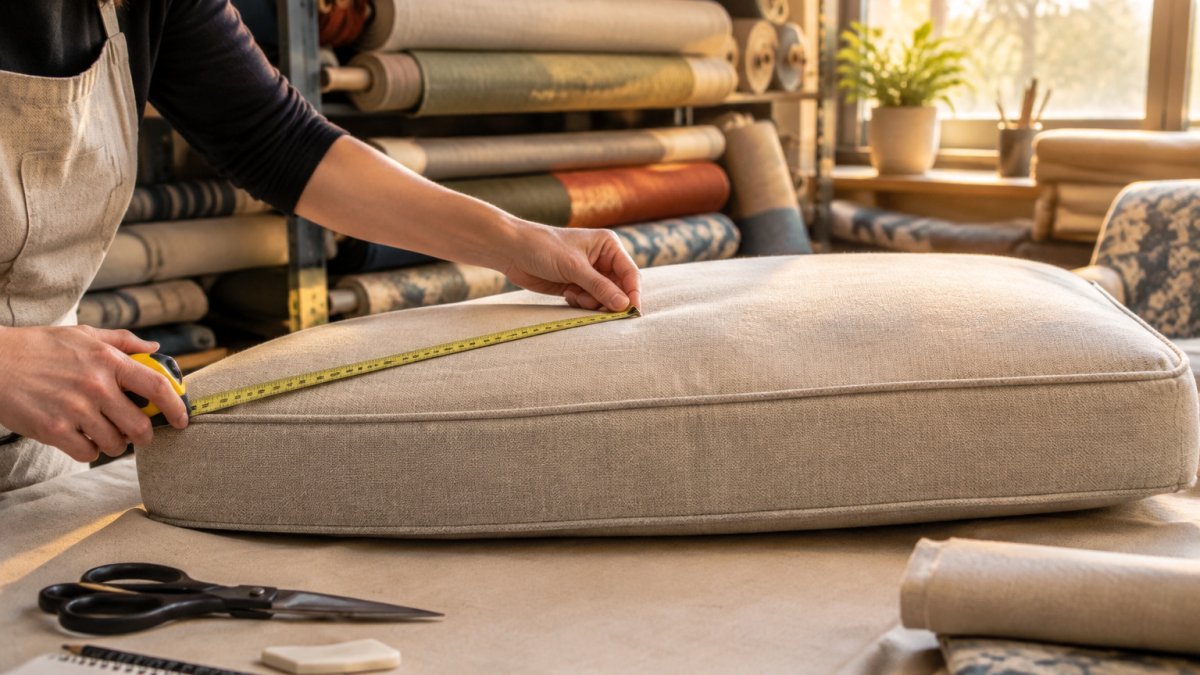
Start by breaking the piece into panels: seat cushions (top, bottom, and boxing), back cushions, inside and outside arms, the deck, and any skirt or welting.
Next, convert square inches to linear yards using the fabric's usable width. A 54-inch-wide fabric does not yield 54 inches of usable width once you account for selvage; most workrooms plan on 52 to 53 usable inches.
Pattern repeats change the math substantially. A fabric with a 27-inch vertical repeat and a 13.5-inch horizontal repeat forces you to align the pattern across every adjacent panel, which means each cut consumes more length than its finished size.
Directional and railroaded fabrics add another layer. If the pattern runs up the roll (directional), every panel must be cut in the same orientation, which increases waste on pieces wider than the usable width.
Use this worksheet for each job:
| Step | What to record | Example |
|---|---|---|
| 1 | Finished panel dimensions | Seat cushion 24" x 22" x 6" boxing |
| 2 | Add seam allowance | +1/2" per seam |
| 3 | Note fabric usable width | 54" listed, 52" usable |
| 4 | Note vertical and horizontal repeat | 27" V, 13.5" H |
| 5 | Determine match type | Straight match, half-drop, or random |
| 6 | Add repeat allowance per cut | One full repeat per cut for large patterns |
| 7 | Add waste buffer | 10% solids, 15-20% large repeats, 20%+ directional |
| 8 | Round up to whole yards | Never round down |
Reorder buffers deserve their own line in your plan. For any job where the client may need a repair or a matching ottoman later, order an extra 10-15% at the same time.
Watch out: a common failure is calculating yardage from finished furniture dimensions rather than cut panel dimensions. Cushions compress, welting consumes extra length, and boxing adds height, all of which push actual consumption above the naive estimate.
Finally, log actual yardage used versus estimated on every job. After five or six jobs, your own waste factors become more accurate than any generic rule, and your quotes get tighter without getting riskier.
Using Fabric Swatches for Upholstery to Test Color and Durability
Swatches are the cheapest insurance you can buy. Screens show colors inaccurately, so request physical samples before committing to a full order. Learn how to order fabric samples online to test color and durability before a full purchase. Hold the swatch next to the existing frame, wall, or client-approved material in natural light, and look at it in the lighting where the furniture will live. For guidance on matching fabric colors online, see how to compare swatches accurately.
Test durability on the swatch too. Rub it, check how it handles light, and confirm whether the color holds up. A common oversight is ordering a light neutral without asking whether it will show soiling quickly on a high-touch sofa.
Confirm sample availability for every fabric before you plan a project around one, and if samples are unavailable, ask the supplier about alternatives so you can still verify the color.
Checking Performance Specs: Abrasion, Weight, and Width
Performance specifications are where a business buyer separates from a retail shopper. A fabric that looks right but fails in service costs you a callback, a replacement, and a client. Read every spec sheet against the actual end use before you commit.
Abrasion rating. Abrasion is measured in double rubs, typically using the Wyzenbeek or Martindale method. The two methods are not directly comparable, so confirm which test a supplier used before you compare numbers.
Weight. Fabric weight is usually given in grams per square meter (gsm) or ounces per square yard (oz/yd). Upholstery-weight fabric generally starts around 250-300 gsm and climbs from there; the Miller Grey listing at 750 gsm (about 35 oz/yd) is a heavy commercial-grade material, while the Charcoal Grey commercial fabric at 490 gsm sits in a mid-weight range suitable for many seating applications.
Sandwell Residential Seating Fabric – Durable Upholstery for Home Projects →

Width. Listed width is not the same as usable width. A 54-inch fabric typically yields 52 to 53 usable inches after selvage, and a 44/45-inch fabric yields about 42 to 43.
Colorfastness. Ask for lightfastness ratings, especially for fabrics going into sunrooms, window-adjacent seating, or commercial spaces with daylight exposure. A fabric that fades in six months is a warranty problem.
Cleanability and cleaning codes. Cleaning codes tell you and your client how the fabric should be maintained. The common codes are W (water-based cleaner), S (solvent-based cleaner), WS (either), and X (vacuum only, no liquid).
Backing and construction. Backing, whether the fabric has a knit, woven, or acrylic back, affects stretch, seam stability, and how the fabric performs on curves and corners.
Applicable standards. For contract and commercial work, confirm whether the fabric has been tested to the relevant performance standards for the application, such as flammability requirements for commercial seating (for example, California Technical Bulletin 117 or the applicable ASTM test for the end use).
Watch out: a spec sheet that lists only abrasion and weight is incomplete for business use.
Ordering Custom Print Fabric by the Yard Online
Custom print orders take more care than stock fabric orders. Suppliers offering custom printing typically work from a customer's artwork and print on heavy cotton, canvas, velvet, linen, or waterproof Oxford.
Before you submit a custom order, confirm the fabric base, the print method, the minimum order quantity, and the production timeline. Our guide to buying designer fabric by the yard covers these questions in more detail. Ask whether the print will be made to order, which usually means a longer lead time than cut-from-stock fabric. For multi-job planning, build in extra time for production and shipping, and order enough yardage for future repairs from the same dye lot.
If you have never bought custom fabric before, start with a small order to test the print quality on the chosen base fabric. It costs less to discover a problem on a yard than on a full sofa set.
Placing Custom Fabric Printing Online: Artwork, Repeats, and Dye Lots
Clean artwork files produce cleaner prints. Submit high-resolution files, check the pattern repeat against the furniture's dimensions, and confirm the color profile with the supplier. Ask how the printer handles color matching against your swatch.
Dye lots are the next concern. Fabric dyed in different batches can vary slightly, so a sofa ordered in two shipments may show a visible difference. Order enough yardage for the entire job at once, and note the dye lot number on your records. If you must reorder later, ask the supplier whether a matching dye lot is still available.
Keep your artwork files, repeat measurements, and dye lot numbers together in one record. Future reorders will go faster, and repeat clients will get consistent results.
Receiving, Inspecting, and Reordering Your Custom Fabric
When the fabric arrives, inspect it before you cut. Unroll it on a clean, flat surface and check the full length for flaws, color variation, and shipping damage. Compare the color against your approved swatch in daylight. If you find a defect, document it with photos and contact the supplier promptly, since many suppliers have return or claim windows.
Check the return policy before you order. Several Beautiful Windows Elgin listings state that all sales are final, and the Sandwell listing marks the product as non-returnable. Inspect fabric as soon as it arrives and report problems quickly.
Finally, update your records. Note the actual yardage used, any waste, and the dye lot received. This data makes your next estimate more accurate and gives you a reliable basis for job costing and pricing.
Once you have a working process, your ordering becomes routine rather than a risk. Beautiful Windows Elgin's fabric selection, including designer and commercial options sold by the yard, can support upholstery projects. Explore the current selection at Shop fabric and check the Upholstery Fabric collection to find options for your next job.
Frequently Asked Questions
How much does it cost to have custom fabric made?
Costs depend on the fabric, the print, and the quantity you order. Beautiful Windows Elgin sells its commercial upholstery fabrics by the yard: the Sandwell Residential Seating Fabric is $63.99 per yard, the Charcoal Grey Commercial Upholstery Fabric is $41.99 per yard, the Miller Grey Commercial Upholstery Fabric is $44.99 per yard, and the Sleek Gunmetal-Grey Fabric is $38.99 per yard. Multiply the per-yard price by the yardage your job requires, then add a waste allowance so you do not run short mid-job.
Where can I order upholstery fabric online?
You can order upholstery fabric online from Beautiful Windows Elgin, which sells designer and commercial upholstery fabrics by the yard with shipping to all 50 states and APO/FPO addresses via USPS or UPS. Before you buy, confirm the fabric's abrasion rating, width, and weight against your project's needs, and check whether the listing says the item is returnable. Several listings state that all sales are final, so order a swatch first when color or texture matters.
Can I order fabric swatches before buying yardage?
Check the product listing before you assume swatches are available. Several Beautiful Windows Elgin listings state that no samples are available at this time, so you cannot rely on a swatch for those specific fabrics. Where samples are not offered, compare the listed specifications, such as abrasion rating, weight, and fiber content, against your job requirements before placing a full yardage order.
How do I calculate how much upholstery fabric I need?
Measure each piece you plan to cover, add the dimensions together in a logical layout, and account for pattern repeat. Listings show repeat horizontal and vertical measurements; for example, one commercial fabric lists an 8.66-inch horizontal repeat and a 14.5-inch vertical repeat. Larger repeats mean more waste, so add extra yardage for matching. Confirm the usable width, which is listed as 54 inches for several commercial fabrics, to avoid buying more length than you need.
