

Buying Designer Fabric by the Yard: 2026 Guide
Table of Contents
- Why Buying Designer Fabric by the Yard Beats Pre-Made
- How to Calculate Fabric Yardage for Curtains and Upholstery
- Ordering Fabric Swatches Online: Avoiding Color and Texture Surprises
- Upholstery vs Drapery Fabric Weight: Choosing the Right Textile
- What to Look for When Buying Designer Fabric by the Yard
- Pricing, Deadstock, and Sustainable Fabric Sourcing
- Frequently Asked Questions
Last Updated: September 19, 2026
Why Buying Designer Fabric by the Yard Beats Pre-Made
The global textile fabrics market is estimated to reach USD 732.38 billion in 2026, according to Market Data Forecast's textile fabrics market report, and a growing share of that spending now flows through online fabric stores rather than showrooms and big-box aisles. Buying designer fabric by the yard is the practice of purchasing premium textiles in cut lengths (typically 36 inches per yard) directly from a fabric retailer or workroom, rather than buying finished curtains, pillows, or upholstered pieces. At Beautiful Windows Elgin, we sell designer fabrics by the yard with nationwide shipping, and the reason customers switch is simple: pre-made goods force you to accept someone else's dimensions, colorway, and lining choices.
Fabric represents 60% to 70% of total garment and soft-goods cost, per Make Mine's fabric sourcing breakdown, so the material decision drives everything downstream. Buying by the yard lets you control three things pre-made products hide from you:
- Exact yardage for non-standard windows and furniture
- Repeat and pattern scale so seams and motifs align
- Fiber content and weight matched to how the piece will actually be used
How to Calculate Fabric Yardage for Curtains and Upholstery
Learning how to calculate fabric yardage for curtains starts with one formula: finished panel width times a fullness multiplier, divided by fabric width, rounded up. Most designers use 2x to 2.5x fullness for a gathered look and 1.5x for a tailored flat panel. Measure your rod width, not your window width, then add 8 to 12 inches for returns and overlap.
Upholstery depends on furniture geometry: a dining chair seat takes 1 to 2 yards, a sofa 12 to 18 yards, a wingback chair 7 to 10 yards. Round up to the next half yard, and add one extra yard if a large repeat must be matched across cushions.
| Project | Typical Yardage | Fullness or Allowance |
|---|---|---|
| Standard curtain panel (48 in wide) | 4-6 yards | 2x fullness, 8 in header |
| Floor-length drapery pair | 10-14 yards | 2.5x fullness, 12 in hem |
| Dining chair seat | 1-2 yards | Add 0.5 yard for repeat |
| Sofa (3-seat) | 12-18 yards | Add 2 yards for pattern match |
| Wingback chair | 7-10 yards | Add 1 yard for piping |
Ordering Fabric Swatches Online: Avoiding Color and Texture Surprises
Ordering fabric swatches online is the most effective way to prevent the color and hand-feel mismatches that make customers abandon a project. A swatch is a small cut sample of the actual fabric, usually 4 to 8 inches square, that ships before you commit to full yardage. Screens render color differently depending on monitor calibration, and no photograph captures drape, weight, or sheen accurately.
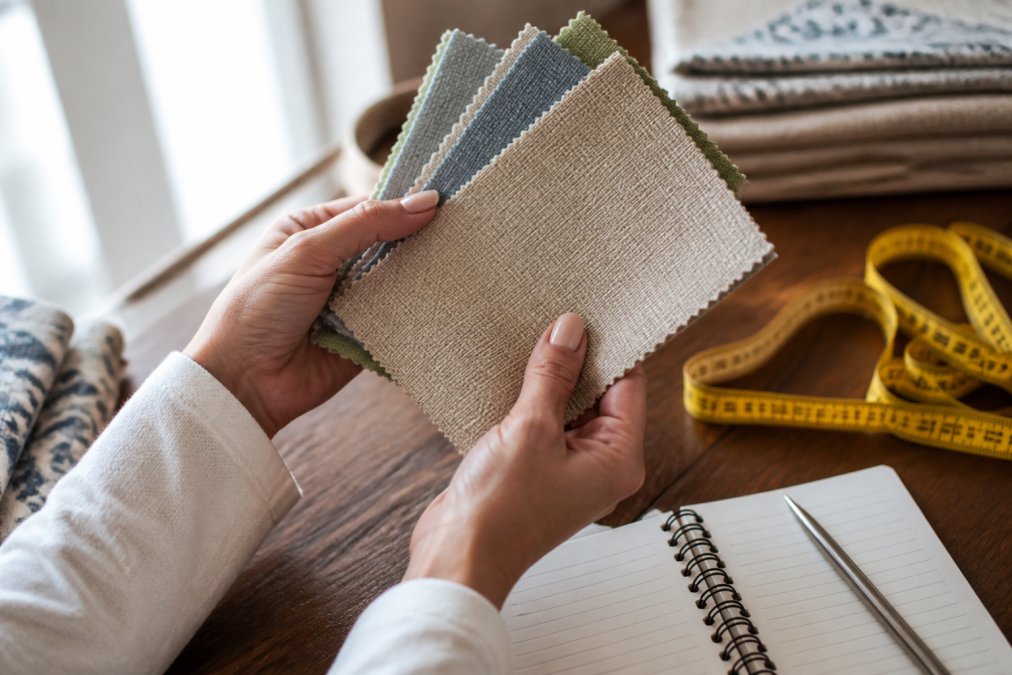
Research published in Springer's Fashion and Textiles journal found that fashion professionals consistently struggle to evaluate fabric quality through digital environments alone, which is why physical swatches remain standard practice even for experienced buyers.
A practical swatch routine:
- Request swatches for every candidate, not just your favorite
- View them in the room where the fabric will live, at morning and evening light
- Rub the swatch against your skin or a chair to test hand-feel
- Tape swatches to the wall and step back 10 feet to judge pattern scale
Upholstery vs Drapery Fabric Weight: Choosing the Right Textile
Upholstery vs drapery fabric weight comes down to two jobs: upholstery must resist abrasion and hold structure, while drapery must hang in clean folds without collapsing or standing stiff. Knowing which numbers apply prevents the category's most expensive mistake, buying a beautiful fabric that fails in the first year.
Common residential benchmarks:
- Light residential use (occasional chairs, bedroom benches): 15,000 double rubs minimum
- Family furniture (sofas, sectional seating, dining chairs): 25,000 double rubs
- Heavy residential or commercial (restaurants, offices, hotel lobbies): 50,000+ double rubs, often 100,000 for contract-grade textiles
| Fabric | Weight / Construction Signal | Best For | Double Rubs |
|---|---|---|---|
| Crepe Satin, Grey | Translucent, 0.28 mm | Apparel, drapery accents | 5,000 |
| Bridal Satin, Light Pink | 0.17 mm, gentle stretch | Bridal, formal drapery | 5,000 |
| Madras Cotton, Royal Blue | 0.25 mm, 44/45 in wide | Shirts, quilting, casual decor | 5,000 |
What to Look for When Buying Designer Fabric by the Yard
Buying designer fabric by the yard rewards buyers who read the specification block before the product photo. Every quality listing discloses fiber content, width, construction, opacity, repeat dimensions, cleaning code, and returnability, fields that tell you more than any styled image.

Pricing, Deadstock, and Sustainable Fabric Sourcing
Pricing for designer fabric by the yard varies widely, and understanding why keeps you from overpaying. Retail pricing for wide quilt fabric runs roughly USD 12.95 to USD 14.95 per yard, according to a 2026 fabric industry analysis, but designer and luxury textiles sit well above that range because of fiber quality, mill reputation, and limited production runs. Pre-cut bundles are a common trap: they can cost up to three times more per yard than buying the same fabric by the cut length, per Suerte Textile's procurement comparison.
-
Limited quantity. Once it's gone, it's gone. If you need 14 yards for a sofa and the listing has 9, you cannot finish the project.
-
No reorderability. You cannot match a deadstock fabric six months later for a second chair or a replacement cushion.
-
Inconsistent documentation. Deadstock rarely carries full certification paperwork, because it was never sold as a certified retail product.
-
Unknown history. Storage conditions, prior handling, and even fiber content can be uncertain.
-
GOTS (Global Organic Textile Standard). The leading certification for organic fiber textiles, covering the supply chain from organic farming through dyeing and finishing, with limits on chemical inputs. If a fabric claims "organic cotton" without GOTS or equivalent certification, the claim is unverified.
-
OEKO-TEX Standard 100. Tests the finished fabric for harmful substances, formaldehyde, heavy metals, azo dyes, pesticide residues, and certifies it safe for human contact. It certifies chemical safety, not organic farming or environmental impact; a fabric can be OEKO-TEX certified and still be conventional cotton.
-
OEKO-TEX Made in Green. Combines the Standard 100 chemical test with a verified sustainable production facility and a traceable supply chain. Stronger than Standard 100 alone.
-
GRS (Global Recycled Standard). Verifies recycled content in a fabric and tracks it through the supply chain. Relevant for recycled polyester and recycled cotton blends.
-
BCI (Better Cotton Initiative). A mass-balance program that improves conventional cotton farming practices. It is not the same as organic, and BCI cotton is not certified organic.
Frequently Asked Questions
Where can I find deals on designer fabric by the yard?
Look for deadstock and discounted textiles from luxury brands, which are increasingly available for individual purchase. Buying by the yard from a curated online store often costs less than pre-cut bundles, which can run up to three times more per yard. Quilt-weight fabrics typically range from $12.95 to $14.95 per yard for 108-inch wide options. Always compare price per yard against fiber content and durability before assuming a deal is real.
How do I calculate how much fabric I need for custom drapery?
Measure your window width and desired finished length, then add 8 to 12 inches for hems and header. Multiply the width by 2 to 2.5 for fullness, then divide by the fabric width to get the number of panels needed. Multiply panels by length in yards. For a 96-inch finished length with 2.5x fullness on a 60-inch window, you would need roughly 8 to 9 yards of 54-inch wide fabric.
What is the difference between upholstery-grade and drapery-weight fabric?
Upholstery fabric is heavier, often 250 to 500 gsm, and rated by double rubs for abrasion resistance, typically 15,000 or more for residential use. Drapery fabric is lighter, usually 150 to 250 gsm, and chosen for drape and hand-feel rather than durability. Using drapery fabric on furniture will wear through quickly, while upholstery fabric on curtains can look stiff and hang poorly.
How can I ensure the color of the fabric matches my room decor?
Order a physical swatch before committing to yardage. Digital screens vary in color calibration, and the fashion industry acknowledges that digital environments struggle to convey texture, weight, and drape accurately. Place the swatch in your room under both natural and artificial light, and compare it against your paint, flooring, and existing furnishings. Most reputable fabric stores offer swatch programs for this reason.