

Top Upholstery Fabric Brands: What to Look For and Where to Buy
Top upholstery fabric brands combine a proven durability rating, a designer-quality finish, and a reliable supply channel for samples and yardage. A brand earns “top” status when its fabrics pass recognized abrasion testing, hold color and shape through repeated cleaning, and ship consistently enough that a designer or homeowner can order more yardage months later without a visible dye-lot shift. For most projects, the fastest path to a confident decision is ordering a handful of physical samples from a curated fabric dealer like Beautifulwindowselgin rather than trusting a brand name alone.
Two signals tell you almost everything before you touch a swatch:
- Double-rub rating. Look for a sufficient double rub rating to ensure durability for your use case, with higher ratings generally recommended for family rooms and high-traffic pieces.
- Fabric family and finish. A performance-treated linen or a tightly woven chenille behaves very differently under kids and pets than an untreated velvet.
Key Takeaways
Choosing among top upholstery fabric brands comes down to matching a verified double-rub rating and the right fiber family to your room’s actual traffic, then buying from a dealer that lets you sample before you commit.
| Point | Details |
|---|---|
| Set a durability floor first | Require a double rub rating appropriate to your daily use level, with more durable fabrics recommended for heavy traffic or households with pets. |
| Match archetype to room | Save heritage linens and jacquards for low-traffic formal seating; use performance lines for family rooms. |
| Confirm the cleaning code | Check for W, S, WS, or X codes before buying so you know how to clean spills safely. |
| Sample before you commit | Order several candidates and test them under real daylight and lamp light before ordering yardage. |
| Start with a curated dealer | Beautifulwindowselgin offers designer upholstery and drapery yardage by the yard with samples and nationwide shipping. |
Table of Contents
- What Makes the Best Upholstery Fabric Brands Stand Out
- Which Brand Archetype Fits Your Project?
- Upholstery Material Guide: Strengths and Tradeoffs by Fiber
- How Do You Choose the Right Upholstery Fabric Brand?
- Where Should You Buy and Sample Upholstery Fabric?
- Why Trust This Guide on Upholstery Fabric Brands?
- A Note on Balancing Style and Durability
- How Beautifulwindowselgin Helps You Order With Confidence
- Sources
What Makes the Best Upholstery Fabric Brands Stand Out
The best upholstery fabric brands share three traits that have nothing to do with logo recognition: they publish real durability numbers, build finishes that solve a specific problem, and run a supply chain that doesn’t leave you guessing when you need three more yards.
Durability starts with the double-rub test, an industry measure where a machine drags a pad back and forth across the fabric to simulate years of sitting and shifting. A rating under 10,000 double rubs is fine for a decorative pillow or an accent chair nobody uses daily. Anything meant for a sofa in regular use should have a durable double rub rating appropriate for frequent use, and pieces destined for busy households, rentals, or office use should have even higher durability ratings. High-performance upholstery lines built for hospitality and heavy residential use often carry contract ratings well beyond that, with finishes engineered specifically for constant wear rather than occasional use.
Statistic to remember: a fabric rated at 15,000 double rubs is generally considered durable enough for standard residential use, while contract and hospitality-grade textiles are frequently tested to 30,000 double rubs or more before they’re considered fit for commercial seating.
Finishes matter almost as much as the base fiber. A few worth knowing:
- Stain-repellent treatments cause spills to bead up rather than soak in, buying you time to blot before a stain sets.
- Crypton and similar performance finishes add resistance to moisture, odor, and abrasion, which is why they show up so often in family rooms and pet-friendly homes.
- UV-stable dyes keep colors from fading in a sun-drenched window seat, a detail that matters more in south-facing rooms than most buyers realize.
Construction cues tell you what’s happening beneath the finish. A tight, dense weave resists pilling and snagging far better than a loose one, and a fabric with a woven or fused backing holds its shape on furniture frames instead of stretching out of true within a season. Reputable dealers also set clear expectations on sample turnaround and yardage lead times, since a fabric you love means little if it takes three months to arrive and the run has changed by the time it does.
Which Brand Archetype Fits Your Project?
Not every upholstery fabric brand is trying to win the same game, and treating them as interchangeable is how buyers end up disappointed. It helps to think in terms of four broad categories rather than a flat list of names, because taxonomy-first buying guides tend to leave readers less stranded than roundups that simply enumerate mills.
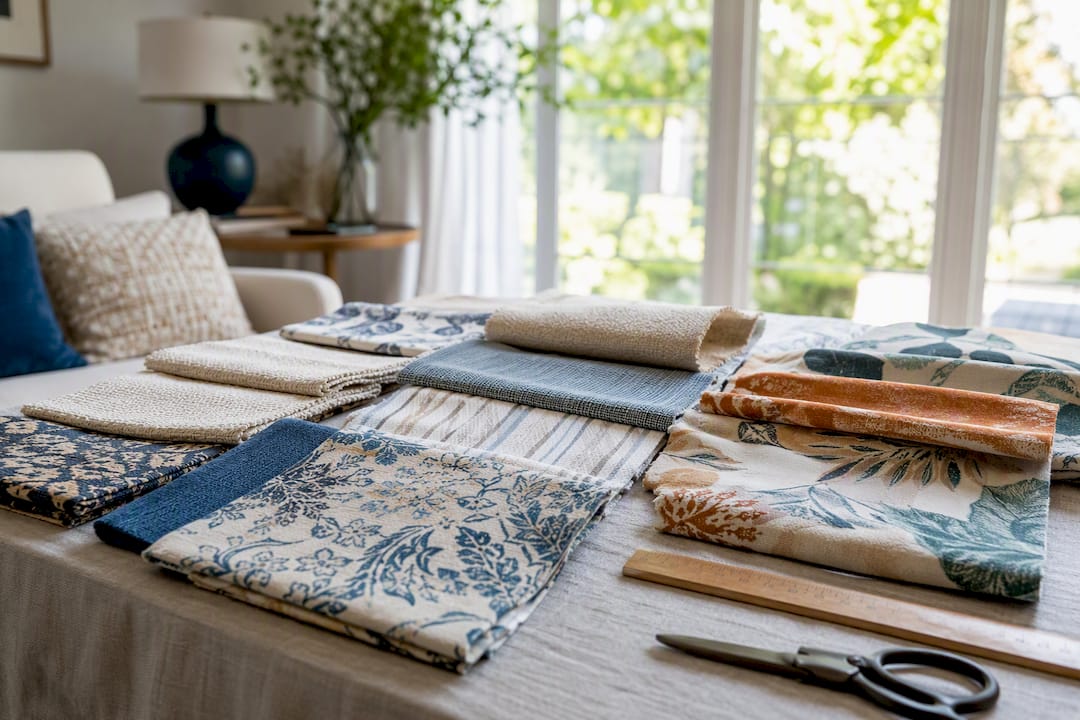
Heritage houses trade on decades or centuries of weaving tradition, often out of European mills, and they specialize in jacquards, damasks, and richly patterned silks and linens. These fabrics shine in formal living rooms, dining chairs, and pieces that get admired more than they get sat on daily. Expect higher price points, often $60 to $150 per yard or more, and expect many of these lines to be sold through design trade showrooms rather than open retail. If you’re reupholstering a rarely used wing chair or a formal settee, this is the category to splurge on.
Performance editors built their whole business around solving the “beautiful, but impractical” problem. These are the brands behind treated velvets, engineered linens, and synthetic blends that look like natural fiber but shrug off spills, pet claws, and daily use. Price points tend to run more moderate, often $30 to $80 per yard, and increasingly they’re available through both trade and direct retail channels. A performance line is the right call for a family sofa, a sunroom, or any seat that sees daily traffic from kids, pets, or guests.
Sustainable and eco-focused brands emphasize recycled fibers, organic cotton, low-impact dyes, or closed-loop manufacturing. Pricing varies widely depending on certification and fiber source, but expect to pay a premium over conventional cotton or polyester blends for genuinely certified organic or recycled content. This archetype fits buyers who care as much about sourcing as they do about hand-feel, and it’s become common enough in mid-range retail that you no longer need a trade account to access it.
Commercial and contract specialists design specifically for hospitality, healthcare, and office environments where fabric has to survive constant use and frequent industrial cleaning. These fabrics carry the highest double-rub ratings on the market and are usually sold in bulk through trade or contract-only channels, rarely in small cuts for a single armchair. Unless you’re outfitting a rental property or a small business waiting room, you probably don’t need to shop this category, but it’s worth knowing it exists when a residential fabric simply won’t survive the use case.
Pro Tip: If you’re torn between a heritage pattern you love and a performance fabric that’s more practical, ask whether a performance line offers that same pattern. Many performance editors now reproduce classic jacquard and damask motifs on treated bases, giving you the look without the fragility.
Matching archetype to room is really a traffic question in disguise. A living room used twice a month for company can carry a heritage linen just fine. A den where three kids and a dog pile onto the couch every evening needs a performance fabric regardless of how much you love a particular jacquard.
Upholstery Material Guide: Strengths and Tradeoffs by Fiber
Every fiber family upholstery brands work with comes with its own durability profile and its own upkeep rules, and material-by-material comparisons consistently show there’s no single “best” fiber, only the best fit for a given room.
Linen softens and develops character over time, which some buyers love and others find frustrating in a fabric that wrinkles easily and shows oil stains from skin contact. It suits low-traffic formal seating far better than a family room.
Cotton is breathable, takes dye well, and cleans easily, but on its own it lacks the abrasion resistance of a tighter synthetic blend, so cotton blends with polyester tend to outperform pure cotton on a daily-use sofa.
Wool brings natural stain and flame resistance to the table along with real durability, though it runs warmer to the touch and carries a higher price than most plant-based fibers.
Leather wipes clean in seconds and ages into a patina many buyers actively want, but it scratches under pet claws and cracks without conditioning in dry climates.
Velvet looks and feels luxurious, and modern performance velvets have closed much of the durability gap that once made it a risky choice, but budget velvets still crush and show water marks easily.
Chenille offers a soft, textured hand with decent durability for its price point, though loose weaves can snag on jewelry, buttons, or claws.
Microfiber resists stains and cleans up with mild soap and water, making it a strong pick for households with young kids or pets who need forgiveness over formality.
Polyester blends resist fading and staining better than almost any natural fiber and hold up under heavy family use, though they can feel less breathable in warm climates.
Where each fits best:
- Pets and children: microfiber, polyester blends, or a performance-treated chenille.
- Formal, low-traffic seating: linen, wool, or a heritage velvet.
- High-use commercial or rental seating: contract-rated polyester blends or treated synthetics.
Statistic to remember: natural fibers like linen soften with wear while synthetics resist fading and staining, which is the core tradeoff behind nearly every upholstery decision you’ll make.
Spot-clean most stains immediately with a mild soap and water solution, testing on a hidden area first. Save professional cleaning for leather conditioning, wool that’s developed odor, or any fabric with a “professional clean only” code on its tag, since a home attempt on the wrong fiber can set a stain rather than lift it.
How Do You Choose the Right Upholstery Fabric Brand?
Choosing among top rated fabric brands gets much simpler once you turn the decision into a short, ordered checklist rather than an open-ended browse through catalogs.
-
Define the use case and traffic level first. A guest bedroom chair and a family room sectional have almost nothing in common in terms of what they need to survive, so set your minimum double-rub requirement before you look at a single swatch. Aim for at least 15,000 for daily household use and 30,000 or higher for heavy traffic or pets.
-
Confirm the cleaning code. Fabrics carry a code such as W (water-based cleaner), S (solvent-based), WS (either), or X (vacuum only, no liquid cleaners). Skipping this step is one of the most common regrets buyers report after a spill ruins a fabric that needed a solvent cleaner they didn’t have on hand.
-
Check the finish warranty. Ask whether stain or fade protection is guaranteed for a specific number of years, and get that in writing if you’re making a significant investment in trade-only yardage.
-
Check pattern scale and repeat. A large-scale pattern on a small chair can look awkward once cut and seamed, and a designer or upholsterer needs the repeat measurement to calculate accurate yardage. This is the detail that most often causes budget surprises mid-project.
-
Confirm yardage availability before you fall in love with a fabric. Some runs are limited, and a beautiful discontinued bolt does you no good if you need six more yards for a sectional than the dealer has in stock.
-
Order physical samples and test them under real lighting. A sample-first approach catches color shifts between screen and swatch, and between store lighting and your actual living room, before you commit to yardage. Order at least two or three candidates side by side rather than one at a time.
-
Confirm lead times before you commit to a schedule. Custom drapery installers, upholsterers, and furniture makers all need a firm delivery date, and trade-only fabrics in particular can run four to eight weeks out depending on the mill.
Pro Tip: Lay your samples on the actual piece of furniture, not on a table, and look at them in the morning and again at night. Warm bulb light and cool daylight can make the same fabric read as two different colors.
This checklist works the same way whether you’re a homeowner picking a sofa fabric for the first time or a professional upholsterer specifying yardage for a client. The order matters: traffic and cleaning code eliminate wrong candidates fast, pattern and yardage prevent budget surprises, and sampling under real light is the last checkpoint before you spend real money.
Where Should You Buy and Sample Upholstery Fabric?
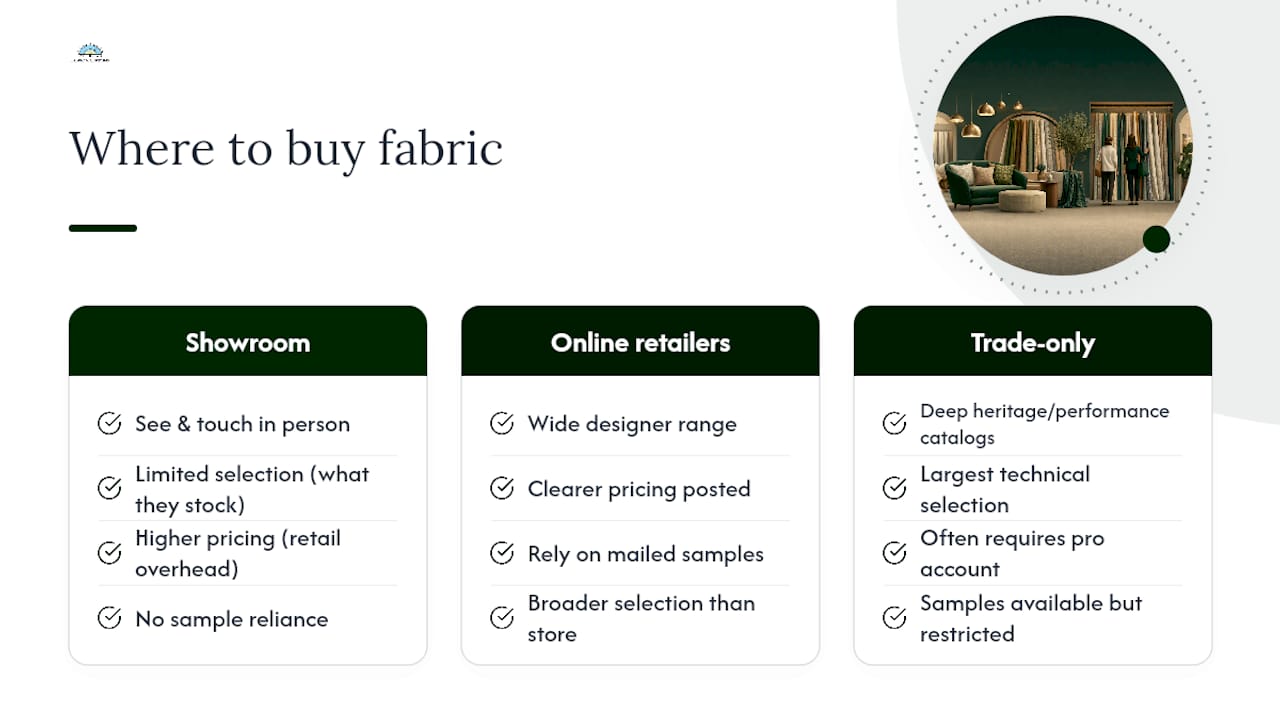
Local showrooms let you see and touch fabric in person, which is genuinely valuable for judging hand and weight, but selection is limited to what that showroom stocks and prices often run higher to cover retail overhead. Online fabric-by-the-yard retailers open up a far wider range of designer collections and typically post clearer pricing, though you’re relying on samples rather than an in-store visit to judge color and texture. Trade-only houses offer the deepest heritage and performance catalogs in the industry, but many require a design professional’s account to order, which shuts out most direct homeowners.
A sample-first workflow solves most of the friction across all three channels. Order three to five candidates rather than committing to one on sight, since fabrics almost always look different in isolation than they do side by side. Check them under both daylight and lamp light, and if pets or heavy use are a factor, rub a sample against denim or a rough towel a few dozen times to get a rough feel for how it will wear.
Run sizes and lead times deserve attention before you finalize a project timeline. A large sofa or sectional can require 15 to 25 yards depending on the piece and pattern repeat, and if a mill’s current run doesn’t have that much left, you may need to wait for the next production cycle. Confirming yardage availability at the sample stage, not after you’ve chosen a drapery installer’s calendar date, prevents the most common scheduling headache in custom upholstery work. For readers refreshing more than just seating, a guide to choosing interior door styles is a useful companion resource when fabric selection is part of a broader room refresh.
Why Trust This Guide on Upholstery Fabric Brands?
This guide draws on Beautifulwindowselgin’s direct experience curating designer fabric for homeowners, interior designers, and drapery workrooms across the country. As an online retailer based in Columbia, South Carolina, Beautifulwindowselgin sources jacquard satin, embroidered textiles, marine and utility fabrics, and upholstery-grade yardage, then ships samples and full orders nationwide.
Buyers don’t need a trade account to access high-quality upholstery fabric. They need clear guidance on durability ratings, honest material tradeoffs, and a dealer willing to send real samples before they commit to yardage.
Beautifulwindowselgin backs that approach with practical resources built for exactly this kind of decision:
- A curated collection of upholstery and drapery fabric sold by the yard, spanning multiple fiber families and finishes.
- A sample program that lets buyers test hand, weight, and color before ordering full yardage.
- Design consultations for readers planning a custom drapery or upholstery project alongside fabric selection.
- Practical buying-process guidance that walks through sampling, ordering, and lead times step by step.
A Note on Balancing Style and Durability
The tradeoff nobody likes to admit is that the fabric you fall for on sight is often not the fabric your household actually needs. Style and durability pull in opposite directions more often than buyers expect, and the households that end up happiest are the ones who set a minimum double-rub threshold before they start browsing, not after they’ve already chosen a pattern. Treat the checklist as the filter and let your eye choose only from what survives it.
— Marrion
How Beautifulwindowselgin Helps You Order With Confidence
Once you know your traffic level, cleaning code, and preferred fiber family, the fastest path forward is a curated dealer rather than a scattershot search across a dozen mill websites. Beautifulwindowselgin’s upholstery and drapery fabric collection brings designer-quality jacquard, performance synthetics, and natural fibers together in one place, sold by the yard with nationwide shipping, so you’re comparing real options instead of hunting for them one brand at a time.
If your project includes drapery alongside upholstery, the designer drapery fabric collection covers coordinating textiles at a consistent weight, and the fabric FAQ page answers the pricing and ordering questions most buyers have before checkout. Beautifulwindowselgin sells fabric and provides design consultations and installation guidance for drapery, but reupholstering an existing sofa or chair frame is a job for a local upholsterer once your fabric has arrived. Order a set of samples today, test them at home under your own lighting, and reach out for a consultation if you want a second opinion before you commit to yardage.
Sources
- Best Couch Fabrics: 9 Types of Upholstery Materials — The Spruce
- High-End Upholstery Fabrics: The Must-Know Brands (A–Z) — Hart Design Selection
- Finishes and Fabrics: An introduction to upholstery fabrics — Lorfords
Recommended
- Upholstery Fabric Types: A Practical Guide for 2026 – Fabric Store in Columbia, SC | Drapery Making Services
- Upholstery Fabric List: A Complete Guide for 2026 – Fabric Store in Columbia, SC | Drapery Making Services
- Tips for Selecting Upholstery Fabric: A Practical Guide – Fabric Store in Columbia, SC | Drapery Making Services
- Upholstery Material Checklist: Your Complete Fabric Guide – Fabric Store in Columbia, SC | Drapery Making Services