

Colorfastness Explained: What Fabric Buyers Need to Know
Colorfastness is a textile’s resistance to fading, bleeding, or staining when exposed to washing, sunlight, perspiration, and friction — and understanding its role shapes every smart fabric purchase. Whether you’re selecting upholstery fabric for a high-traffic sofa or choosing drapery for a sun-drenched room, the color performance built into a fabric at the dyeing stage determines how it looks five years from now. Industry bodies like AATCC, ISO (through the ISO 105 textile testing series), and Cotton Incorporated have developed standardized methods to measure and report this performance reliably.
Three practical takeaways to keep in mind:
- Appearance protection: High colorfastness preserves the original color and pattern through repeated use and cleaning, keeping textiles looking as intended.
- Fewer returns and less waste: Fabrics that hold color reduce consumer complaints, returns, and premature disposal — a direct sustainability benefit.
- Smarter care decisions: Knowing a fabric’s fastness rating guides the right wash temperature, detergent choice, and sun exposure limits before damage occurs.
Key Takeaways
Colorfastness determines how long a fabric retains its original color under washing, light, friction, and perspiration — and the outcome is largely set during the dyeing and wet-processing stage, not after purchase.
| Point | Details |
|---|---|
| Definition and scope | Colorfastness measures resistance to fading, bleeding, and staining across wash, light, rub, and sweat conditions. |
| Standards to reference | AATCC and ISO 105 series ratings (wash 1–5, lightfastness 1–8) are the benchmarks to request on any spec sheet. |
| Lightfastness benchmark | An industry reference for indoor upholstery is 40 hours of UV exposure with no visible fading. |
| Top care habit | Wash colored fabrics inside-out in cold water with a color-safe detergent to slow dye loss. |
| Sustainability link | Higher colorfastness extends product life, reducing replacement frequency and textile waste. |
Table of Contents
- The role of colorfastness: main types and everyday examples
- Why some fabrics keep color better than others
- How industry standards and rating scales report colorfastness
- What common lab tests actually simulate
- How to check colorfastness before buying or after receiving fabric
- Everyday care practices that slow color loss
- Why colorfastness matters for durability, returns, and sustainability
- Signs that colorfastness is failing and when to act
- A retailer’s perspective on choosing colorfast fabrics
- Sources
The role of colorfastness: main types and everyday examples
Colorfastness is not a single property — it describes resistance across several distinct stress conditions, each mapped to a real-world scenario.
- Wash (laundering) fastness: A brightly dyed cotton shirt that bleeds onto lighter garments in the wash — this is wash fastness failing.
- Lightfastness: Curtains hung in a south-facing window that fade to a washed-out version of their original color within a season.
- Rub/crocking fastness: Dye transferring from a dark upholstered sofa arm onto light-colored clothing after regular contact.
- Perspiration fastness: A synthetic athletic shirt developing pale patches under the arms after repeated workouts.
- Water fastness: A linen throw pillow that loses color when it gets wet from a spill or humid conditions.
- Chlorine fastness: Swimwear or pool-adjacent textiles that fade rapidly after exposure to chlorinated water.
- Dry-cleaning fastness: Delicate embroidered or structured fabrics that lose color depth after professional solvent cleaning.
- Ironing/heat fastness: A printed fabric that transfers dye onto the ironing board cover or changes shade under a hot iron.
For window treatments and drapery, lightfastness is the dominant concern. For clothing and upholstery, wash and rub fastness typically matter most. Matching the right fastness priority to the end use is the first step toward a durable purchase.
Why some fabrics keep color better than others
Color retention depends on a chain of decisions made long before a fabric reaches a store shelf. The most significant factors are fiber chemistry, dye class, and wet-processing choices.
Fiber type sets the baseline. Cellulosic fibers like cotton and linen have a different molecular structure than synthetics like polyester or nylon, which means they accept and hold dyes differently. Polyester, for example, requires disperse dyes applied under heat and pressure — a process that produces strong dye-fiber bonds and generally high wash fastness. Cotton dyed with reactive dyes forms covalent bonds with the fiber, which also delivers good performance when the process is well controlled.
Dye class matters enormously. Reactive, vat, sulfur, and disperse dyes each bond to fibers through different mechanisms, and peer-reviewed analysis of dye-fiber bonding confirms that the chemistry of dye desorption under stress directly informs how laboratory tests are designed and interpreted. Vat dyes on cotton, for instance, tend to deliver superior lightfastness compared to direct dyes, which are cheaper but less stable under UV exposure.
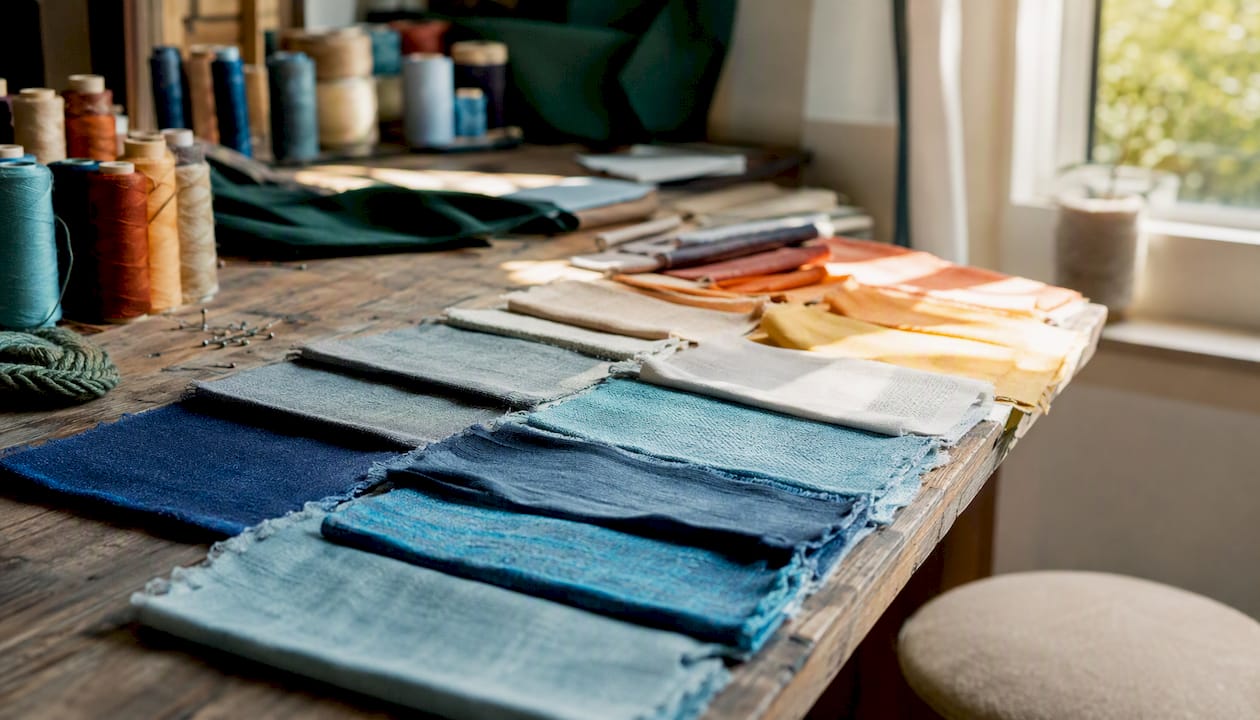
Wet-processing and finishing are where most of the outcome is decided. Cotton Incorporated’s technical guidance states plainly that dye selection during wet-processing has the most significant effect on final colorfastness performance. Finishing treatments like resins, softeners, and enzymes can either protect or compromise dye bonds depending on how they interact with the dye class chosen.
On the consumer side, wash temperature, agitation level, detergent chemistry, and sunlight exposure all accelerate dye loss after purchase.
Pro Tip: When reviewing a fabric spec sheet, check whether the listed dye class matches the end use. A fabric dyed with direct dyes may show acceptable wash fastness in a lab test but degrade faster under prolonged UV exposure — a tradeoff that matters for curtains far more than for a throw pillow.
- Fiber type (cellulosic vs. synthetic) determines which dye classes bond effectively.
- Dye class governs bond strength under washing, light, and mechanical stress.
- Wet-processing conditions (temperature, pH, fixation time) affect how completely dye bonds to fiber.
- Finishing auxiliaries (softeners, resins, enzymes) can alter dye stability after dyeing.
- Consumer laundering habits (hot water, heavy agitation, enzyme detergents) accelerate dye desorption.
How industry standards and rating scales report colorfastness
Two organizations set the testing framework used across the U.S. textile industry: AATCC (American Association of Textile Chemists and Colorists) and ISO (through the ISO 105 series). Both publish standardized methods that labs follow when generating the ratings printed on spec sheets and quality certificates.
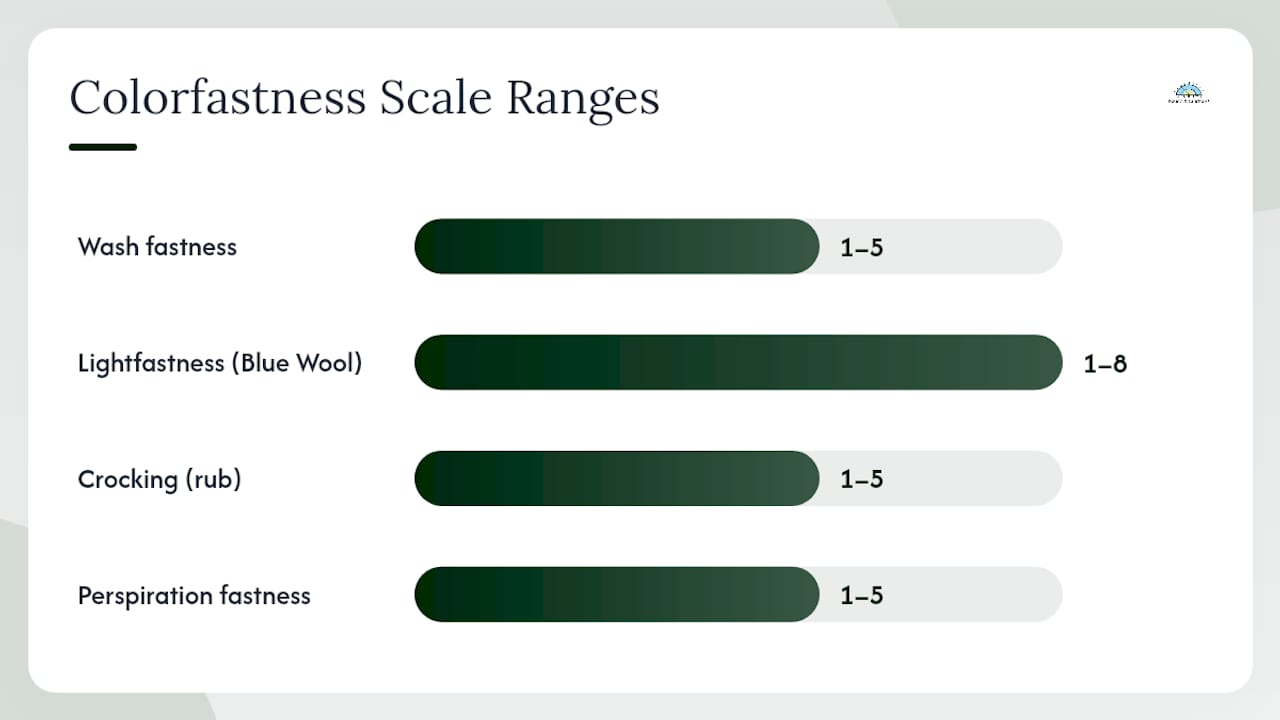
Ratings are expressed on numeric scales. According to Testex, visual grey-scale assessments and reference systems like the Blue Wool scale are the standard tools for assigning those numbers. The Blue Wool scale uses eight reference wool samples dyed to progressively higher lightfastness levels, giving labs a physical anchor for rating light-exposed specimens.
| Property | Scale | Rating 1 (poor) | Rating 5 or 8 (excellent) | Common standard |
|---|---|---|---|---|
| Wash fastness | 1–5 | Severe color change or staining | No change or staining | AATCC 61 / ISO 105-C06 |
| Lightfastness | 1–8 | Rapid fading under minimal exposure | No fading after extended exposure | AATCC 16 / ISO 105-B02 |
| Crocking (rub) | 1–5 | Heavy dye transfer to rubbing cloth | No dye transfer | AATCC 8 / ISO 105-X12 |
| Perspiration fastness | 1–5 | Significant color change and staining | No change or staining | AATCC 15 / ISO 105-E04 |
On a lab report, you will typically see the method name (e.g., AATCC 61), the test condition (number of wash cycles, temperature), and a numeric rating for both color change and staining. A wash fastness rating of 4 or above is generally considered acceptable for apparel; lightfastness ratings of 4 or above are a common minimum for interior textiles.
- AATCC standards are the primary reference for U.S. domestic testing and procurement.
- ISO 105 series standards are used in international trade and often appear on imported fabric spec sheets.
- The Blue Wool scale provides a physical, reproducible reference for lightfastness assessment.
- Grey-scale cards assess color change (how much the tested specimen faded) and staining (how much dye transferred to an adjacent white cloth).
What common lab tests actually simulate
Laboratory colorfastness tests are designed to compress months or years of real-world exposure into hours of controlled stress. Each method replicates a specific consumer scenario, which is why reading the method name on a report tells you exactly what stress was simulated. Eurofins notes that reliable testing against real-world stresses is what reduces consumer complaints and product returns.
- Accelerated wash test (AATCC 61 / ISO 105-C06): Simulates multiple home laundering cycles in a short time using a rotating steel cylinder with steel balls; replicates repeated machine washing.
- Xenon arc light test (AATCC 16 / ISO 105-B02): Exposes fabric to a xenon arc lamp that mimics the full solar spectrum; simulates months of window or outdoor sun exposure.
- Crockmeter rub test (AATCC 8 / ISO 105-X12): Rubs a white cloth against the fabric under controlled pressure, both dry and wet; simulates friction from clothing contact or upholstery use.
- Perspiration test (AATCC 15 / ISO 105-E04): Immerses fabric in an artificial sweat solution and applies pressure; simulates skin contact during physical activity.
- Water immersion test (ISO 105-E01): Soaks fabric in distilled water; simulates rain, spills, or humid storage conditions.
- Chlorine water test (AATCC 162): Exposes fabric to chlorinated water; simulates pool use or chlorinated tap water in laundering.
- Dry-cleaning simulation (ISO 105-D01): Uses solvent solutions to replicate professional dry-cleaning cycles.
A lab report lists the method, the test parameters (temperature, number of cycles, concentration), and the numeric rating. A rating of 4–5 on wash fastness or 4–8 on lightfastness indicates fabric suitable for most residential applications.
How to check colorfastness before buying or after receiving fabric
You don’t need a lab to catch obvious colorfastness problems. A few targeted checks at the point of purchase or on delivery can reveal likely issues before fabric is cut and sewn.
- Read the label or spec sheet. Look for AATCC or ISO test references and numeric ratings. A spec sheet that lists no fastness data is a gap worth questioning.
- Request a swatch or sample. Order a small cutting before committing to yardage. Beautifulwindowselgin’s fabric FAQ page explains how to request samples before placing a full order.
- Run a wet rub test at home. Dampen a white cotton cloth and rub it firmly against an inconspicuous area of the fabric (an inside seam or selvedge edge) for 10 strokes. Significant color transfer onto the white cloth signals poor wet crocking fastness.
- Pre-wash a small sample. Cut a 6-inch square, wash it at the temperature you plan to use, and compare it to an unwashed piece. Visible fading or bleeding after one wash is a reliable warning sign.
- Ask the retailer for test certificates. A reputable supplier can provide the test method name, rating, and the lab that issued the result. If that documentation isn’t available, ask which dye class was used.
- Check care labels for temperature limits. A “cold wash only” instruction on a deeply saturated color often signals that the dye is sensitive to heat agitation.
Pro Tip: Order two swatches of any fabric you’re considering for curtains or upholstery. Place one in direct sunlight for two to four weeks and keep the other in a drawer. The difference in color depth between the two samples is a reliable preview of how the fabric will perform near a window.
Everyday care practices that slow color loss
How a textile is cared for after purchase determines how long it retains the color performance it left the factory with. These habits make a measurable difference.
Do:
- Wash garments and removable covers inside-out to reduce surface abrasion.
- Use cold water (60°F or below) for colored fabrics; heat accelerates dye desorption.
- Choose a color-safe, pH-neutral detergent without optical brighteners or activated bleach.
- Reduce wash load size so fabrics move freely with less mechanical friction.
- Add a fabric softener in the final rinse to reduce fiber-to-fiber abrasion.
- Air-dry or tumble-dry on low heat; high heat degrades dye bonds and weakens fiber structure.
- Line-dry in shade rather than direct sunlight to limit UV exposure between washes.
Don’t:
- Use chlorine bleach on colored textiles, even diluted — it breaks dye bonds rapidly.
- Overload the washing machine; crowded loads increase mechanical abrasion significantly.
- Soak colored fabrics in hot water for extended periods.
- Leave wet colored items in a pile or in the drum after the cycle ends.
For curtains and upholstery, the care approach shifts slightly. Rotate cushion covers periodically so sun exposure is distributed evenly. Custom window treatments with UV-protective interlining or blackout lining shield the face fabric from direct solar radiation, extending color life considerably. Enzyme-based detergents, while effective on stains, can degrade certain dye-fiber bonds in natural fibers — use them selectively on colored cotton or linen.
Why colorfastness matters for durability, returns, and sustainability
The connection between colorfastness and product longevity is well established in the industry. Eurofins frames colorfastness as both a quality-control metric and a sustainability lever: fabrics that hold color reduce returns, extend product lifespan, and lower the volume of textiles discarded prematurely. A garment or curtain that fades within a year is effectively a single-use product regardless of its structural durability.
For indoor upholstery, Revolution Fabrics notes that an industry benchmark for acceptable lightfastness is 40 hours of direct xenon or artificial UV exposure with no visible fading. Fabrics that meet or exceed this threshold are significantly less likely to show sun damage within the first few years of residential use near windows.
The sustainability argument is direct: better fastness means longer useful life, fewer replacement purchases, and less textile waste entering landfills. Cotton Incorporated’s technical guidance reinforces that wet-processing decisions made at the manufacturing stage are the primary driver of this outcome — which means the quality of a fabric’s colorfastness is largely determined before it reaches the consumer.
- Poor colorfastness is a leading cause of consumer returns in apparel and home textiles.
- Fabrics with high lightfastness ratings reduce the frequency of curtain and upholstery replacement.
- Longer product life directly reduces the environmental cost of textile production per year of use.
- Retailers and manufacturers who test and certify fastness performance face fewer compliance issues in regulated markets.
Signs that colorfastness is failing and when to act
Colorfastness failure is rarely sudden. It shows up as a gradual pattern of visible changes that, once recognized, help you decide whether to treat, repair, or replace.
Red-flag symptoms:
- Uneven fading across a fabric panel, particularly near seams or folds where dye concentration differs.
- Dye transfer onto light-colored clothing after contact with upholstery or bedding.
- Patchy sun-fading concentrated near window edges while the center of a curtain remains deeper in color.
- Persistent staining on adjacent materials (cushion covers, pillowcases) that doesn’t wash out.
- Significant color loss after the first or second wash, well beyond what a pre-wash swatch test predicted.
When to repair vs. replace:
- Repair or treat: If the fabric structure is intact and fading is mild or localized, professional re-dyeing or color restoration is worth considering. Spot-cleaning with a color-matched product can address isolated staining.
- Replace: When structural wear (thinning, pilling, fraying) accompanies color loss, the fabric has reached the end of its useful life. Replacing at this stage is both more practical and more cost-effective than attempting restoration. For window treatments in sun-heavy rooms, selecting a replacement fabric with a documented lightfastness rating of 4 or above on the ISO 105-B02 scale prevents the same problem from recurring.
Sustainability and cost both favor replacement when color loss is accompanied by physical degradation. A fabric that has lost both its color and its structural integrity offers no further return on repair investment.
A retailer’s perspective on choosing colorfast fabrics
Selecting fabric for a client’s home is as much about predicting performance as it is about aesthetics. When I review a fabric for a drapery or upholstery project, the first question isn’t “Does it look beautiful?” — it’s “Where will this fabric live, and what will it face?” A rich jewel-toned velvet that performs beautifully in a north-facing study will fade noticeably within two seasons if placed in a west-facing sunroom without protective lining.
Requesting test reports before committing to a fabric is standard practice, not an extra step. A spec sheet that lists an AATCC 16 lightfastness rating of 4 or above gives a client a reasonable expectation of color stability near windows. For upholstery in high-contact areas, a crocking fastness rating of 4 or above on AATCC 8 is the threshold worth insisting on. When test data isn’t available, ordering swatches and running a simple home exposure test — as described earlier in this article — provides a working preview.
At Beautifulwindowselgin, design consultations include guidance on fabric placement, lining choices, and care requirements so clients understand what they’re buying before the first yard is cut. Fabric samples are available for this reason: a swatch in your actual room, under your actual light, tells you more than any product photograph.
Sources
The following references cover testing standards, technical guidance, and retailer resources for verifying colorfastness claims and selecting well-tested fabrics.
- Colorfastness of Cotton Textiles (Technical bulletin) - Cotton Incorporated
- Ensuring textile colourfastness — Eurofins
- Colour fastness
- Color Fastness Basics: Rating and Assessment - Testex
- JSTOR: Dye-fiber interaction study
Recommended
- Understanding fabric durability for lasting home textiles – Fabric Store in Columbia, SC | Drapery Making Services
- Explaining Fabric Durability for Home Decor Projects – Fabric Store in Columbia, SC | Drapery Making Services
- Upholstery Fabric Checklist: A Practical Guide – Fabric Store in Columbia, SC | Drapery Making Services
- The Role of Fabric Durability in Interior Design Choices – Fabric Store in Columbia, SC | Drapery Making Services