


Upholstery materials: durability, compliance, and style
TL;DR:
- Choosing upholstery fabric based solely on abrasion ratings is misleading, as other factors like lightfastness and pilling significantly impact durability. Real-world performance depends on environmental conditions, foam quality, and safety standards, which cannot be assessed through lab tests alone. Carefully matching materials to usage and environmental stresses ensures long-lasting, safe, and visually appealing upholstered furniture.
Choosing upholstery fabric based on abrasion ratings alone is one of the most common mistakes homeowners and interior designers make. A fabric rated for heavy-duty use can still fade within a season if it lacks proper lightfastness, or pill mercilessly in a home with active pets. True material selection involves layered decisions that span performance metrics, real-world use conditions, foam quality, and safety compliance. This guide walks you through each of those dimensions so you can make confident, well-informed choices for every custom project.
Table of Contents
- What really matters in upholstery materials
- How durability is measured: Beyond abrasion tests
- Performance for your space: Matching material to real-world needs
- Foam and filling: The unseen foundation of upholstered comfort
- Fire safety compliance: What U.S. regulations require
- The uncomfortable truth: Why perfect lab numbers rarely mean perfect real-life upholstery
- Ready to upgrade your space? Here’s how to elevate your upholstery choices
- Frequently asked questions
Key Takeaways
| Point | Details |
|---|---|
| Durability is multidimensional | Consider abrasion, pilling, fading, and cleanability when choosing upholstery materials. |
| Performance depends on context | The right fabric for you depends on room use, sun exposure, and pets—not just looks. |
| Cushion quality is critical | Foam density and firmness are as important as fabric for comfort and longevity. |
| Compliance ensures safety | Make sure your custom upholstery meets U.S. flammability standards for every material layer. |
| Lab numbers are only guides | Test results help, but real-life factors ultimately dictate how materials perform at home. |
What really matters in upholstery materials
To make informed custom upholstery choices, you first need the full picture of what makes a quality material. Most buyers focus on a single number, an abrasion rating printed on a fabric spec sheet, and assume the work is done. That’s rarely enough.
As noted in upholstery research, abrasion resistance is only one dimension of durability. Pilling, fuzz, lightfastness, and cleanability each describe a separate failure mode that a high abrasion rating won’t prevent. A fabric can pass rigorous rub testing and still look worn after a year of sunlight and daily use.
When evaluating an upholstery material, consider all of the following:
- Abrasion resistance: How well the fabric holds up under repeated friction
- Pilling resistance: Whether the surface develops small fiber balls from surface wear
- Lightfastness: How resistant the dye and fiber are to fading from UV exposure
- Cleanability: Whether stains can be removed without damaging the weave or finish
- Tensile strength: The fabric’s ability to resist tearing under tension at seams and stress points
- Moisture resistance: Relevant for high-humidity rooms or homes with children and pets
Pro Tip: Always request a full performance spec sheet from your fabric supplier, not just the abrasion double-rub count. The lightfastness and pilling ratings are equally important for residential upholstery projects.
Understanding how to choose upholstered fabrics for your specific situation means factoring in traffic levels, sun exposure, and whether pets or children will interact with the furniture daily. These environmental conditions determine which failure modes are most likely, and therefore which ratings matter most to you.
How durability is measured: Beyond abrasion tests
With durability’s many dimensions in mind, let’s clarify how testing and standards intersect with daily use.
The two dominant abrasion test methods used in upholstery fabric evaluation are the Wyzenbeek and Martindale tests. Wyzenbeek rub testing (ASTM D4157) is the standard method used in the United States, measuring durability by rubbing fabric back and forth against a wire mesh or cotton duck cloth. The resulting “double rub” count tells you how many passes the fabric withstood before showing visible wear. Martindale testing, more common in Europe, uses a circular rubbing motion and is measured in cycles rather than double rubs.
Here’s a practical comparison to set realistic expectations:
| Double-rub count (Wyzenbeek) | Recommended use | Typical residential application |
|---|---|---|
| 3,000 to 9,000 | Light duty | Decorative pillows, bedroom chairs |
| 9,000 to 15,000 | Medium duty | Occasional-use chairs, guest rooms |
| 15,000 to 25,000 | Heavy duty residential | Sofas, dining chairs, family rooms |
| 25,000 and above | Extra heavy or commercial | High-traffic living rooms, rental properties |
These numbers are useful benchmarks. But here’s what spec sheets don’t show: fabrics that pass with high double-rub counts can still fail early if fading or pilling dominate the wear pattern. Abrasion numbers alone can mislead when the primary stressor in a room is UV exposure or friction-heavy pet interaction rather than simple surface abrasion.
A fabric with 30,000 double rubs still requires UV protection in south-facing rooms. No abrasion test simulates six hours of direct sun each day.
Common failure risks in home upholstery, when mapped against room conditions, look quite different from what test numbers suggest. Exploring designer fabric examples for upholstery gives a clearer sense of which textile constructions tend to resist multiple failure modes simultaneously. Woven jacquards, for instance, tend to hold structure well under abrasion, while solution-dyed fibers offer superior resistance to fading.
Looking at trending curtain fabrics also reveals which fiber types are gaining favor precisely because they balance visual appeal with measurable performance across multiple dimensions.
Performance for your space: Matching material to real-world needs
Now that you understand how materials are measured, let’s see how to connect the science to your home’s specific needs.
Upholstery material performance depends on the project’s actual use conditions, including traffic level, pet presence, and sunlight exposure, far more than it depends on aesthetic preference alone. A fabric that’s ideal for a formal sitting room could fail in a family room within months.
Follow this three-step process to match material to project:
- Define the use environment. Note daily traffic, the number of users, whether pets have access, proximity to windows, and the room’s humidity level.
- Identify the dominant stressors. Based on that environment, determine which failure modes are most likely: abrasion, fading, pilling, moisture, or tearing.
- Filter fabrics by the stressor profile. Prioritize fabrics that score well on the metrics aligned with your dominant stressors, then select for color and pattern within that filtered group.
The table below aligns common residential use cases with the upholstery features they call for:
| Room or use case | Primary stressor | Recommended features |
|---|---|---|
| Living room with pets | Claws, friction, fur | Tight weave, high pilling resistance, dark or textured patterns |
| South-facing sunroom | UV exposure | Solution-dyed fibers, high lightfastness rating |
| Dining chairs with children | Food, liquids, daily friction | High abrasion resistance, moisture-resistant finish |
| Master bedroom chaise | Occasional use, aesthetics | Medium abrasion, texture appeal, drapability |
| Home office chair | Consistent sitting pressure | High density support fabric, no stretch weave |
Pro Tip: For pet-friendly rooms, choose fabrics with a tight, dense weave such as canvas or microfiber rather than loopy textures like bouclé. Looped constructions snag easily on pet claws and unravel quickly.
Helpful window treatment fabric tips often apply to upholstery in the same rooms, since UV protection and fabric weight concerns overlap. If a fabric is going on a chair near a sunny window, it should carry the same lightfastness consideration as the drapery fabric you’d select for that window.
For rooms where seating comfort directly affects how a space is experienced, understanding fabric’s impact on comfort can help you balance tactile quality with structural performance.
Foam and filling: The unseen foundation of upholstered comfort
Performance isn’t just skin deep. Your material choices below the surface matter just as much as the cover fabric.
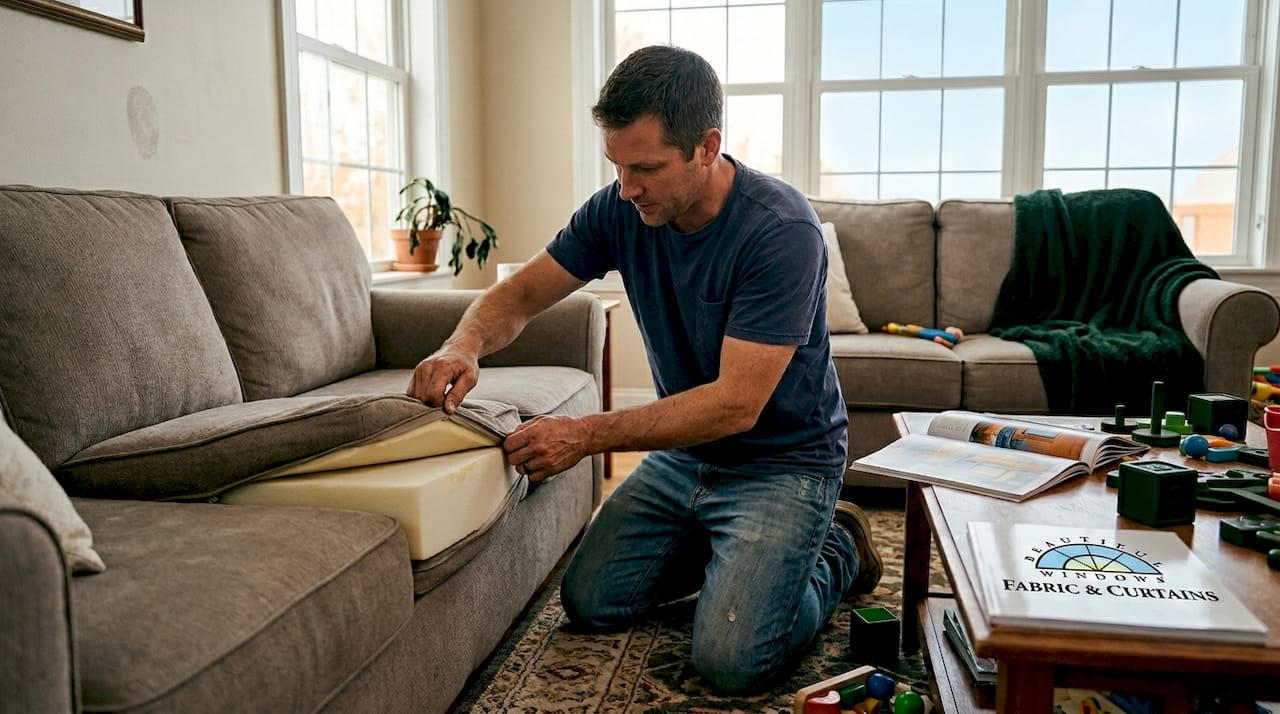
When a sofa or chair begins to sag prematurely, most people assume the fabric has failed. More often, the problem lies in the foam or filling. Density and firmness metrics such as PCF (pounds per cubic foot) and ILD/IFD (indentation load deflection) are used to benchmark durability and support. Selecting the wrong foam grade is one of the most common causes of premature sag or loss of comfort.
Here’s what those two measurements actually tell you:
- PCF (density): Measures how much foam material is packed into a cubic foot. Higher PCF means more material, greater durability, and longer-lasting shape retention. A value of 1.8 PCF is considered entry-level residential; 2.5 PCF and above is standard for quality home upholstery.
- ILD/IFD (firmness): Measures how much force is required to compress foam by 25%. Lower ILD means softer foam; higher ILD means firmer. A sofa seat cushion typically benefits from an ILD in the 35 to 45 range for balanced support and comfort.
The interaction between these two metrics matters. You can have high-density foam that is still very soft, or lower-density foam that feels firm but deteriorates quickly. Choosing high PCF and appropriate ILD for the specific piece ensures both comfort and lasting structure.
Common filling materials also include down and feather wraps, polyester fiberfill, and sinuous spring systems combined with foam. Each contributes differently to the overall seating experience. Down wraps create a luxurious surface feel but require regular fluffing and won’t hold shape as consistently as foam alone.
Pro Tip: For a sofa that will see daily use by adults, target a seat cushion foam of at least 2.0 PCF density and 35 to 45 ILD firmness. This range reliably supports body weight without bottoming out over time.
The right filling supports the textiles and comfort relationship throughout the life of the piece. A quality cover fabric placed over under-spec foam will still disappoint. Conversely, knowing how to clean a fabric sofa properly also extends the life of both the fabric and the foam by preventing moisture penetration that degrades foam density over time.
Fire safety compliance: What U.S. regulations require
Durability and comfort aside, safety and compliance are non-negotiable for U.S. homes and custom design work.
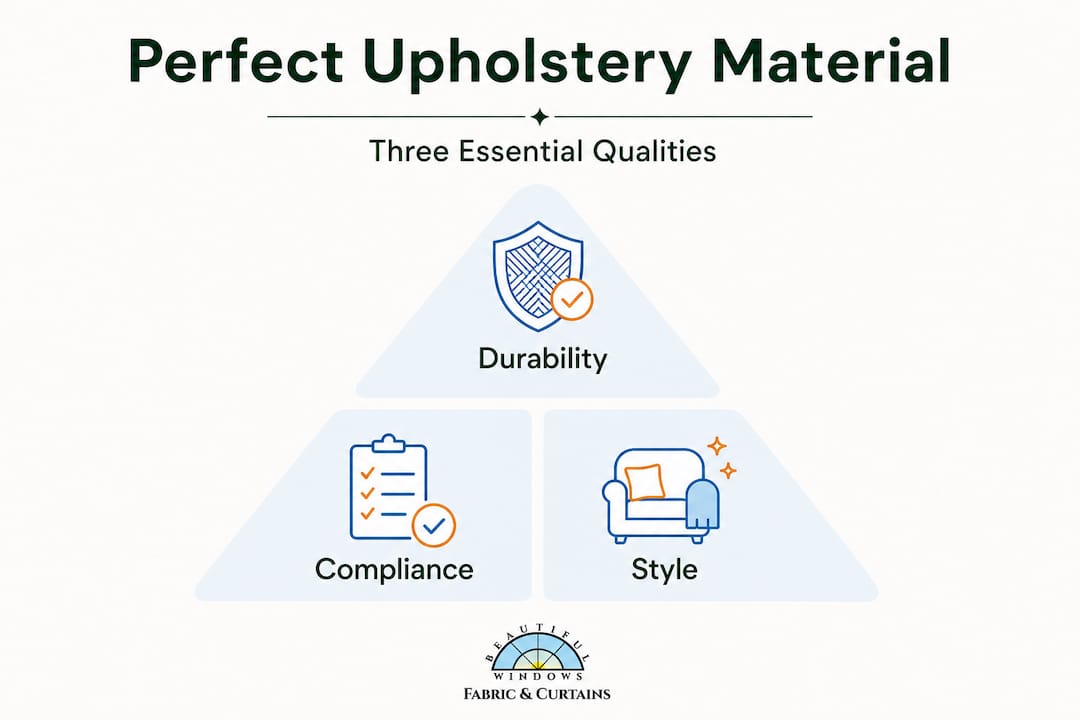
Flammability compliance in U.S. upholstered furniture centers on CAL TB 117-2013, a California standard that has been widely adopted across the country. CAL TB 117-2013 is commonly referenced as a smolder-resistance standard for upholstered furniture, and many national retailers and custom manufacturers require compliance as a baseline, regardless of the state in which the furniture will be used.
What most homeowners don’t realize is that compliance involves more than selecting a safe fabric. Fire compliance is multi-component: the cover fabric, the filling material, and any barrier or decking layer must all be selected and evaluated as part of the complete upholstered system. A compliant fabric placed over non-compliant foam may still result in a non-compliant piece.
Follow these steps to ensure your custom upholstery project meets fire safety requirements:
- Confirm your fabric’s flammability classification with your supplier. Ask specifically about CAL TB 117-2013 compliance and whether testing has been conducted on the fabric itself.
- Verify foam and filling compliance. Request documentation that the foam used meets the relevant smolder and open-flame requirements when used as part of an upholstered assembly.
- Check for barrier fabric requirements. In commercial or regulated settings, a fire-resistant barrier between foam and cover fabric may be required as part of the upholstered system.
- Request full documentation for commercial or public settings. If you’re furnishing a rental property, hotel, or any space subject to inspection, keep compliance certificates on file for each component.
Understanding these requirements is also relevant when choosing drapery fabrics, since flame-retardant considerations extend to window treatments in regulated environments. Similarly, reviewing curtain fabric types helps clarify which fiber types carry inherent flame resistance versus those requiring chemical treatment.
The uncomfortable truth: Why perfect lab numbers rarely mean perfect real-life upholstery
There’s a pattern that surfaces in professional upholstery work again and again. A homeowner, or even a seasoned designer, selects a fabric with outstanding ratings across the board. High abrasion count, good lightfastness score, clean-grade classification. The piece is delivered, installed, and admired. Then, twelve months later, it shows wear that the spec sheet never suggested was possible.
Lab ratings are guides, not guarantees. They describe controlled conditions with calibrated equipment and standardized specimens. Your living room is none of those things. Your sofa faces a combination of a large dog who circles before lying down, afternoon sun that shifts through west-facing windows in summer, and three children who use armrests as launchpads. No standardized test captures that particular matrix of stress.
The variables that drive real-world performance include the consistency of cleaning habits, the pH level of the cleaning products used, humidity fluctuations from season to season, and even the micro-texture of clothing worn by regular users. Denim, for example, is notoriously abrasive against upholstery and can accelerate pilling faster than any lab test would predict for that fiber type.
This isn’t a reason to ignore spec data. It’s a reason to treat it as one input among several. Understanding fabric and lifestyle insights gives you the fuller picture that test numbers alone won’t provide.
The most reliably satisfied upholstery clients are those who made case-by-case decisions. They started with performance data, then layered in honest assessments of their household’s actual behavior, their cleaning routines, and the visual priorities that would keep them happy with the piece for years. That combination of analysis and self-knowledge produces better outcomes than any single metric ever could.
Ready to upgrade your space? Here’s how to elevate your upholstery choices
Once you understand the real-world role of materials, partnering with professionals ensures your choices deliver lasting satisfaction. Navigating abrasion ratings, lightfastness scores, foam specs, and fire compliance documentation is a substantial undertaking for any homeowner or designer working on a custom project.
Beautiful Windows Elgin offers a carefully curated selection of premium upholstery and drapery fabrics, supported by expert guidance at every stage of your project. From jacquard satin and embroidered textiles to durable woven upholstery fabrics, each material in the collection is selected with real-world performance in mind. Explore the full range of custom upholstery solutions available, with nationwide shipping and personalized consultation to match the right material to your specific space. To start with a clear foundation, learn more about upholstery selection and use that knowledge to shop with greater confidence.
Frequently asked questions
What is the difference between Wyzenbeek and Martindale tests for upholstery fabric?
Wyzenbeek tests use back-and-forth rubs measured in double rubs and are the U.S. standard (ASTM D4157), while Martindale tests use a circular rubbing motion measured in cycles and are more commonly used in European markets. Both measure abrasion resistance but are not directly interchangeable in their numeric results.
Why do some high-abrasion fabrics still wear out quickly at home?
Pilling, fuzzing, and lightfastness can dominate fabric failure in homes with friction-heavy use or significant UV exposure, regardless of a high abrasion rating. These failure modes operate independently from what abrasion tests measure.
What performance features should I consider for a sofa in a sunny, pet-friendly room?
Prioritize solution-dyed or high-lightfastness fabrics combined with a tight, snag-resistant weave, since real-world use cases including pets and sunlight require layered performance, not just one strong rating. Also verify that the fabric carries a moisture-resistant or easily cleaned finish.
How do I know if my custom upholstered furniture is fire-safe?
Confirm that both the cover fabric and inner filling materials meet CAL TB 117-2013 smolder resistance requirements, and request written compliance documentation from your supplier or designer for each component in the system.
What does PCF and ILD mean for cushion quality?
PCF measures foam density and directly affects how long a cushion retains its shape, while ILD measures firmness; together, these metrics benchmark durability and support and selecting the wrong combination is a leading cause of premature sag.
Recommended
- Trending curtain fabrics for stylish windows in 2026 – Fabric Store in Columbia, SC | Drapery Making Services
- How fabric shapes your home’s comfort and style – Fabric Store in Columbia, SC | Drapery Making Services
- 7 Essential Curtain Fabric Types List for Homeowners – Shop Designer Fabrics by the Yard | Curtains & Drapery
- Fall Window Treatment Trends 2025: Warmth, Texture Tailored Elegance – Shop Designer Fabrics by the Yard | Curtains & Drapery