


Forest Lake Fabrics vs Boutique Drapery Workrooms for Custom Projects
Last Updated: November 8, 2026
Quick Summary
Forest Lake Fabrics is a fabric store that sells textiles by the yard, while boutique drapery workrooms sell finished window treatments made to measure, including consultation, measurement, fabrication, and installation. Choosing between them depends on how much of the project you want to own.
- A fabric store sells material by the yard; a workroom sells labor, measurement, and finished goods.
- Custom curtains are made to exact window measurements, while semicustom curtains use standard sizes with limited options.
- A drapery workroom project runs through six stages, from consultation and measurement to installation.
- Compare boutique drapery workrooms on documented scope, measurement responsibility, construction standards, written lead time, fabric transparency, and project-fit guidance.
- Confirm the damage and defect process before ordering, since custom goods are frequently non-returnable.
Table of Contents
- Forest Lake Fabrics vs Boutique Drapery Workrooms: The Core Difference
- Fabric Store or Workroom: What Each Model Actually Delivers
- The Best Fabric for Drapes: How to Judge a Store's Selection
- Custom vs. Semicustom Curtains: Where Each Option Fits
- Custom Drapery Fabrics: Matching Material to the Room
- The Drapery Workroom Project Process, Step by Step
- Criteria for Comparing Boutique Drapery Workrooms
- Choosing Your Fabric and Drapery Partner for the Project
- Frequently Asked Questions
Forest Lake Fabrics vs Boutique Drapery Workrooms: The Core Difference
Forest Lake Fabrics is a fabric store that sells textiles, while a boutique drapery workroom sells finished window treatments made to measure. That distinction sounds small.
This comparison walks through both models, because choosing between them is really a question about how much of the project you want to own.
Below, we break down what each model delivers, how to judge fabric quality, where custom and semicustom curtains split, and what a real project timeline looks like.
Fabric Store or Workroom: What Each Model Actually Delivers
A fabric store sells material by the yard; a workroom sells labor, measurement, and finished goods. Retail textile sales and workroom services such as measuring, cutting, sewing, and finishing are generally different service models, not interchangeable ones.
That framing matters more than most buyers expect.
What Forest Lake Fabrics Documents About Its Services
What the public materials do not clearly establish is the full scope of workroom services: who measures, who specifies lining and header construction, and who handles installation. That is not a criticism. It is a gap a buyer should close with direct questions before committing.
What a Boutique Workroom Adds to the Project
A boutique workroom takes the fabric decision and the fabrication decision and puts them under one roof.
The trade-off is control: you give up some DIY satisfaction and cost savings in exchange for someone else owning the outcome.
At Beautiful Windows Elgin, we run a boutique-style fabric store and drapery workroom together, which means a customer can buy designer fabric by the yard for a sewing project or request custom drapery services.
The Best Fabric for Drapes: How to Judge a Store's Selection
The best fabric for drapes balances weight, drape, light control, and durability, and a store's selection tells you quickly whether it understands that.
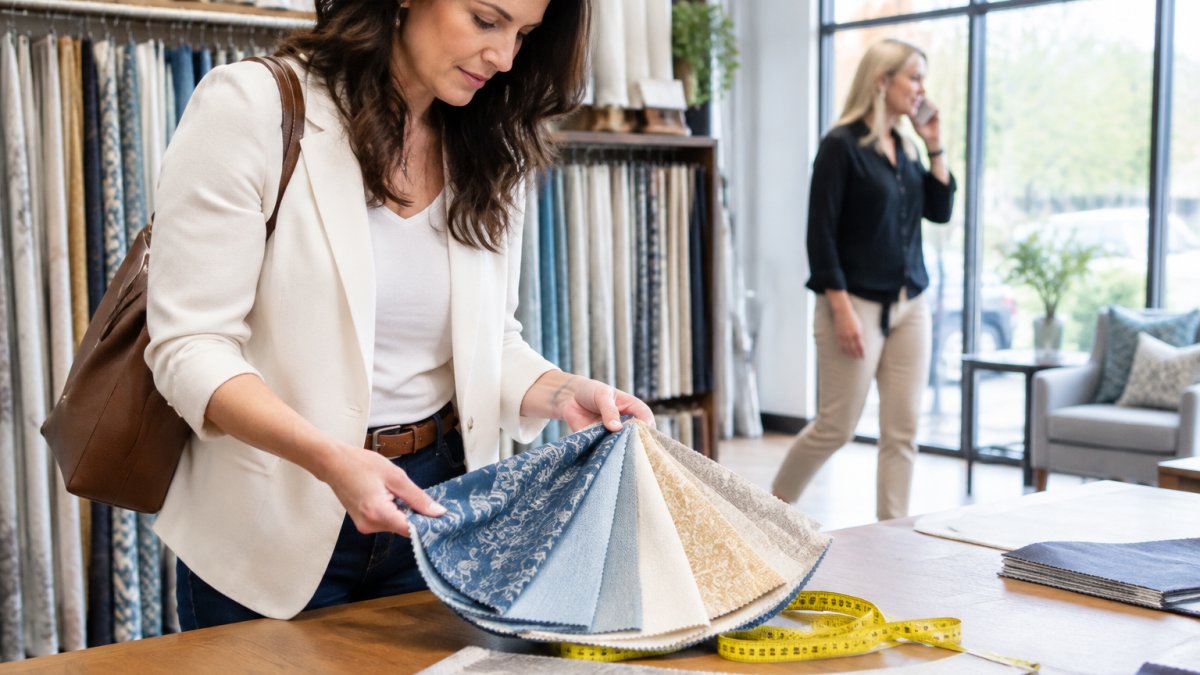
The harder question is whether the store or workroom documents construction standards alongside the goods. Here is what to look at:
- Weight and hand: Drapery fabrics generally need enough body to hang in clean folds. Very light goods can work as sheers but rarely as full panels. Ask for the fabric's weight in ounces per square yard.
- Width: Standard 54 to 56 inch goods need seams on wide windows. Extra-wide fabric avoids them. Confirm the usable width after selvage, not the nominal width.
- Fiber content: Natural fabrics like linen and cotton breathe and drape beautifully. Synthetic fabrics like polyester resist wrinkling and fading. Blends are common and often the practical choice for high-traffic rooms.
- Abrasion ratings: A double-rub count tells you how the fabric handles friction over time. Ask whether the rating is Wyzenbeek or Martindale, because the two tests are not directly comparable.
A store that publishes these details per fabric expects informed buyers. See the difference in our silver-tone polyester and cotton blend fabric sold by the yard, which states width, content, and construction up front.
Watch out: A fabric can pass every spec on paper and still fail at the window if its stretch, shrinkage, or directional nap is not accounted for.
Custom vs. Semicustom Curtains: Where Each Option Fits
Custom curtains are made to your window's exact measurements and specifications. Semicustom curtains are produced in standard sizes with limited options, then adjusted to fit.
| Option | Fit | Typical Lead Time | Best For |
|---|---|---|---|
| Ready-made | Fixed sizes, often short | Same day | Renters, quick refreshes |
| Semicustom | Standard sizes with some choice | Days to a few weeks | Standard windows, tighter budgets |
| Custom | Exact to the window | Weeks | Odd sizes, full-height windows, design intent |
Custom wins whenever the window is unusual. Bay windows, floor-to-ceiling glass, and arched openings rarely cooperate with standard sizing.
For a concrete look at what made-to-measure output involves, our tailored rod pocket custom curtain shows the construction details that separate a custom panel from a packaged one.
Custom Drapery Fabrics: Matching Material to the Room
Custom drapery fabrics should be chosen for the room's function first and its look second. A bedroom needs light control.
Buyers who start with color often end up with a beautiful fabric that fails at the window.
A few pairings that hold up in practice:
- Bedrooms and media rooms: Blackout constructions. Our gold blackout curtain fabric is built for light blocking and noise reduction at 56 inches wide.
- Living and dining rooms: Mid-weight wovens with good drape. A blue shantung-look curtain fabric reads formal without feeling heavy.
- Large openings and backdrops: Extra-wide goods. Our 110-inch wide cream polyester fabric eliminates the center seam on wide spans.
- Nurseries and soft furnishings: Coordinating prints and solids.
For color and material range across a bespoke project, browse our bespoke drapery fabric selection to see how patterns and tones sit next to each other.


The Drapery Workroom Project Process, Step by Step
A drapery workroom project runs through six stages: consultation, measurement, fabric selection, fabrication, quality check, and installation. Each stage has a handoff.
- Consultation. You describe the room, the light, and how the window needs to function. This is where blackout versus sheer gets decided.
- Measurement. Someone measures the window, the rod position, and the desired finished length. Off-the-shelf sizing does not apply here.
- Fabric selection. You choose material, lining, and header style. Yardage gets calculated from the repeat and the fullness ratio.
- Fabrication. Panels are cut, seamed, lined, and finished. This is the longest stage.
- Quality check. Hems, seams, and pleat spacing get inspected before anything ships or installs.
- Installation. Hardware goes up and panels get hung, steamed, and adjusted.
Ask upfront who handles installation.
Our custom-length drapery panels reflect the made-to-measure steps above, from specified drop to finished hem.
Criteria for Comparing Boutique Drapery Workrooms
Compare boutique drapery workrooms on six criteria: documented service scope, measurement and installation responsibility, construction standards, lead time in writing, fabric transparency, and project-fit guidance.
Here are the questions that separate a workroom that owns the outcome from one that hands off the hard parts.
1. Documented Service Scope
Ask what the workroom does versus what it leaves to you. A full-scope workroom handles consultation, measurement, fabric sourcing or approval, fabrication, quality check, delivery, and installation. A partial-scope workroom may stop at fabrication and hand off measuring or installation. Neither is wrong, but the surprise is expensive if it comes late.
- Does the workroom publish a written scope of services?
- Can it source fabric, or must you supply it?
- Does it coordinate with your contractor or designer, or only with you?
2. Measurement and Installation Responsibility
Ask who measures and whether that measurement is guaranteed. A workroom that measures and installs owns the fit. One that measures but does not install may stand behind panel dimensions but cannot control how the rod is mounted.
Watch out: Return policies on cut fabric are usually strict, and custom goods are frequently non-returnable. Confirm the damage and defect process before you order, not after.
3. Construction Standards
This is where workrooms separate most clearly. Ask specifically about:
- Lining: Is the panel lined, interlined, or unlined? Lining protects the face fabric from sun and adds body; interlining adds insulation and a softer hand.
- Seams: Are seams serged, French-seamed, or bound? A French seam hides raw edges and is a mark of higher construction.
- Pleats: What header styles are offered, pinch pleat, euro pleat, ripplefold, rod pocket, tab top, and how is pleat spacing calculated for the fullness ratio?
- Hems: How deep is the bottom hem, and is it weighted? A deep, weighted hem helps the panel hang straight.
- Hardware: What rods, brackets, and rings are specified, and are they rated for the panel weight?
4. Lead Time in Writing
Ask for lead time in writing, including the resupply policy for out-of-stock fabric. A workroom that quotes a range without a written commitment leaves you exposed if the fabric is backordered. Confirm whether the lead time starts at order, at fabric approval, or at measurement.
5. Fabric Transparency
Ask whether fabric specs are listed per item: width, content, abrasion rating, cleaning code, and repeat. A workroom that publishes these details expects informed buyers and is easier to compare against alternatives.
6. Project-Fit Guidance
Ask what project types and budgets the workroom is set up for. Some specialize in full-home drapery packages; others take single-window projects. Some have project minimums; others do not. A workroom that tells you upfront which projects it is not a good fit for is easier to trust on the ones it takes.
Best for: homeowners with non-standard windows and designers who want fabrication handled end to end.
Choosing Your Fabric and Drapery Partner for the Project
Choosing a fabric and drapery partner comes down to matching the partner's model to your project's demands.
Decide which one you are before you shop. Then ask the questions above and let the answers sort the options.
If you are ready to move from browsing to building, our mustard and blue toile fabric for custom drapes is a good place to start matching a pattern to a room.
Custom projects fail at the handoffs, not the fabric. The measurement nobody took, the installation nobody claimed, the lead time nobody wrote down.
Frequently Asked Questions
How can I compare boutique drapery workrooms before starting a project?
Ask each workroom the same five questions: who measures the windows, who sews the panels, what the lead time is, whether installation is included, and how they handle a panel that arrives wrong. A boutique drapery workroom that answers all five in writing is easier to hold to a schedule. Also ask whether they sell fabric by the yard only or also fabricate, because those are different service models with different responsibilities.
What is the difference between custom and semicustom curtains?
Custom curtains are measured for your specific windows, cut and sewn to those dimensions, and usually include choices about lining, pleat style, and fullness. Semicustom curtains come in standard sizes with some options, such as length or header style, but they are not built to your window's exact measurements. Ready-made panels are the least flexible. The trade-off is time and cost against fit: custom panels handle non-standard windows that standard sizes cannot.
What is the best fabric for drapes in a custom home project?
It depends on the room. For light control in a bedroom or media room, a blackout fabric made from 100% polyester blocks light and reduces noise. For living spaces where drape and texture matter, a woven polyester-cotton blend drapes well and resists fading. Look at the abrasion rating and the cleaning code on the listing before you buy, since those tell you how the fabric holds up and how it should be cleaned.
What should I ask a drapery workroom before starting a custom project?
Ask who takes the measurements and whether they visit the site or work from yours. Confirm the lead time in writing, and ask what happens if the fabric is out of stock. Ask whether installation is part of the service or yours to arrange. Finally, ask for a finished project example with the same window type as yours, such as an arched window or a floor-to-ceiling span.
How do I choose a fabric store for custom drapery?
Check three things: whether the store sells by the yard or only finished goods, whether it also fabricates panels, and how much of its inventory it can show you. A store with a large fabric inventory gives you more room to mix and match patterns, textures, and colors. Confirm the return policy before ordering, because many decor fabrics are final sale, and buy a sample yard to check the color against your room's light.
