


Beginner's Guide to Drapery and Fabric Weight
Last Updated: November 4, 2026
Quick Summary
Drapery fabric weight is the mass of a fabric measured per unit of area, usua
lly in GSM or ounces per square yard, and it predicts how a curtain will hang, fold, and filter light. Lightweight fabrics fall under 150 GSM, medium-weight runs 150-300 GSM, and heavyweight is over 300 GSM.
- Weight predicts behavior, not quality: a heavy fabric can hang stiffly and refuse to pleat.
- Two fabrics with identical GSM can drape completely differently due to weave, fiber, and finish.
- Medium weight, 150-300 GSM, is the safer default for bedrooms, living rooms, and dining areas.
- Finished panel weight includes face fabric plus lining plus interlining, and your rod must carry that total.
- For heavyweight and lined panels over 300 GSM, fix brackets into solid framing or proper blocking.
Table of Contents
- What Drapery Fabric Weight Actually Means
- A GSM Fabric Weight Chart for Drapery Projects
- How Weight Changes Drape, Fullness, and Light Control
- Medium Weight Fabric Examples for Everyday Curtains
- The Drapery Lining Weight Guide: Linings and Interlinings
- Matching Fabric Weight to Curtain Style and Hardware
- Shop Drapery Fabric by the Yard at Beautiful Windows Elgin
- Frequently Asked Questions
What Drapery Fabric Weight Actually Means
Drapery fabric weight is the mass of a fabric measured per unit of area, and it is the single most useful number for predicting how a curtain will hang, fold, and filter light. Weight tells you what a fabric will do before you cut a single panel.
Here is the part most beginners miss: weight is not the same as quality, and heavier is not automatically better. A heavy fabric can hang stiffly and refuse to pleat. A lighter one can look elegant or cheap depending on weave and finish. Weight is a behavior predictor, nothing more.
GSM and Ounces per Square Yard, Explained
GSM (grams per square meter) is the metric measure of fabric weight, used worldwide in textile manufacturing. Ounces per square yard (oz/yd²) is the customary measure used on many American fabric listings. Manufacturers quote one or both, and the two do not convert cleanly in your head, so keep a reference handy.
Fabric weight is measured by cutting a known area of cloth and weighing it. Because the measurement is per area, a wider fabric and a narrower fabric of the same weight behave similarly in the hand, though a wider roll gives you more usable yardage per cut.
One warning worth stating plainly: two fabrics with identical GSM can drape completely differently, as Cut Sew's fabric weight explainer notes. Weave structure, fiber type, and finish all change how cloth falls. Treat weight as one data point among several.
A GSM Fabric Weight Chart for Drapery Projects
The chart below is built for curtain making, with both units side by side.
| Weight Band | GSM Range | Ounces per Square Yard (approx.) | Typical Drapery Fabrics | Best For |
|---|---|---|---|---|
| Lightweight | Under 150 GSM | Under 4.4 oz/yd² | Sheer, voile, lace, light linen, batiste | Sheers, layering, casual curtains, small windows |
| Medium-weight | 150-300 GSM | 4.4-8.8 oz/yd² | Cotton, linen blends, polyester, medium jacquard | Everyday drapery, bedrooms, living rooms, dining rooms |
| Heavyweight | Over 300 GSM | Over 8.8 oz/yd² | Upholstery-weight, blackout, heavy jacquard, velvet | Formal drapery, light blocking, large windows, thermal panels |
A few notes on reading the chart. First, the ounce figures are approximate conversions, not exact equivalents, because mills round differently and because fabric width affects how a given weight feels in hand. Second, the boundaries are working lines, not walls: a 295 GSM fabric and a 305 GSM fabric will behave similarly, and a tightly woven 280 GSM cloth can feel heavier than an open 320 GSM one. Third, weight alone does not determine performance. Weave structure, fiber type, and finish change drape, opacity, and insulation independently of GSM, which is why two fabrics with identical numbers can hang completely differently.
For context, Classic Modern Fabrics' drapery guidance describes lightweight drapery fabric as under 150 GSM and medium-weight as 150-300 GSM, which matches the working ranges above. Other sources draw the heavyweight line at 250 GSM or at 350 GSM depending on whether they are describing apparel or upholstery. The ranges here are chosen for curtain making, where a fabric must hold a pleat, filter light, and carry its own weight over a span.
Use the chart to narrow your options, then judge drape from a sample. A number on a listing tells you where to start, not where to finish.
How Weight Changes Drape, Fullness, and Light Control
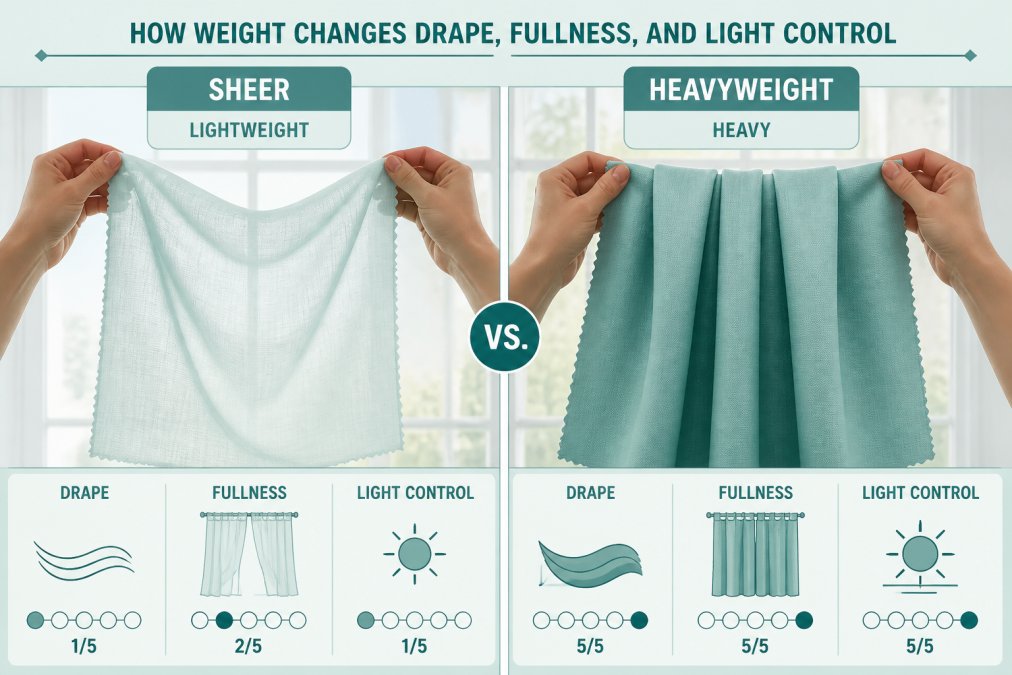
Weight governs three visible outcomes: drape, fullness, and light control. Lighter fabrics fall in soft, fluid folds and gather into tight pleats easily. Heavier fabrics hold a structured line, resist wrinkling, and block more light, but they need more fabric and stronger hardware to look right.
Fullness is where beginners get caught. A lightweight sheer at two-and-a-half times the window width looks generous. The same fullness ratio in a heavy fabric looks bulky and can overwhelm a rod. Heavier cloth often looks best at a lower fullness ratio because each fold carries more visual weight.
Light control follows the same logic. A dense, heavy weave filters more light than an open, light one, and a blackout-lined panel blocks almost all of it. If light blocking is the goal, weight and lining work together.

Medium Weight Fabric Examples for Everyday Curtains
Medium weight fabric examples are the workhorses of residential drapery: cotton, linen, polyester, and blends in the 150-300 GSM range. These fabrics balance structure and softness, hang well in most rooms, and tolerate everyday wear.
Examples from our shelves:
- Clayton Smoke Silver drapery fabric, a 100% polyester at 285 GSM, with a smooth drape and a refined silver tone suited to custom panels.
- Keaton Two-Tone Linen, a 7 oz yarn-dyed blend that brings linen texture with polyester's wrinkle resistance.
- Yorkshire natural 100% linen, a 6.7 oz linen that reads light and airy.
A common mistake is buying a heavyweight fabric for a small window. It looks heavy and stiff in a tight space. Medium weight is the safer default for bedrooms, living rooms, and dining areas.
Clayton Smoke Silver Drapery Fabric—100% Polyester—Sold by the yard →
The Drapery Lining Weight Guide: Linings and Interlinings
A drapery lining weight guide matters because lining changes the finished panel's behavior as much as the face fabric does. Linings add body, protect the face fabric from sun, and improve insulation. Interlinings add bulk and structure, pushing a medium-weight fabric toward a heavier, more formal drape.
Think of it as a stack. Face fabric plus lining plus interlining equals finished weight, and that total is what your rod and brackets must carry. A lightweight face fabric with a heavy blackout lining can end up behaving like a heavyweight panel. Plan the whole stack, not just the outer cloth.
A lined panel adds body and privacy compared with an unlined one of the same face weight. If you want a softer look, a light cotton lining adds minimal weight. If you want structure, an interlining does more of the work.
Matching Fabric Weight to Curtain Style and Hardware
Hardware selection should follow finished panel weight and span, not the other way around. The number on the fabric listing is the starting point, but the load on your rod and brackets is the finished panel weight, face fabric plus lining plus interlining plus the weight of the heading and any hardware attached to the panel. A medium-weight face fabric with a heavy blackout lining can easily behave like a heavyweight panel, and a lightweight sheer doubled for fullness can add up faster than expected.
A beginner-friendly way to estimate finished panel weight is to multiply the fabric weight by the cut area. If a fabric is listed at 200 GSM and you cut a panel 2 yards wide by 2.5 yards long, that is 5 square yards, or about 4.2 square meters, which gives roughly 840 grams, or about 1.85 pounds, for the face fabric alone. Add the lining at its own GSM over the same area, add 10-15 percent for hems, heading, and seam allowance, and you have a working estimate of what the rod must carry.
With that number in hand, match the support to the load and the span:
- Lightweight sheers (under 150 GSM): slim rods and simple brackets are usually fine. A 1-inch rod on brackets spaced no more than 4 feet apart will carry most sheer panels without sagging.
- Medium-weight panels (150-300 GSM): use a sturdier rod, at least 1¼ inches in diameter, with brackets anchored into framing or solid blocking. Space brackets closer than you would for sheers, especially on wide windows.
- Heavyweight and lined panels (over 300 GSM): choose a rod rated for the load and brackets fixed into solid framing or proper blocking. Drywall anchors alone are not enough for a heavy lined panel on a wide span. For spans over about 8 feet, add a center bracket or use a ceiling-mounted track rated for the load.
Style matters too. Pinched pleats and tailored headings suit medium to heavy fabrics that hold a crisp fold. Casual rod-pocket and tab-top styles favor lighter fabrics that gather softly. Frequently operated curtains, those you open and close daily, put repeated stress on the rod and brackets, so size up on hardware rather than down.

Watch out: hanging a heavy lined panel on an undersized rod or drywall anchors alone can pull brackets out of the wall. Match the support to the finished load and the span before you drill, and when in doubt, estimate high rather than low.
Shop Drapery Fabric by the Yard at Beautiful Windows Elgin
Choosing the right weight is easier when you can see the numbers on the listing. Every fabric we sell by the yard states its width and weight, so you can compare options against the chart above before you order.
For a polyester option, the Clayton Smoke Silver drapery fabric lets you check weight and width against this guide.
We also offer custom drapery services if you would rather hand off fabrication, including Curtain Panels. Browse the full Shop fabric collection, then order with confidence.
Frequently Asked Questions
What is a good fabric weight for curtains?
For most living rooms and bedrooms, a medium-weight fabric between 150 and 300 GSM gives the best balance of drape, privacy, and durability. Sheer voiles under 150 GSM suit layered window treatments, while heavyweight fabrics above 300 GSM work well for formal, floor-length panels. The right choice depends on the room, the curtain style, and how much light control you need.
What is the difference between GSM and ounces in fabric weight?
GSM means grams per square meter, and ounces per square yard is the imperial equivalent. Both measure the same thing: how much a given area of fabric weighs. To convert, multiply GSM by 0.0295 to get ounces per square yard. For example, a 285 GSM drapery fabric equals about 8.4 oz per square yard. Check which unit a listing uses before comparing fabrics.
How do I calculate the yardage for drapery fabric?
Measure your rod width and the finished length you want, then add 8 to 12 inches for hems and headers. Multiply the rod width by 2 to 2.5 for fullness, divide by the fabric width (often 54 to 60 inches), round up to whole widths, and multiply by the cut length. Order all yardage at once so the panels come from the same dye lot.
Do I need heavy fabric for blackout curtains?
Not always. Blackout performance comes from the lining, not the face fabric alone. A medium-weight face fabric paired with a blackout lining blocks light effectively while keeping the panel manageable on standard hardware. Heavyweight blackout fabric works for large windows, but check your rod and brackets can carry the finished panel weight before you commit.
How do I know if a fabric is too heavy for my curtain rod?
Estimate the finished panel weight by multiplying the fabric's weight per square yard by the panel area, then add lining and hardware. Compare that total to your rod's rated capacity. Solid wood or metal rods with center brackets handle heavier panels; thin decorative rods may sag. When in doubt, add a center support bracket or size up the rod diameter.
Fabric weight is the number that turns a pretty swatch into a curtain that actually hangs the way you pictured. If you are unsure which weight suits your window, our team can help you match fabric to style and hardware. Beautiful Windows Elgin offers designer fabrics sold by the yard, nationwide shipping, and custom drapery services on request. Get started with Beautiful Windows Elgin and choose fabric that performs as well as it looks.
