

The Workroom vs Spiffy Spools: What to Compare First
Last Updated: November 12, 2026
Quick Summary
The workroom vs spiffy spools comparison starts with what each company sells and how it delivers. The Workroom is best understood as a custom drapery workroom, while Spiffy Spools is better known for custom window treatments and shades. Confirm current details directly with each company before ordering.
- Compare total project cost using the same written spec sheet for each company.
- Check whether lining, hardware, shipping, sales tax and installation are included in each quote.
- Sort reviews by date and look for repeated themes on measurement accuracy and timing.
- Measure every window at least twice and use the smallest width measurement.
- Ask each company for its remake and return policy in writing before you order.
Table of Contents
- How The Workroom and Spiffy Spools Differ at a Glance
- The Workroom vs Spiffy Spools Reviews: What Customers Report
- The Workroom vs Spiffy Spools Price: Comparing Total Project Cost
- Spiffy Spools Roman Shades: Options and Fit
- Custom Sizing, Measuring, and Installation
- Fabric Samples, Lead Times, and Shipping Logistics
- What to Ask a Custom Drapery Workroom Before You Order
- Booking Your Custom Drapery Consultation at Beautiful Windows Elgin
- Frequently Asked Questions
How The Workroom and Spiffy Spools Differ at a Glance
If you are comparing The Workroom with Spiffy Spools, the first question is what each one actually sells and how it delivers. The two names come up together often, but they are not interchangeable. One is best understood as a custom drapery workroom. The other is better known for its custom window treatments and shades. Starting with that distinction saves a lot of confusion later.
Readers should confirm current details directly with each company before ordering.
The guidance here focuses on the questions that decide which option fits a given project: product type, customization, timing, and cost.
The Workroom vs Spiffy Spools Reviews: What Customers Report
Customer reviews are where many buyers start, and they are also where the evidence is weakest. This section does not assign scores. Instead, it gives you a repeatable method for reading reviews, so you can form your own view rather than relying on a star average.
Start by sorting reviews by date, not by rating. A five-star review from three years ago may describe a fabric line, a production process, or a shipping method the company no longer uses. Recent reviews are more predictive of what you will experience. Then read for these specific points:
- Measurement accuracy. Did the finished piece fit the window as ordered? Look for comments about finished width and length matching the spec sheet, not just "beautiful curtains."
- Timing. Did delivery match what was promised at checkout? Note whether the reviewer mentions a specific lead time and whether it slipped.
- Fabric match. Did the color and texture look like the sample? Dye-lot variation and screen-color differences are common, so reviews that mention a swatch comparison are more useful than ones that do not.
- Problem resolution. How did the company respond when something went wrong? A review that describes a remake, a replacement, or a refund is more informative than one that only praises or only complains.
- Construction details. Comments about lining attachment, hem depth, pleat memory, and hardware fit tell you more about craftsmanship than general praise.
When you see the same theme across several reviews from different dates, treat it as a real risk and ask the company how it handles that specific case before you order. A single strong review, positive or negative, is weak evidence on its own.
Watch out: review platforms differ in how they verify purchases and how they filter submissions. A high average on a site that does not verify buyers is not comparable to a lower average on one that does. Check the platform's verification policy before you weigh the score.
For a balanced view, read reviews on more than one platform, compare the themes rather than the averages, and ask each company directly for its remake and return policy in writing. That combination gives you a clearer picture than any single star rating.
The Workroom vs Spiffy Spools Price: Comparing Total Project Cost
Pricing is where most buyers get surprised, and it is also where most comparisons fall apart. The sticker price for a single panel or shade rarely reflects the full cost of a project, and the two businesses do not quote in the same way. Before comparing The Workroom and Spiffy Spools, build a total-cost worksheet with the same line items for each.
Use this checklist and fill in a number for every row from a written quote:
- The treatment itself. Priced by finished width and length, fabric grade, style (panel, Roman shade, valance), and fullness. A pleated panel at 2.5x fullness uses far more fabric than a flat panel at 1.5x, so ask each company what fullness multiplier its quote assumes.
- Lining and interlining. Standard lining, blackout lining, and interlining are usually separate add-ons. Confirm whether the quote includes them or lists them as upgrades.
- Hardware. Rods, brackets, finials, rings, cleats, and cord tensioners. Some quotes bundle hardware; others do not. A long span may also require a center bracket or a heavier rod, which changes the hardware tier.
- Shipping and handling. Is it included, flat-rate, or calculated at checkout by weight and distance? Oversized panels and long rods often ship by freight, which is priced differently from parcel delivery.
- Sales tax. Rates vary by state and by whether the seller has nexus in your state. A quote that excludes tax is not the final number.
- Installation. If you hire a pro, ask for a per-window or per-hour rate. If you install yourself, budget for the tools and time, especially on tall windows.
- Remakes and alterations. Ask what a remake costs if the finished piece does not match the sample or the measurements. This is the line item buyers forget, and it is the one that turns a cheap quote into an expensive project.
A quote can look lower until you add lining, hardware, and shipping, so compare the totals. That is why you should request quotes on identical specifications: same window sizes, same fabric grade, same fullness, same lining, same hardware, and same delivery address. Send each company the same written spec sheet so the quotes are truly comparable.
Request a written quote from each company covering the same window sizes and fabric grade, then compare totals rather than unit prices.
Watch out: a quote that prices "per panel" without stating the finished width and fullness is not comparable to one that prices by the window. Ask each company to restate its quote as a total for the whole room, delivered and installed, before you decide.
Beautiful Windows Elgin's pricing depends on fabric choice, quantity and delivery, and the most accurate figure comes from a direct quote on the specific project.
Pricing is easier to compare when the same line items are checked for each provider, so the checklist below sets out what a total-cost worksheet should cover.
| Cost line item | What to check | Why it matters |
|---|---|---|
| The treatment itself | Finished width, length, fabric grade, style, fullness | Fullness changes fabric use |
| Lining and interlining | Included or listed as an upgrade | Often sold as separate add-ons |
| Hardware | Rods, brackets, finials, rings, cleats | Some quotes bundle it, others do not |
| Shipping and handling | Included, flat-rate, or calculated at checkout | Oversized items may ship by freight |
| Sales tax | Rate by state and seller nexus | A quote without tax is not the final number |
| Installation | Per-window or per-hour rate | Tall windows add time and tools |
| Remakes and alterations | Cost if the finished piece does not match | Often the line item buyers forget |
Spiffy Spools Roman Shades: Options and Fit
Roman shades fold up in even horizontal pleats and suit rooms where you want a tailored, clean look without the fabric volume of full drapery.
Before you choose a Roman shade, check three things:
- Mount type. Inside mount needs enough depth in the window frame. Outside mount covers the frame and can make a small window look larger.
- Light control. Lined or blackout versions block more light than a single layer of fabric.
- Operation. Confirm whether the shade is cord-operated, cordless, or motorized.
If you want the soft fullness of curtains rather than a shade, a custom drapery workroom may be a better match. Beautiful Windows Elgin offers pinch pleat panels and tailored drapery.
Custom Sizing, Measuring, and Installation
Accurate measurement is the single biggest factor in whether a custom window treatment fits well. A homeowner measuring a large front window with a tape measure, while fabric swatches sit on a nearby table, is doing the most important step in the whole process.
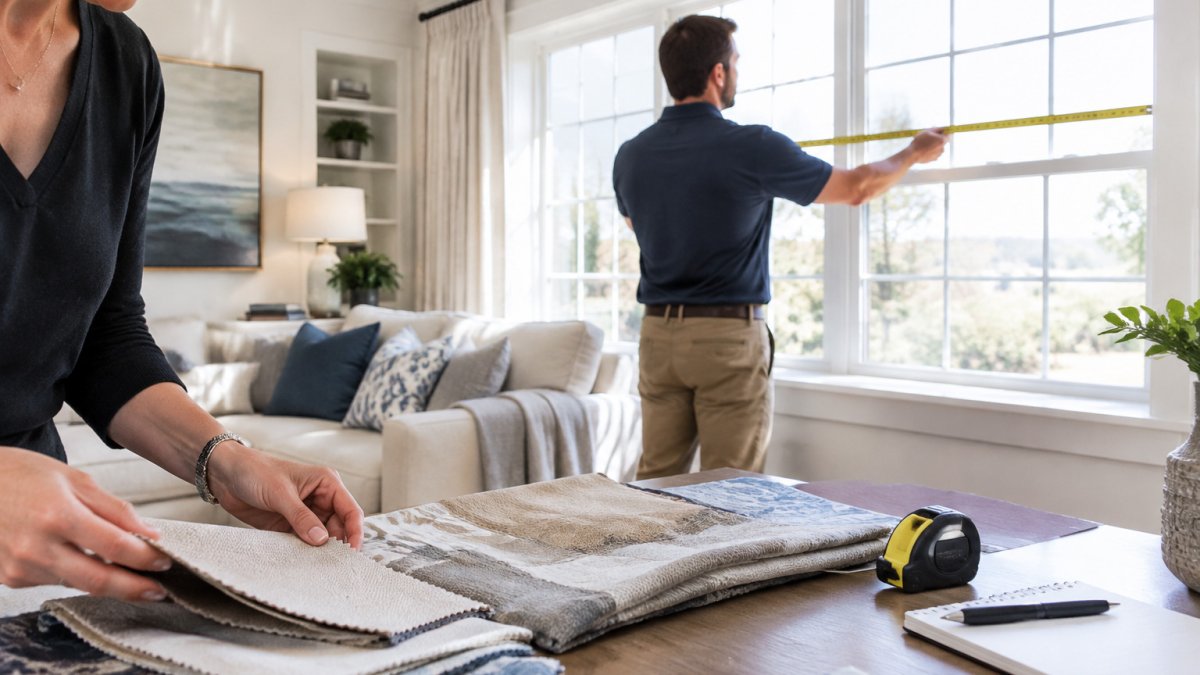
Measure every window at least twice. See a made-to-order window drapery example to understand how fit and measurements are handled. Record width at the top, middle and bottom, and height at the left, center and right. Older homes often have walls and window frames that are not square, so the smallest measurement is usually the one to use for width.

Ask each company whether it offers measuring guidance and who handles installation. Clarify the answers in writing. A non-standard window size is a common reason orders go wrong, so confirm how the company handles that case.
Fabric Samples, Lead Times, and Shipping Logistics
Lead time is often a practical difference between providers. Before you order, ask:
- Production location. Is the work done in-house or outsourced? This affects both quality control and timing.
- Lead time. How many business days pass between order confirmation and shipping?
- Shipping method and cost. Is shipping included, flat-rate, or calculated at checkout?
- Sample policy. Are fabric samples free, and how long do they take to arrive?
Samples matter more than most buyers expect. Check the fabric shipping times to see how long a swatch or order takes to arrive. Ordering a swatch and viewing it in your actual room under your actual light prevents the most common color disappointment. Review the virtual drapery consultation process before committing to an order. Beautiful Windows Elgin offers fabric by the yard, and you can shop fabric online.
For a more personal planning step, a virtual drapery consultation can help you review fabric options, lead times and logistics before you place an order.
What to Ask a Custom Drapery Workroom Before You Order
Whether you choose The Workroom, Spiffy Spools or another provider, these questions will reveal the most about how a company operates: review the fabric options you can ask about by material.
- What is the full price, including hardware, lining and shipping?
- How do you handle a measurement error, and what does that cost me?
- What is your lead time from order to delivery, in writing?
- Who installs the treatment, and is installation included?
- What fabric options are available, and can I see samples first?
- What is your return or remake policy if the finished piece does not match the sample?
For fabric-focused projects, you can also browse embroidered fabric for custom curtains to see how a specific material looks when made up.
Booking Your Custom Drapery Consultation at Beautiful Windows Elgin
Choosing between The Workroom and Spiffy Spools comes down to your window sizes, the style you want, your timeline and your budget. Request written quotes from each, check their policies in writing, and compare total cost rather than the headline price.
If you want help weighing fabric options for your own windows, start by reviewing the fabric collection.
Frequently Asked Questions
What is the difference between The Workroom and Spiffy Spools?
The two businesses differ in how they sell and produce window treatments, so the right choice depends on what you need. Compare each company's current product types, fabric selection, sizing process, lead times, shipping terms, and return policy directly on their websites, since these details change. Ask each company to confirm the total cost for your specific windows, including fabric, lining, hardware, and installation, before you decide.
Does Spiffy Spools make custom Roman shades?
Confirm Spiffy Spools' current product range and options on its website before you order. Ask about available fabrics, lining choices, mounting options, and whether they can accommodate non-standard window sizes. Request written measurement and fabrication guidance so you know what to expect.
How do custom drapery workrooms differ from online curtain retailers?
Custom drapery workrooms typically fabricate window treatments to your measurements and let you choose fabric, heading style, and lining, while online retailers often sell standard sizes. A workroom can handle unusual window dimensions and tailored details, but lead times are usually longer. Beautiful Windows Elgin offers custom drapery services on request, and pricing depends on fabric, quantity, and delivery timing, so contact the store for a quote.
Can I order fabric samples before choosing custom curtains?
Ordering fabric samples before committing to custom curtains helps you check color, texture, and light filtering in your own room, since screen colors can differ from the fabric in person. Beautiful Windows Elgin sells designer fabrics by the yard and ships nationwide, so you can compare swatches at home. Confirm sample availability and any shipping costs when you place your order.
