


Why Custom Drapery Takes Time: Real Lead Times Explained
Table of Contents
- Why Custom Drapery Takes Time: The Short Answer
- Custom Curtains vs Ready-Made Curtains: What You Trade for Speed
- The Custom Drapery Process, Step by Step
- How to Measure Windows for Custom Drapery (and Why It Matters)
- Custom Drapery Lead Time: Realistic Ranges by Project Type
- What Causes Delays and How to Prevent Them
- How to Plan Around a Deadline and Evaluate a Delayed Order
- Frequently Asked Questions
Last Updated: October 18, 2026
Why Custom Drapery Takes Time: The Short Answer
Custom drapery takes time because every panel is made for one window, not pulled from a shelf. At Beautiful Windows Elgin, we tell customers to plan on several weeks from fabric selection to installation, not days. The work is measured, cut, sewn, and pressed by hand.
Here is the short answer in one sentence: custom drapery is a made-to-order product, so the timeline covers consultation, measurement, fabric ordering, workroom sewing, and installation.
That wait is the trade-off for fit. A ready-made panel fits a standard window size. A custom panel fits your window.
Most guides skip the details of where those weeks actually go. Below, we break down each stage, realistic timelines by project type, and how to protect a deadline.
Custom Curtains vs Ready-Made Curtains: What You Trade for Speed
Ready-made curtains win on speed. You can buy them and hang them the same day. Custom curtains win on fit, fabric choice, and finish, and that is where the time goes.
The pros and cons of store-bought versus custom drapery put it plainly: custom drapery is not a same-day purchase-and-hang option, and most projects take weeks.
What you gain with custom work:
- Exact fit for odd window sizes and tall ceilings
- Your fabric, including designer and embroidered options
- Proper lining for light control and privacy
- A clean drape that hangs straight instead of pulling
What you give up is speed. A ready-made panel is already sewn. A custom panel has not been cut yet.
The Custom Drapery Process, Step by Step
Every custom drapery order moves through the same basic stages. Knowing them helps you see where the calendar time goes, and most guides never break this down with realistic ranges. Here is the transparent timeline.
- Consultation (1-3 days to schedule, 1-2 hours to complete). You discuss style, fabric, budget, and the room's lighting with the workroom. This is also when you confirm whether the project is a single window or a full room, because that decision affects every later stage.
- Measurement (1-2 days to schedule, 30-60 minutes on site). A skilled installer measures the window, checking width, drop, and mounting height. The measurement visit is fast, but scheduling it around your availability and the installer's route is where the calendar days go.
- Fabric selection and ordering (1-5 days for in-stock, 2-6 weeks for special-order). You pick the fabric. If it is not in stock, the mill has to produce or ship it before the workroom can cut. This is the single largest variable in the entire timeline.
- Workroom production (1-4 weeks depending on complexity). The fabric is cut, sewn, lined, pleated, and pressed. A simple unlined panel might take a few days of workroom time; a lined, interlined, hand-set pleat can take two to three times as long per panel.
- Quality check (1-2 days). Seams, hems, and pleats are inspected before packing. Most workrooms build this into the production schedule rather than treating it as a separate wait.
- Delivery and installation (3-10 days for shipping, 1-3 days to schedule install). Panels ship or arrive, then get mounted on the hardware. If the hardware is not yet installed, add another scheduling window.
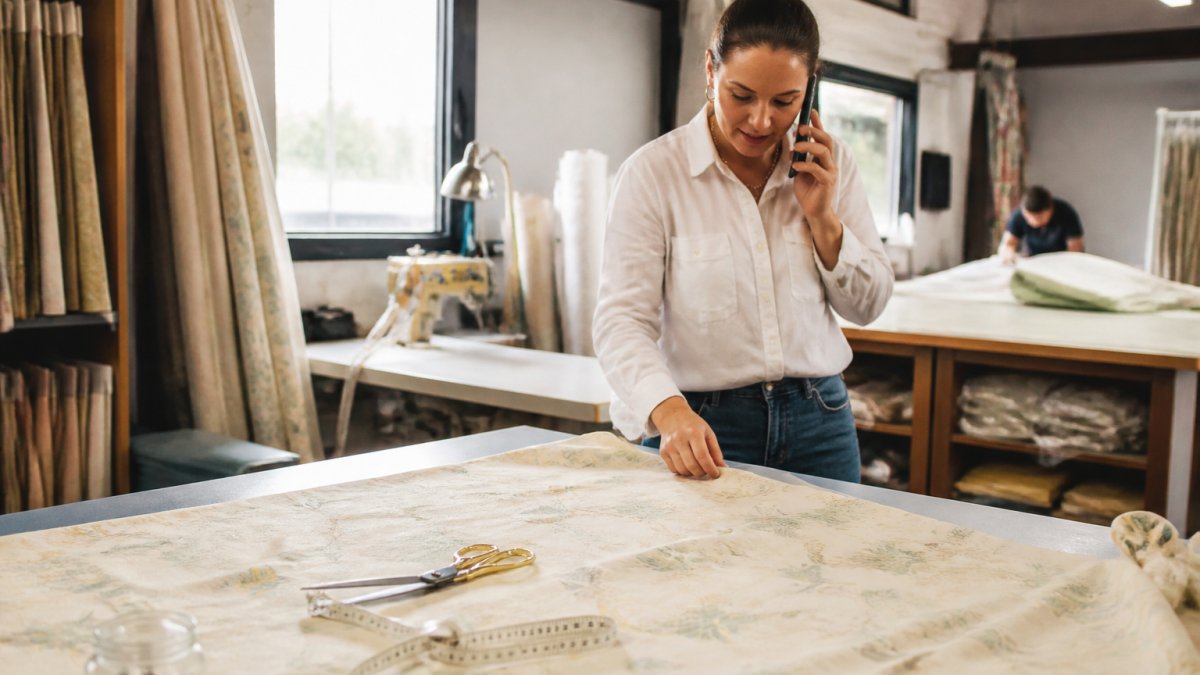
From Consultation to Workroom: What Happens at Each Stage
The consultation and measurement stages are fast in terms of actual work, a day or two to schedule, an hour or two on site. The calendar time comes from coordinating schedules, not from the work itself.
Fabric availability is the first real variable. In-stock fabric moves quickly, often within a week. Special-order fabric adds shipping time before sewing even starts, and that shipping time can range from a few days to several weeks depending on the mill's production schedule and whether the dye lot is currently running.
Sewing is the longest single stage. Lining, interlining, pleat style, and panel count all add hours. A simple single pleat panel sews faster than a lined, interlined, hand-set pleat. A common pattern is that a single unlined panel takes a few days of workroom time, while a lined and interlined panel with a complex pleat can take a week or more per panel once you account for cutting, sewing, pressing, and inspection.
How to Measure Windows for Custom Drapery (and Why It Matters)
Measuring correctly is the step that protects your whole timeline. A wrong measurement means a remake, and a remake adds weeks.
Measure width and drop in three places each, then use the smallest width and the longest drop. Decide your stack-back first, so the open panels clear the glass.
- Width: measure the rod or track span, then add overlap and return
- Drop: measure from the mounting point to the floor or sill
- Panel count: plan for fullness, not a flat sheet of fabric
If you are ordering fabric by the yard for a DIY project, our measuring and installation guidance from the window covering industry is a useful cross-check before you cut.
Custom Drapery Lead Time: Realistic Ranges by Project Type
Custom drapery lead time depends on fabric availability and design complexity, not on a single fixed number. Simple projects using in-stock fabric can move faster, while complex designs take longer.
Custom-Length Flame-Red Pinch Pleat Curtain Panel – Stylish & Easy to Hang – 5" →
guidance on custom drape production timelines notes that simple projects can beat a typical timeline, and complex designs can run past it.
| Project Type | Typical Range | Main Time Driver |
|---|---|---|
| Single panel, in-stock fabric | Shorter end of range | Sewing and pressing |
| Multiple panels, in-stock fabric | Standard range | Panel count and lining |
| Special-order fabric | Standard plus shipping | Fabric availability |
| Lined and interlined, pleated | Longer end of range | Hand detailing |
| Full-room or renovation project | Longest range | Volume and scheduling |
Simple vs Complex Projects: Where the Weeks Go
A single unlined panel is the fastest custom order you can place. One panel means one cut, one hem, one press.
Complex work stacks stages. Lined and interlined panels double the sewing. Pleat styles like pinch pleat take more handwork. A full room multiplies every stage by the panel count.

That is the honest answer to why custom drapery takes time: complexity compounds.
What Causes Delays and How to Prevent Them
Delays usually come from a short list of causes, and most are preventable.
- Fabric backorder. The mill ships late, so sewing waits. Fix: confirm availability before you commit.
- Measurement errors. A wrong drop means a remake. Fix: measure twice, in three places.
- Design changes mid-order. Changing pleat style after cutting wastes fabric. Fix: lock the design before production.
- Hardware not ready. Panels arrive with nothing to hang on. Fix: order rods and brackets early.
- Unclear communication. Silent gaps stretch timelines. Fix: ask for stage updates.
How to Plan Around a Deadline and Evaluate a Delayed Order
Start from your install date and work backward. That is the only reliable way to plan a custom drapery order around a deadline. But the backward plan is only as good as the checkpoints you build into it.
How to Plan Around a Deadline
- Set the install date first. For a renovation, that is the day the room is finished and furnished. For a move, it is the day you want the windows dressed. For a holiday, it is the day guests arrive.
- Subtract installation and delivery time. Allow 3-10 days for shipping and 1-3 days to schedule the install.
- Subtract workroom sewing time. Allow 1-4 weeks depending on complexity.
- Subtract fabric shipping time. Allow 1-5 days for in-stock fabric and 2-6 weeks for special-order fabric.
- Leave a buffer. A two-week buffer absorbs most normal scheduling friction without forcing you to rush the workroom.
A booking and ordering checklist for common fixed dates:
- Renovation: Order fabric and hardware as soon as the window openings are framed, before drywall and paint, so the workroom can measure the finished opening and you are not waiting on a backordered mill while the room sits empty.
- Move: Place the order after you have the keys but before you move in, and confirm the workroom can install after the moving truck leaves. Temporary paper shades or tension rods with ready-made panels can cover the windows in the meantime.
- Holiday or event: Book the consultation at least eight to ten weeks before the date. Special-order fabric and complex pleats are the two variables most likely to push past a tight deadline.
How to Evaluate a Delayed Order
If an order runs late, ask three questions: which stage is delayed, what is the new date, and what is the cause. A realistic delay has a named stage, fabric backorder, workroom backlog, shipping delay, or a measurement revision. An unusually long delay often has no clear answer, and that is your signal to ask harder questions.
Request status updates at each checkpoint: fabric order confirmation, fabric receipt at the workroom, production start, production completion, and shipping. Document revised dates in writing, an email or order note is enough. If the delay stretches past the revised date, review the cancellation or refund terms in your order agreement. Terms vary by workroom and by whether the fabric was custom-cut, so read the agreement before you pay rather than after.
Our Custom-Length Flame-Red Pinch Pleat Curtain Panel shows what a finished custom panel looks like: a 5-inch header, lining included, and a custom drop you choose. If you would rather start from the fabric side, browse our embroidered fabric for custom curtains and shop fabric by the yard to control the timeline yourself.
Frequently Asked Questions
Why does custom drapery take so long to make?
Custom drapery takes time because each panel is made to order, not pulled from a shelf. The process includes a consultation, fabric selection, precise window measurements, workroom production, and professional installation. Most projects fall into a 6 to 8 week range, though simple designs using in-stock fabric can move faster. Complex pleat styles, layered treatments, and backordered fabric add weeks. The time reflects the fitting, sewing, and quality checks that ready-made panels skip entirely.
How long does it take to make custom drapes?
Your exact timeline depends on fabric availability, the number of panels, pleat style, and workroom scheduling. Ask for a written timeline at the consultation so you can plan around it.
Does choosing a fabric affect custom drapery lead time?
Yes. Fabric availability is one of the biggest factors in custom drapery lead time. In-stock fabrics can move into production quickly, while special-order or backordered fabrics add weeks before sewing even begins. Pattern matching on large repeats, embroidery, and delicate materials also require more careful handling in the workroom. If your deadline is tight, choose an in-stock fabric and a simpler pleat style to keep the project moving.
Are custom drapes worth the wait compared with ready-made curtains?
Custom drapes are worth the wait when fit, fabric quality, and design matter. Ready-made panels come in standard sizes and may not cover non-standard windows properly, while custom drapery is measured to your exact window size and made with the lining, pleat style, and hardware you choose. The trade-off is time: ready-made curtains are available same-day, but custom panels deliver a tailored fit and a more polished appearance that standard sizes rarely match.
A custom drapery project rewards planning, and the calendar is the part most people underestimate. If you want the fit and finish without guessing at timelines, Beautiful Windows Elgin can help. We offer curated designer fabrics by the yard with nationwide shipping, custom drapery services on request, and a workroom that walks you through each stage. Select your fabric and start your project with a clear plan from day one.