

Olefin Fabric for Outdoor Cushions: A Buyer's Guide
Olefin (polypropylene) is an excellent choice for poolside and covered patio cushions because it is hydrophobic, stain-resistant, and easy to clean with diluted bleach. It’s a strong pick for shaded or partially covered outdoor seating and marine applications where water exposure and mildew are the main threats. It’s less ideal for furniture that sits in relentless, all-day, full-sun exposure year after year, where premium solution-dyed acrylic tends to hold its color longer.
- Solution-dyed olefin plus reticulated quick-dry foam and well-sewn, drained seams delivers genuine all-weather performance.
- Best fit: poolside loungers, covered or semi-shaded patios, boats and marine seating.
- Weaker fit: unshaded decks in extreme-UV climates without stabilizers or a planned replacement cycle.
Key Takeaways
Solution-dyed olefin paired with quick-dry foam and drained, well-sewn seams delivers reliable, budget-friendly performance for poolside and covered outdoor seating.
| Point | Details |
|---|---|
| Best-fit placements | Choose olefin for poolside furniture, covered or shaded patios, and marine seating exposed to salt or chlorine. |
| Colorfastness depends on process | Solution-dyed olefin can reach 1,500 to 2,000 hours of accelerated weathering; surface-dyed versions fade much faster. |
| Cleaning is straightforward | Mild soap for routine care, diluted bleach for stains and mildew, always followed by thorough rinsing and full air drying. |
| Construction matters as much as fabric | Reticulated quick-dry foam, marine-grade seams, and drainage are essential for true all-weather cushions. |
| Verify authenticity before buying | Request swatches, confirm solution-dyed labeling, and check both sides of the fabric for consistent color saturation. |
| Source samples from Beautifulwindowselgin | Beautifulwindowselgin offers durable outdoor fabric by the yard with sample service and nationwide shipping for confident buying. |
Table of Contents
- What Is Olefin Fabric Outdoor Material, Exactly?
- How Does Olefin Perform in Water, Sun, and Daily Wear?
- Olefin vs Solution-Dyed Acrylic: Which Wins Where?
- Where Should You Use Olefin Fabric Outdoors?
- What’s the Right Way to Clean Olefin Fabric?
- What Should You Check Before Buying Olefin Cushions?
- Does Olefin Fabric Cause Allergies or Skin Sensitivities?
- How Well Does Olefin Fabric Color Actually Hold Up?
- How Do You Verify You’re Getting Real Solution-Dyed Olefin?
- How Beautiful Windows Elgin Supports Outdoor Fabric Buyers
- Ready to Choose Your Outdoor Fabric?
- Sources
What Is Olefin Fabric Outdoor Material, Exactly?
Olefin is the textile industry’s name for polypropylene fiber, and you’ll see it labeled as “olefin,” “polypropylene,” or occasionally a branded product line on fabric spec sheets. It’s a synthetic derived from petroleum, extruded into fiber and woven or knitted into upholstery-weight cloth.
The version that matters for outdoor use is solution-dyed olefin. Instead of dyeing finished fabric on the surface, manufacturers mix pigment directly into the liquid polymer before it’s extruded into fiber. The color runs all the way through each strand, so fading happens far more slowly than with surface-dyed textiles, and a scuff or scratch won’t expose a lighter shade underneath. This process also tends to use less water than traditional piece-dyeing, and polypropylene itself is broadly recyclable, which some manufacturers highlight as a sustainability advantage over blended synthetic fabrics.
How Does Olefin Perform in Water, Sun, and Daily Wear?
Olefin’s defining trait is that it’s hydrophobic. The fiber doesn’t absorb water the way cotton or even polyester does, so cushions shed rain and pool splashes and dry noticeably faster than acrylic alternatives. That matters most at poolside and in humid climates, where a slow-drying cushion becomes a breeding ground for mildew and a magnet for musty odors.
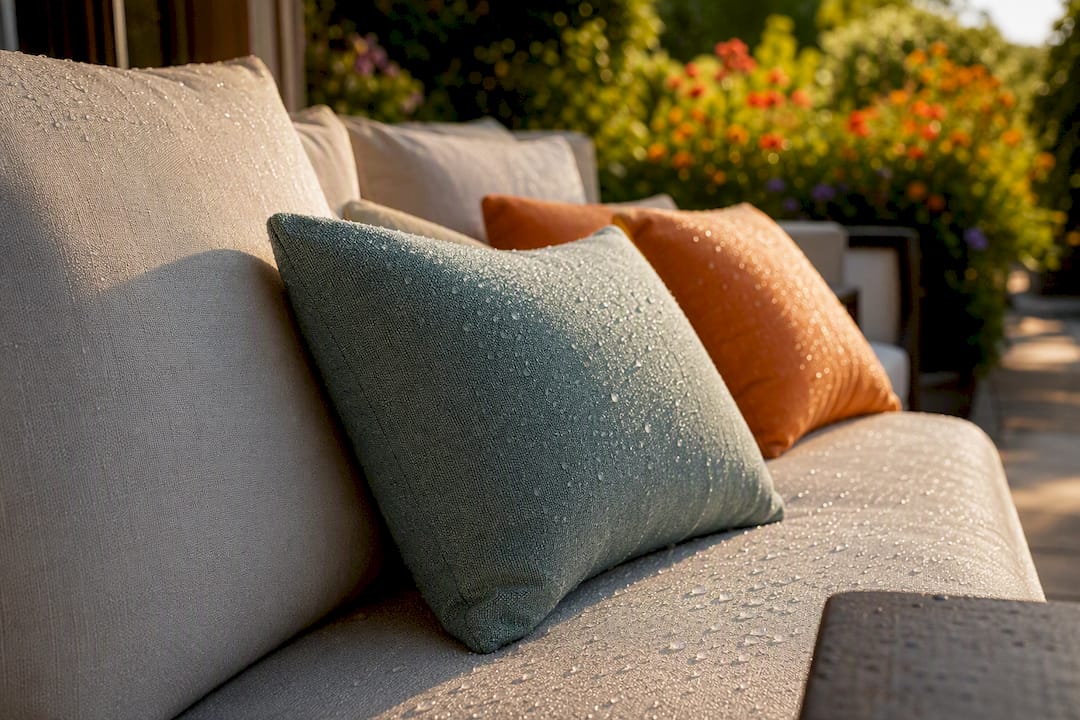
Stain resistance follows the same logic. Because the fiber itself repels moisture and oils rather than absorbing them, most spills sit on the surface long enough to wipe away. Revolution Fabrics notes that polypropylene-based performance textiles are bleach-cleanable and inherently stain-resistant, which is a major reason they’re used in heavy-traffic commercial settings, not just backyards.
UV performance is good, not the best available. Solution-dyed olefin can hold up impressively under accelerated weathering, with some product lines rated for a range of hundreds to a couple thousand hours of accelerated testing before noticeable fading, according to Spuncrylic. That’s a solid range, but it depends on UV stabilizers built into the fiber, and without them, prolonged sun exposure will degrade the polymer faster than premium acrylic.
Quick reference on wear characteristics:
- Lighter-weight olefin (lower GSM) has a softer hand but less abrasion resistance.
- Heavier commercial-grade olefin resists abrasion well, closer to marine-grade upholstery.
- Feel varies by weave; tightly woven olefin can feel almost as soft as acrylic.
Olefin vs Solution-Dyed Acrylic: Which Wins Where?
The olefin vs acrylic question comes down to which trade-off matters more for your specific spot on the patio. Both fibers are high-performance outdoor fabrics, but they excel in different conditions.
- UV and colorfastness: Solution-dyed acrylic (the Sunbrella-style category) generally leads for long-term fade resistance in full, unbroken sun.
- Water resistance: Olefin wins here. It’s naturally hydrophobic and dries faster than acrylic or polyester.
- Hand and comfort: Acrylic often has a softer, more natural feel; olefin varies by weave and weight.
- Cost: Olefin is typically the more budget-friendly option for large cushion runs.
- Lifespan in extreme UV: Acrylic tends to outlast olefin in year-round, high-intensity sun without shade breaks.
For poolside furniture, shaded patios, and cost-conscious projects, olefin makes practical sense. For a permanently sun-exposed dining set you want to keep for a decade, acrylic is usually worth the premium. Either way, check the actual lightfastness figures on a fabric’s spec sheet before you buy. That number predicts fading far more reliably than the fiber name alone.
Where Should You Use Olefin Fabric Outdoors?
Match the fabric to the exposure it will actually face, not the exposure you wish it had.
- Poolside loungers and chairs — chlorine resistance and fast drying make olefin a natural fit near pools and hot tubs.
- Covered or semi-shaded patios — partial shade limits UV load, letting solution-dyed olefin perform close to its rated lifespan.
- Marine seating — boats expose cushions to salt spray and constant moisture, conditions olefin handles well.
- Commercial outdoor cushions — restaurants and hotels favor olefin for its bleach-cleanability and lower replacement cost across many units.
Avoid relying on standard olefin for furniture sitting in relentless, unshaded, all-day sun in extreme-UV regions. If that’s your only option, choose lighter colors (they show less fading than deep, saturated tones), confirm the fabric includes UV stabilizers, and budget for replacement sooner than you would with acrylic.
What’s the Right Way to Clean Olefin Fabric?
A basic care routine keeps olefin cushions looking new for years, and it doesn’t require anything specialized.
- Brush off loose dirt and debris before wetting the fabric.
- Hose down the cushion cover with plain water.
- Mix a mild soap solution (a few drops of dish soap in a bucket of water) and work it in with a soft brush.
- Rinse thoroughly until no soap residue remains.
- Air dry fully in an open, ventilated spot; olefin’s hydrophobic fiber speeds this step considerably.
For tougher stains or mildew spots, a diluted bleach solution works because olefin’s pigment is embedded in the fiber rather than sitting on the surface. Test any bleach mix on a hidden seam first, then rinse extensively afterward, since leftover residue can attract dirt.
If mildew has already taken hold, scrub the affected area with the bleach solution, let it sit briefly, then rinse and dry completely before storing or reusing. Store cushions in a dry, ventilated space over winter rather than sealed plastic bins, which can trap moisture against the fabric.
Pro Tip: Keep a small labeled spray bottle of your diluted bleach mix near your patio storage. A five-minute spot treatment right after a spill prevents most stains from ever setting in.
For a more detailed walkthrough, this fabric maintenance workflow guide covers cleaning steps for multiple upholstery types, and this outside resource on cleaning outdoor chairs naturally offers additional low-chemical options if you’d rather skip bleach entirely.
What Should You Check Before Buying Olefin Cushions?
Fabric alone doesn’t determine how long a cushion lasts. The construction around it matters just as much.
- Confirm the label says solution-dyed, not just “olefin” or “polypropylene,” since surface-dyed versions fade faster.
- Look for lightfastness or accelerated-weathering hours on the spec sheet rather than trusting marketing language.
- Check the fabric weight in GSM; heavier weights generally resist abrasion better for high-traffic seating.
- Pair the fabric with reticulated quick-dry foam so water passes through instead of pooling inside the cushion.
- Verify seams use marine-grade thread and that the cushion design includes drainage, since a hydrophobic fabric still needs somewhere for water to go.
Expect a well-built olefin cushion in a covered or poolside spot to last several seasons with regular care; full-sun placement shortens that window. Browse the durable outdoor fabric collection to compare weights before you commit to a specific grade.
Does Olefin Fabric Cause Allergies or Skin Sensitivities?
Olefin is generally considered one of the more skin-friendly synthetic fabrics used outdoors. Because it’s a petroleum-derived polymer rather than a natural fiber, it doesn’t carry the plant proteins or animal dander that trigger classic fabric allergies the way wool or certain plant fibers can.
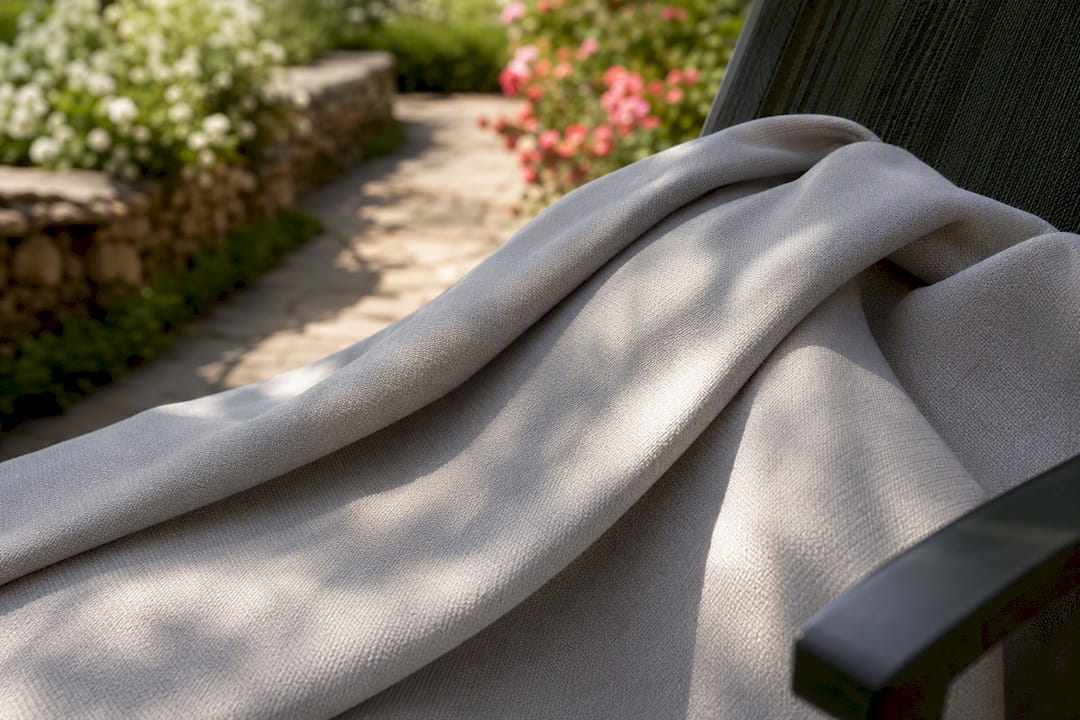
That said, a few practical sensitivities are worth knowing about. Some people with broader sensitivities to synthetic textiles report mild skin irritation from prolonged direct contact with any tightly woven polymer fabric, olefin included, particularly in hot, sweaty conditions where friction and heat combine. This isn’t an allergy to the fiber itself so much as a reaction to reduced breathability against bare skin.
Olefin’s hydrophobic nature also plays in the reader’s favor here. Because it resists moisture absorption, it doesn’t hold onto sweat, sunscreen residue, or pool chemicals the way a more absorbent fabric would, which lowers the chance of residue building up against skin over repeated use. It also resists mildew and mold growth far better than natural fibers when kept reasonably clean, and mold spores are a far more common allergy trigger outdoors than the fiber itself.
If anyone in your household has known sensitivities to synthetic dyes, ask specifically whether a fabric is solution-dyed. Because pigment is locked inside the fiber rather than applied as a surface treatment, there’s less loose dye available to transfer onto skin through sweat or moisture, compared with some surface-dyed alternatives.
How Well Does Olefin Fabric Color Actually Hold Up?
Colorfastness is where buyers get the most confused, mostly because “olefin” gets talked about as if it’s one uniform product. It isn’t. Performance depends heavily on whether the color is solution-dyed and whether the specific product includes UV stabilizers.
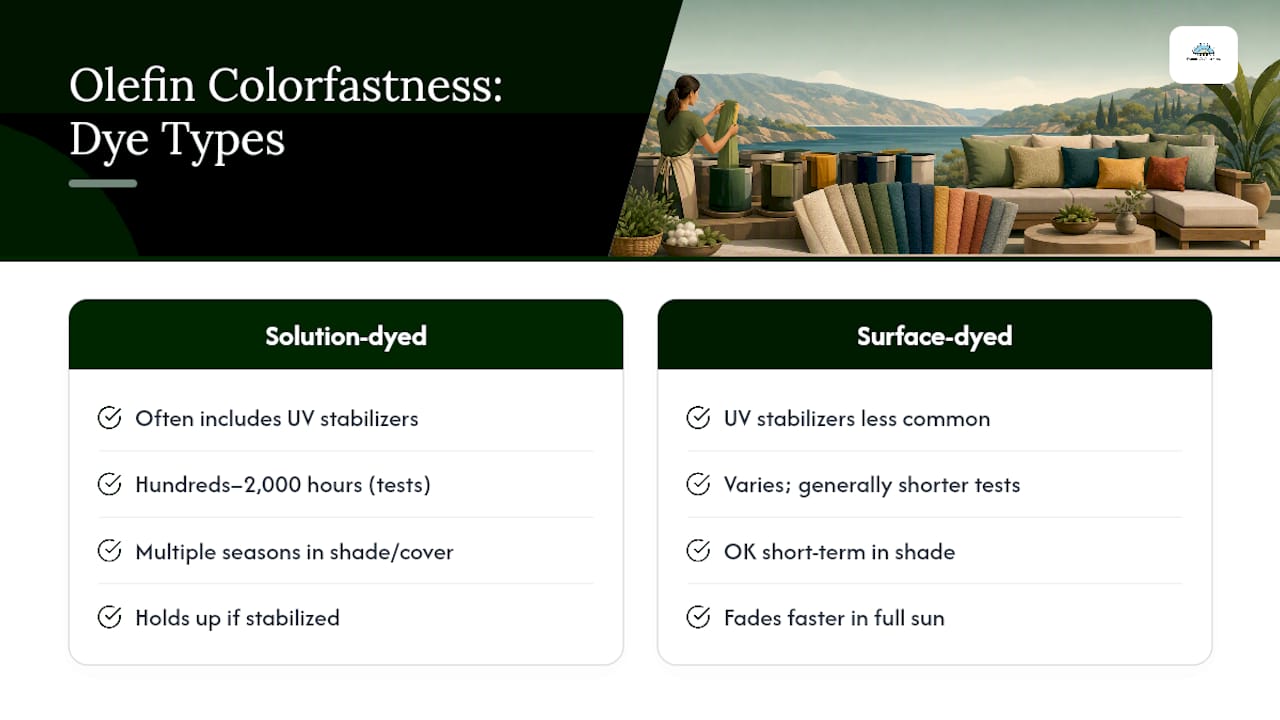
Solution-dyed olefin can perform impressively well. As noted earlier, some product lines reach a range of hundreds to a couple thousand hours of accelerated weathering testing before visible fading begins, a range documented by Spuncrylic. In real-world terms, that typically translates to multiple seasons of reliable color retention in a covered or partially shaded spot.
Full, unbroken sun tells a different story. Marcelina Furniture’s guide points out that olefin performs especially well in covered or semi-shaded positions but can degrade faster than premium acrylic under extreme, sustained UV exposure when the fabric lacks adequate UV stabilizers. The fiber itself is more UV-sensitive at a molecular level than acrylic, so the protective additives baked in during manufacturing do a lot of the heavy lifting.
Color choice affects the outcome, too. Lighter, less saturated colors generally show fading less visibly than deep reds, navy, or black, since the contrast between faded and unfaded fiber is smaller. If you want a bold, dark cushion for a spot that gets sun most of the day, ask specifically about that color’s lightfastness rating rather than assuming all shades in a line perform equally.
How Do You Verify You’re Getting Real Solution-Dyed Olefin?
The outdoor fabric market has no shortage of listings that use “olefin” loosely, sometimes to describe surface-dyed polypropylene blends that fade far faster than the solution-dyed version buyers actually want. A little diligence at the point of purchase saves years of disappointment.
Start by asking the seller directly whether the fabric is solution-dyed, and expect a clear yes or no rather than vague language about “outdoor-rated” or “fade-resistant” fabric. Those phrases get used for surface-dyed products too. A legitimate solution-dyed fabric will typically have documentation, a lightfastness rating, or an accelerated-weathering hour figure the seller can point to.
Request a physical swatch before ordering yardage for a full cushion set. Solution-dyed olefin tends to have consistent color saturation visible from both the front and back of the fabric, since the pigment runs through the fiber. Surface-dyed imitations often show a lighter, less saturated back side, a quick visual test you can do at home. A reputable fabric retailer that offers samples, like a sample-and-swatch service before you commit to yardage, is generally a safer source than a listing with no verification path at all.
How Beautiful Windows Elgin Supports Outdoor Fabric Buyers
Beautifulwindowselgin carries durable outdoor fabrics and waterproof canvas by the yard, giving homeowners and drapery workrooms a straightforward source for cushion-grade materials backed by real product listings, not guesswork. Our sample service lets you check hand, weight, and color saturation before committing to a full yardage order, which matters most when verifying solution-dyed quality. We also offer design consultation and nationwide shipping, so whether you’re outfitting a poolside bench or a covered porch sectional, you can get guidance on the right fabric weight and construction for your specific exposure before you buy.
— Marrion
Ready to Choose Your Outdoor Fabric?
If you’ve been comparing swatches online or weighing olefin against acrylic without a clear answer, the fastest path forward is working directly with a fabric retailer that stocks both options and lets you see them in person. Beautifulwindowselgin is the alternative to guessing from product photos: you get real yardage samples, weight and weave you can feel, and a team that can walk you through which grade suits a poolside bench versus a covered patio sectional.
Beyond outdoor fabrics, Beautifulwindowselgin’s designer drapery fabric collection and broader upholstery and drapery fabric selection cover the rest of the home, so one order can handle both your patio cushions and your indoor décor needs. Based in Columbia, SC, the store ships nationwide and offers custom drapery consultation for readers who want professional input on measurements or installation. If you’re ready to move past research and start comparing actual fabric in hand, request samples or browse the current outdoor-ready yardage today.
Sources
- Spuncrylic — comparison and product claims
- What Is Olefin Fabric? Pros, Cons & Real-World Durability (2026 Guide)
Recommended
- Upholstery Fabric Checklist: A Practical Guide – Fabric Store in Columbia, SC | Drapery Making Services
- Upholstery Material Checklist: Your Complete Fabric Guide – Fabric Store in Columbia, SC | Drapery Making Services
- Marine Fabric Checklist: Select the Right Boat Upholstery – Fabric Store in Columbia, SC | Drapery Making Services
- Upholstery Fabric Types: A Practical Guide for 2026 – Fabric Store in Columbia, SC | Drapery Making Services