


Interlining vs Lining: Sewists & Homeowners 12 inch Test
Lining is the finished layer you see inside a garment or curtain; interlining is the hidden layer that gives it shape, body, or warmth. The rule of thumb is simple: reach for interlining when you need structure or insulation, and reach for lining when you need a clean, comfortable finish. Most tailored garments and heavier drapery use both, layered together rather than as a choice between one or the other.
TL;DR:
- Interlining provides essential support and insulation for garments, while lining offers a smooth, protective finish visible on the inside.
- Fusible interlinings are quick to apply and best for shaping, but can cause puckering or bubbling if not properly handled or matched to the fabric type.
- Nonwoven, woven, and knitted interlinings each suit different applications, from cheap mass production to tailored, stretchable garments, with testing recommended before full use.
- For large, drafty windows or heavy garments, interlining enhances thermal insulation and shape more effectively than lining alone.
- Matching fabric weight, stretch, and care instructions is crucial for properly combining lining and interlining to avoid stiffness, shrinkage, or damage.
Table of Contents
- What Is Lining and Where Does It Belong?
- What Is Interlining, and How Does It Shape a Garment?
- Lining vs Interlining: The Direct Comparison
- When Should You Use Each Layer?
- How to Choose and Apply Interlining or Lining Correctly
- Fixing Fusion Problems, Puckering, and Stiffness
- A Practitioner’s Notes on Interlining and Lining for Drapery
- Get Fabric Samples or a Custom Drapery Consultation
- Sources
- FAQ
What Is Lining and Where Does It Belong?
Lining sits against the inside of the shell fabric as the final, visible layer. It hides raw seams, lets a jacket slide easily over a shirt, and shields the outer fabric from body oils, sweat, and everyday wear. According to a technical guide from Cimmino, lining also boosts the perceived value of a finished piece, and it should be lighter in weight than the shell with care requirements that roughly match it, so the whole garment or drape can be cleaned as one unit.
Sewers typically reach for one of these lining fabrics depending on the project:
- Silk or China silk for a luxurious hand in jackets and formalwear
- Rayon or viscose for breathability at a lower cost
- Polyester for durability and easy care in everyday garments
- Cupro for a silk-like drape that resists static
In drapery, lining does different work. A standard cotton sateen lining adds body and protects decorator fabric from sun fade, while thermal and blackout linings block light and reduce drafts. Either way, lining is the layer a customer or wearer actually touches.
What Is Interlining, and How Does It Shape a Garment?
Interlining is the structural or insulating layer sandwiched between the shell fabric and the lining, or sometimes stitched directly to the shell alone. It never shows on the outside, and it rarely shows on the inside either. Its job is to hold shape: a collar that stands, a lapel that rolls cleanly, a curtain that hangs with real weight and fullness.
Interlining comes in two main application types. Fusible interlining is coated with a heat activated resin that bonds to the fabric under an iron or press, and it is widely used because it’s fast to apply and firms up silhouette and shape retention, according to a technical review of fusible interlinings. Sew-in interlining is basted or stitched in place instead, which suits fabrics that can’t take heat.
Beyond application method, interlining also varies by substrate:
- Nonwoven interlining — economical, common in mass production, less flexible
- Woven interlining — matches the grain of tailored garments like suit jackets
- Knitted interlining — stretches with knit fabrics and moving garments
- Specialty types — cotton batting for curtain interlining, or water-soluble backing for embroidery stabilization
Each substrate carries tradeoffs: woven, knitted, and nonwoven interlinings each suit different construction goals, from structured tailoring to stretch comfort to low-cost bulk manufacturing, per Chargeurs PCC’s guide to interfacing types. Newer printable interlinings are also entering the market as a lower-defect, more resource-efficient alternative to traditional fusibles.
Lining vs Interlining: The Direct Comparison
The core interlining vs lining distinction comes down to purpose. Lining finishes and protects; interlining builds and insulates. One sits closest to the body or the room, the other sits buried where no one ever sees it.
Here’s how the two stack up across the details that actually matter when you’re cutting fabric:
| Factor | Lining | Interlining |
|---|---|---|
| Purpose | Finish, comfort, protection | Shape, support, insulation |
| Placement | Innermost visible layer | Hidden between shell and lining |
| Visibility | Often seen (jacket interior, curtain hem) | Never seen |
| Common materials | Silk, rayon, polyester, cupro | Nonwoven, woven, knit, batting |
| Application | Sewn in as a separate finished layer | Fused or sewn to the shell |
A few sewing scenarios show the split clearly:
- A collar or cuff typically needs interfacing (a close cousin covering small, targeted areas) plus lining, not full interlining.
- A tailored jacket front often carries both an interlining for shape and a full lining for finish.
- A heavy winter coat leans hardest on interlining for warmth, with lining added mainly for comfort.
- Curtains on a large window benefit most from interlining for fullness and thermal performance, while lining alone handles light control on lighter-weight panels.
One common mix-up: interlining is not the same as interfacing or underlining. Interfacing targets small, structural zones like collars and waistbands, while interlining can span entire panels for insulation or overall shape. Underlining, meanwhile, is cut to match the shell piece for piece and adds body without necessarily insulating.
When Should You Use Each Layer?
Matching the layer to the project avoids both wasted fabric and disappointing results.
- Tailored jackets and blazers call for interlining in the chest, collar, and lapel areas, paired with a full lining for comfort and a clean finish.
- Coats and outerwear depend on interlining for warmth, often combined with a napped or quilted lining for extra insulation against the body.
- Formalwear and structured gowns use interlining sparingly at the bodice for shape, with lining throughout for comfort against skin.
- Knit garments rarely need interlining at all; a knit lining or none is usually enough since the fabric already has body.
- Curtains and drapery benefit from interlining when fullness or insulation matters, especially on large windows, while lining alone is often sufficient for light control and fabric protection on smaller panels.
- Bags, hats, and embroidered accessories often use specialty interlinings, including water-soluble stabilizer backing for machine embroidery that washes away after stitching.
Before committing fabric to any of these, cut a test swatch. Fuse or baste your chosen interlining to a scrap, then handle it the way the finished piece will be handled, folded, worn, or hung. If you’re working with silk drapery specifically, testing a 12 inch sample before ordering yardage saves both fabric and disappointment.
How to Choose and Apply Interlining or Lining Correctly
Start with the fabric itself, not the pattern instructions. Weight, drape, stretch, and care requirements should drive every decision from here.
Run through this checklist before cutting:
- Fabric weight: match lining weight to the shell; go lighter with fusible interlining than the shell fabric to avoid over-stiffening, a rule confirmed by NMSU Cooperative Extension.
- Stretch and drape: knit interlining for knit shells, woven for woven, to keep movement natural.
- Care instructions: lining and shell should tolerate the same cleaning method; mismatched care ruins garments and drapery alike.
- Silhouette goal: crisp and structured points to fusible woven interlining; soft and fluid points to sew-in or none at all.
- Heat sensitivity: delicate silks, sequined fabrics, and some synthetics can scorch or melt under a fusing iron, so sew-in is safer.
Cut interlining and lining on the same grain as the shell whenever possible, and always test fuse or baste a scrap first.
Pro Tip: Fuse a small sample, let it cool completely, then launder it exactly as you’ll launder the finished piece. Shrinkage, bubbling, or color bleed shows up here, not on the runway or the window.
Fixing Fusion Problems, Puckering, and Stiffness
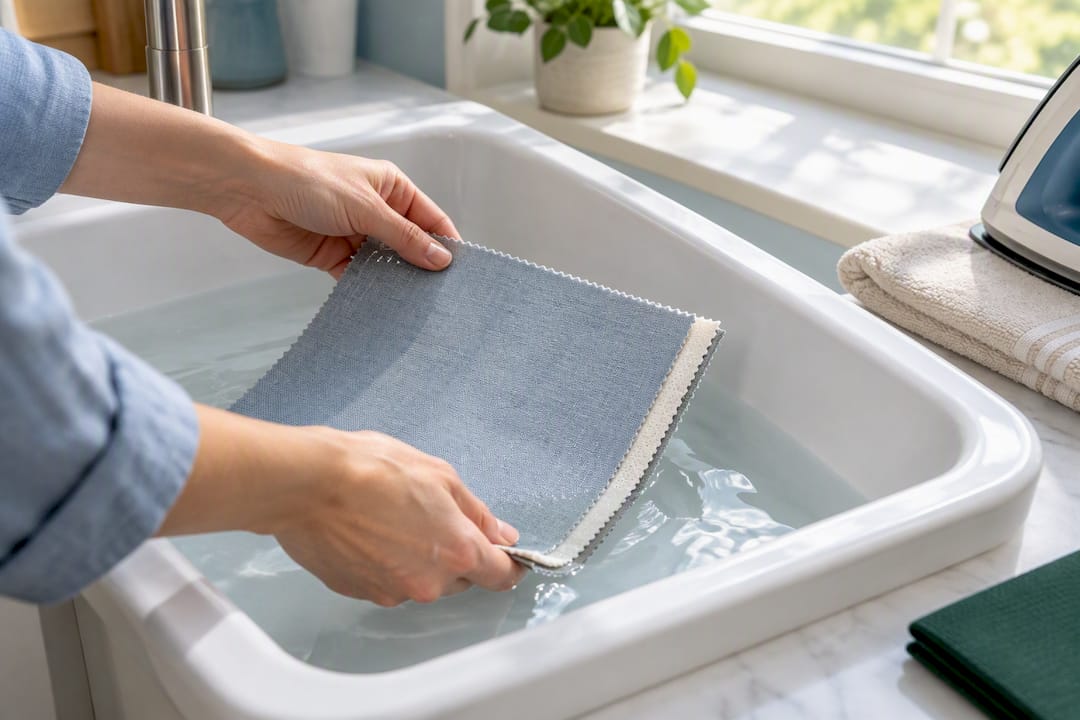
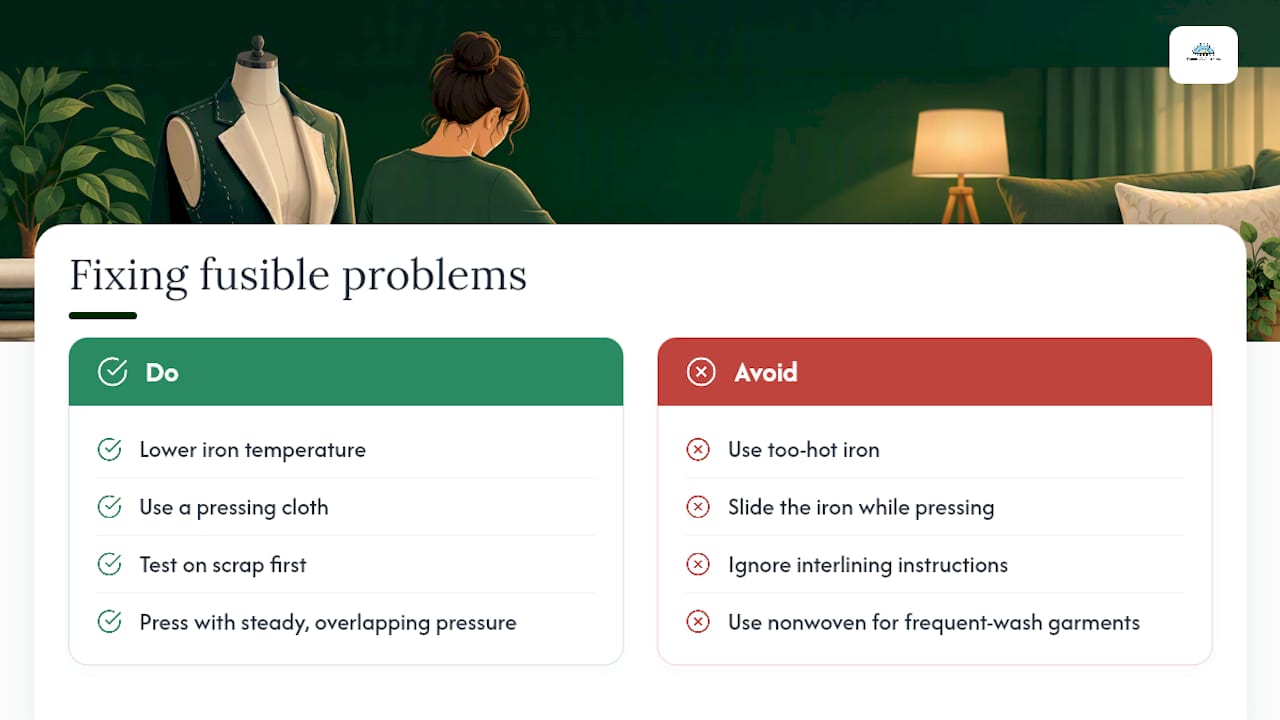
Strike-through happens when fusible resin melts through to the right side of delicate or loosely woven fabrics, leaving a shiny patch. Lower your iron temperature, add a pressing cloth, and test on scrap before committing to the full piece.
Bubbling or a weak bond usually means uneven pressure or insufficient dwell time under the iron. Press in overlapping sections rather than sliding the iron, and hold steady pressure for the full time your interlining’s instructions specify.
Puckering after laundering often points to a mismatch between interlining and shell shrinkage rates. Nonwoven interlinings can hold up less well through repeated home laundering and offer less stretch than woven versions, so swap to woven or knit interlining for garments that see frequent washing. If a heat-sensitive shell keeps scorching under fusible resin, stop fighting it. Switch to sew-in interlining, or bring the piece to a professional workroom for hand basting.
A Practitioner’s Notes on Interlining and Lining for Drapery
Curtain interlining is recommended whenever real fullness, a heavier hand, or noticeable thermal benefit is desired on a large window. Lining alone still does plenty of work on lighter panels where light control is the main goal.
Always test a fabric sample before ordering yardage. It’s the cheapest insurance in sewing. When a project calls for more than a straightforward lining swap, that’s the point to consider a custom drapery consultation rather than guessing your way through it.
— Marrion
Get Fabric Samples or a Custom Drapery Consultation
Some fabric retailers offer one-on-one design guidance before you commit to yardage. Instead of guessing which lining or interlining pairs with your fabric, you can order swatches, talk through your project, and get a professional recommendation before a single yard ships.

Selections may include cotton, embroidered, upholstery, marine, and utility fabrics, plus ready-made curtain panels for readers who want a finished look without cutting a single seam. Whether you’re outfitting a tailored jacket lining or planning heavy interlined drapery for a large window, start by browsing fabric by the yard and custom drapery services or exploring the full catalog on the Beautifulwindowselgin site. If your project needs more than fabric alone, request a design consultation to get professional guidance on lining and interlining choices for your exact window or garment before ordering fabric.
Sources
- A Review of Fusible Interlinings Usage in Garment Manufacture
- Shaping garments: interfacing, underlining, and lining (NMSU Cooperative Extension)
- What are the different types of interfacings? | Chargeurs PCC
- Difference between Lining and Interlining: A Complete Technical Guide - Cimmino
FAQ
Is Curtain Interlining Worth It?
For large windows, drafty rooms, or drapery that needs real fullness and weight, yes. Interlining improves thermal performance and gives curtains a fuller, more substantial hang than lining alone can provide, particularly on bigger windows where insulation matters most.
How Do I Sew Interlining Into a Garment or Drape?
Sew-in interlining is basted to the wrong side of the shell fabric before the piece is assembled, then treated as one layer through the rest of construction. Fusible interlining skips basting entirely; it bonds under heat and pressure from an iron or press, following the manufacturer’s fusing guidelines for temperature and time.
What Are the Three Types of Interfacing?
Interfacing and interlining substrates generally fall into woven, knitted, and nonwoven categories. Woven suits structured tailoring, knitted offers stretch for garments that move, and nonwoven works well for economical, mass-produced pieces, according to Chargeurs PCC.
What Is the Difference Between Interlining and Interfacing?
Interlining can span entire garment panels or curtain widths for insulation and overall shape, while interfacing targets small, specific areas like collars, cuffs, and waistbands. Both sit hidden inside the piece, but their scope and purpose differ.
Should I Choose Lining or Interlining for My Project?
Choose lining when you need a clean, comfortable finish and protection for the shell fabric; choose interlining when you need structure, body, or insulation. Many tailored garments and heavier drapery projects use both together, with interlining underneath a full lining for the best of both.