


7 Steps to Calculate Drapery Fabric Yardage for your project
Last Updated: October 30, 2026
Quick Summary
To calculate drapery fabric yardage, measure your rod width and finished length in inches, multiply the rod width by your fullness ratio to get total fabric width, then divide by usable fabric width and round up to find your panel count. Add hem and header allowances to each panel's cut length, multiply by panel count, divide by 36, and round up.
- Measure the rod width including returns, not the glass, and add 4-6 inches of center overlap.
- Fullness ratios range from 1.5x for tab top to 2.5-3x for sheer panels.
- Most decor fabric runs 54 inches wide, leaving about 52 usable inches per panel after seam allowances.
- Round your panel length up to the nearest full vertical repeat to match prints across panels.
- Add 10 percent contingency for waste, and more for patterned, pleated, or directional prints.
Table of Contents
- How to Measure for Curtains Before You Calculate Yardage
- Fabric Fullness for Curtains: Choosing Your Ratio
- Fabric Width, Usable Width, and How Many Panels You Need
- Pleated Curtain Fabric Yardage: Headings That Change the Math
- Fabric Pattern Repeat Yardage: Matching Prints Across Panels
- Adding Hem and Header Allowances to Your Drapery Fabric Total
- Ordering Your Drapery Fabric by the Yard
- Frequently Asked Questions
How to Measure for Curtains Before You Calculate Yardage
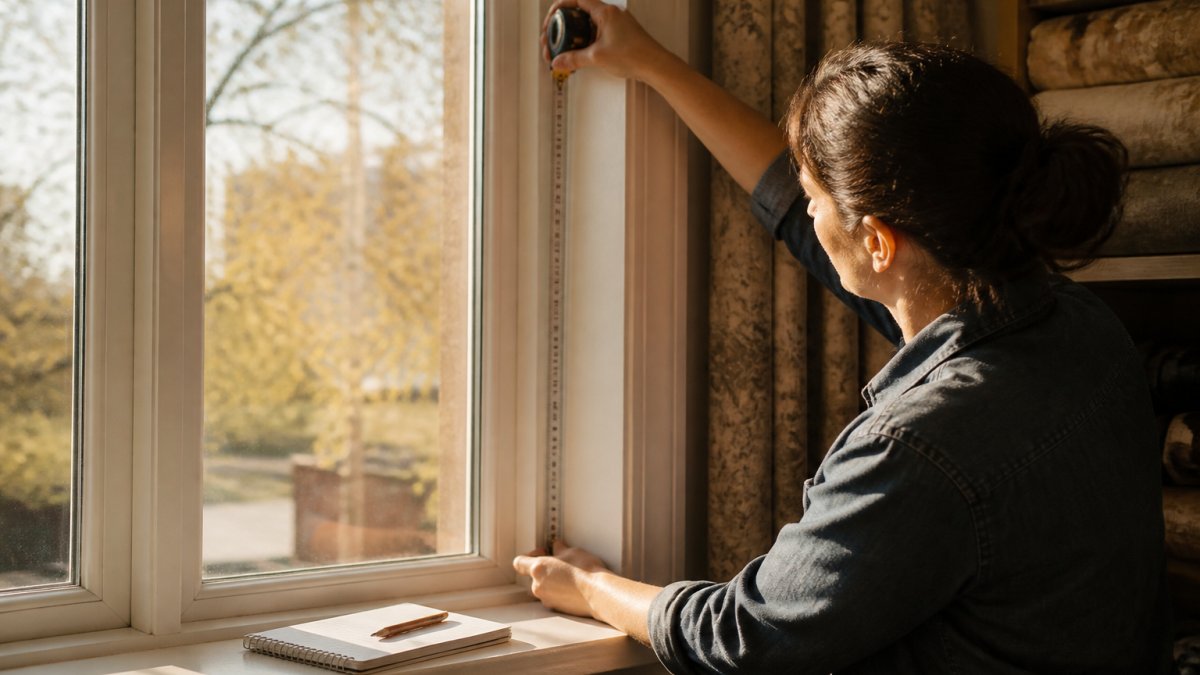
Getting drapery fabric yardage right starts with two numbers: finished width and finished length. Measure the rod width, not the glass, then decide where the panels will end. Measure twice, write it down, and add your allowances before you touch a calculator.
Finished length is the distance from the rod to your chosen break point. Pick one of these:
- Sill length: ends just above the window sill
- Apron length: drops 3-4 inches below the sill
- Floor length: ends about 1/2 inch above the floor
- Puddle: rests on the floor with a small fold
Window width should be measured across the rod, including the returns. Add 4-6 inches of overlap at the center if you want the panels to close fully.
Write both numbers in inches. You will convert to yards at the very end.
For a full walkthrough of rod placement and tricky window shapes, see our guide on how to measure windows for custom drapery.
Fabric Fullness for Curtains: Choosing Your Ratio
Fabric fullness for curtains is the multiplier you apply to your measured width.
Here is how we set ratios by heading style:
- Pencil pleat: 2 to 2.25 times the rod width
- Pinch pleat: 2.25 to 2.5 times
- Tab top or eyelet: 1.5 to 2 times
- Sheer panels: 2.5 to 3 times for a soft, dense look
Multiply rod width by your ratio to get the total fabric width you need.
Example: a 60-inch rod with a 2x ratio needs 120 inches of fabric width. That is your target before you count panels or pattern matching.
If you are still deciding on material, our guide to the best fabric for DIY window curtains covers how weight and drape change the ratio you should pick.
Fabric Width, Usable Width, and How Many Panels You Need
Fabric width is the number on the bolt. Usable width is what is left after seam allowances. Most decor fabric runs 54 inches wide.
A wide-width sheer changes the math completely. Wide-width sheers such as the Rosemont 108 inch wide polyester white sheer are 108 inches wide, so a single panel can cover a wide window with no vertical seam.

To find your panel count, divide total fabric width by usable width, then round up:
- Total fabric width needed: 120 inches
- Usable width per panel: 52 inches
- 120 divided by 52 = 2.3
- Round up to 3 panels
Always round up. A short panel count cannot be fixed after the fabric is cut.
Pleated Curtain Fabric Yardage: Headings That Change the Math
Pleated curtain fabric yardage runs higher than flat-panel yardage because pleats eat fabric. A pinch pleat heading folds the fabric back on itself, so you need more width to hit the same coverage. The table below gives working ratios, but the ratio alone does not tell you how many yards to buy.
| Heading Type | Fullness Ratio | 60-inch Rod Needs |
|---|---|---|
| Tab top | 1.5x | 90 inches |
| Eyelet | 1.75x | 105 inches |
| Pencil pleat | 2x | 120 inches |
| Pinch pleat | 2.5x | 150 inches |
The pleat depth and spacing on your chosen heading decide the final number. Check the pattern instructions before you order.
Worked example: pinch pleat on a 60-inch rod
Start with a 60-inch rod and a 2.5x pinch pleat ratio. That gives 150 inches of total fabric width. With 54-inch decor fabric trimmed to about 52 usable inches per panel, divide 150 by 52 to get 2.88, then round up to 3 panels.
Now add length. Suppose the finished panel is 90 inches. Add a 6-inch header for pleats and a 4-inch double bottom hem, and the cut length is 100 inches per panel. Three panels at 100 inches is 300 inches.
Worked example: pencil pleat on a 96-inch rod
A 96-inch rod at a 2x pencil pleat ratio needs 192 inches of fabric width. Divide 192 by 52 and you get 3.69, which rounds up to 4 panels. At a 100-inch cut length, 4 panels equal 400 inches, or 11.11 yards, rounded up to 12 yards before contingency.
Why pleat count matters more than the ratio label
Two pinch pleat headings can carry the same 2.5x ratio but use different pleat depths and spaces. A deeper pleat consumes more fabric per pleat, and a tighter pleat spacing means more pleats across the panel. When you buy a pleated heading tape or a custom pleated panel, the manufacturer's pleat count and spacing are the real drivers of fabric width.
Orange Color—Window Curtain Satin Fabric—High-Quality—100% Polyester—Sold →
Pleated versus flat-panel yardage side by side
For the same 60-inch rod and 90-inch finished length, a flat tab-top panel at 1.5x needs 90 inches of width, or 2 panels at 52 usable inches, for 200 inches of cut length and about 5.56 yards. The pinch pleat version above needs 3 panels and 300 inches, or 8.33 yards. The pleated heading adds roughly 2.8 yards for the same window. That difference is the number to budget for, not the ratio alone.
Fabric Pattern Repeat Yardage: Matching Prints Across Panels
Fabric pattern repeat yardage is where most DIY orders go wrong.
Measure the vertical repeat, the distance from one point in the pattern to the same point again.
Example: a 90-inch finished panel with a 12-inch vertical repeat. Divide 90 by 12 to get 7.5. Round up to 8 repeats, which gives 96 inches per panel.
Horizontal repeats matter too. When you join panels side by side, the pattern must match across the seam.
Directional prints cannot be turned sideways to save fabric.
Before you commit to a patterned order, check the repeat and color in your own light. Our guide to ordering fabric samples online shows how to request and review samples.
Adding Hem and Header Allowances to Your Drapery Fabric Total
Hem and header allowances turn a raw measurement into a real cut length. Skip them and your panels come up short.
Add these to every panel:
- Bottom hem: 4 inches for a double 2-inch fold, or 8 inches for a weighted hem
- Top header: 4 inches for a rod pocket, 6 inches for pleats
- Lining: cut separately to the same panel length minus the header
So a 90-inch finished panel with a 4-inch bottom hem and 6-inch header needs a 100-inch cut length.
Lining adds a second fabric to your order. Calculate lining yardage on its own, using the same panel count and cut length. Interlining goes between the face fabric and lining, and it follows the same math.
Ordering Your Drapery Fabric by the Yard
Convert inches to yards last. Add up all panel cut lengths, multiply by panel count, then divide by 36.
Example: 3 panels at 100 inches each equals 300 inches. Divide by 36 and you get 8.33 yards. Round up to 9 yards. Add 10 percent for waste and mistakes on patterned or pleated projects, which turns 9 yards into 10.
That is the arithmetic. The part that actually protects your order is the checklist below, because most yardage shortfalls come from measurement and ordering errors rather than from the division step.
Measurement and ordering checklist
- Measure the rod, not the glass. Include the returns at each end and any overlap at the center where panels meet. A rod that extends 6 inches past each side of the window adds 12 inches of width you must cover.
- Decide the break point before you measure length. Sill, apron, floor, and puddle lengths each change the cut length, and changing your mind after ordering is expensive.
- Record every number in inches. Mixing feet and inches is the most common source of a short order.
- Confirm the fabric's usable width. Subtract seam allowances from the bolt width before you divide. A 54-inch bolt is not 54 usable inches.
- Round panel count up, never down. A short panel count cannot be fixed after the fabric is cut.
- Round the vertical repeat up to a full repeat per panel. Partial repeats waste fabric and break the match.
- Add one horizontal repeat per seam when joining panels side by side.
- Calculate lining and interlining separately using the same panel count and cut length.
- Order a contingency amount. Ten percent is a common working figure for solid fabrics; patterned, pleated, and directional prints often justify more.
- Check the cut length against the bolt. If your cut length exceeds the fabric width, you may need to rotate the pattern or choose a different fabric.
Common ordering mistakes and how they show up
A panel that comes up short usually traces back to one of three things: measuring the glass instead of the rod, forgetting the header allowance, or rounding the panel count down. A pattern that will not match across a seam usually traces back to skipping the horizontal repeat. A second order that does not match the first usually traces back to a dye lot change, so order the full quantity in one cut when you can.
The orange satin curtain fabric sells by the yard at $36.99 and runs 54 inches wide, which suits most standard panel projects. For a softer, textured look, the elegant silver polyester-linen blend comes 58 inches wide at $44.50.


Ordering fabric by the yard follows a simple process once your numbers are set. Our guide to buying designer fabric by the yard explains how the ordering process works. If the measuring and math still feel like a lot, you can skip the yardage guesswork entirely with Curtain Panels in a pinch pleat style, or browse the shop fabric selection to compare widths and prints before you commit to a cut.
Frequently Asked Questions
How many yards of fabric do I need for curtains?
It depends on your finished length, fullness, and fabric width. A common formula: multiply the finished panel length plus hem and header allowances by the number of fabric drops, then divide by 36 to convert inches to yards. For example, a 90-inch finished length with 12 inches of allowances and two drops per panel needs about 5.7 yards per panel. Always round up to the next whole yard and add one extra yard if your fabric has a pattern repeat.
How does pattern repeat affect drapery fabric yardage?
A pattern repeat forces you to buy extra fabric so motifs line up across panels. Measure the vertical repeat from the fabric listing, then round each cut length up to the nearest multiple of that repeat. If your repeat is 9 inches and your cut length is 100 inches, you need 108 inches per drop. Multiply the difference across every drop, and the extra yardage adds up fast on large windows.
How much fullness should I allow for drapery panels?
Most drapery headings call for 2 to 2.5 times the window width in fabric. Pinch pleat and pencil pleat headings look best at 2.25 to 2.5 times, while tab top and eyelet styles work at 1.5 to 2 times. Multiply your measured window width by the ratio, then divide by the fabric's usable width to find how many panels or drops you need.
How much extra fabric should I add for hems and headers?
Plan on 8 inches for a double 4-inch bottom hem and 4 to 6 inches for the top, depending on your heading type. Pleated headings often need 6 to 8 inches at the top for the pleat depth and buckram. Add these allowances to your finished length before you calculate drops, and round the total up to the next whole yard when you order.
Getting the math right the first time saves you a second order and a stalled project. At Beautiful Windows Elgin, we sell designer fabrics by the yard with nationwide shipping, and we offer custom drapery services when you would rather hand off the fabrication. Browse our fabric selection, check the width and repeat on each listing, and order with confidence. Get started with Beautiful Windows Elgin and turn your measurements into finished panels.
