

Best Fabric Store Alternatives for Designers in 2026
Table of Contents
- Why Designers Are Rethinking Where They Source Fabric
- Online Fabric Stores for Interior Designers: What Sets Them Apart
- Fabric Samples for Interior Design: Testing Before You Buy
- Designer Fabric by the Yard: What to Look for in Quality and Composition
- Custom Drapery Workroom Services: When to Outsource Fabrication
- Deadstock and Sustainable Sourcing: The Circular Economy Angle
- How to Choose the Right Fabric Store Alternative for Your Practice
- Conclusion
- Frequently Asked Questions
Last Updated: October 7, 2026
Why Designers Are Rethinking Where They Source Fabric
The best fabric store alternatives for designers are no longer just brick-and-mortar shops with limited inventory. They are a mix of online fabric stores for interior designers, trade-account suppliers, deadstock dealers, and workrooms that handle fabrication end to end.
The old model had a built-in ceiling: a local store carries what fits on its shelves. Online sourcing changed that, but the risks remain, color that looks different on screen, yardage that arrives short, or a supplier who disappears mid-project.
Online Fabric Stores for Interior Designers: What Sets Them Apart
The best online fabric stores for interior designers separate themselves through three things: inventory depth, swatch access, and clear trade terms.
Here is how we sort the landscape:
- Cut-to-order retailers: Sell by the yard, ship fast, and suit small residential jobs.
- Wholesale and trade suppliers: Require an account and often a minimum order quantity (MOQ), but offer better pricing at volume.
- Workroom hybrids: Sell fabric and fabricate drapery, which removes a handoff and a source of error.
Each type solves a different problem, a single living room has different needs than a studio running six projects a month.
Trade Accounts, MOQs, and Wholesale Access
Trade accounts are the biggest lever most designers underuse, typically unlocking wholesale pricing, priority stock access, and sometimes reserved yardage on popular patterns.
The trade-off is commitment. Many wholesale suppliers set a minimum order quantity, often measured in full bolts rather than yards.
Ask three questions before opening an account:
- What is the MOQ, and is it per order or per pattern?
- Is pricing tiered, and what triggers the next tier?
- What happens if a dye lot is discontinued mid-project?
That third question matters more than most designers expect. Dye lots vary, and a reorder six weeks later may not match the original bolt.
How to Vet a Supplier Before You Commit
A common mistake is judging a supplier on catalog photos alone. The operational details decide whether a project succeeds.
Run this checklist before your first large order:
- Request a physical swatch, not a screen image
- Confirm the return policy in writing, including cut yardage
- Ask for current lead times, not the website's stated average
Fabric Samples for Interior Design: Testing Before You Buy
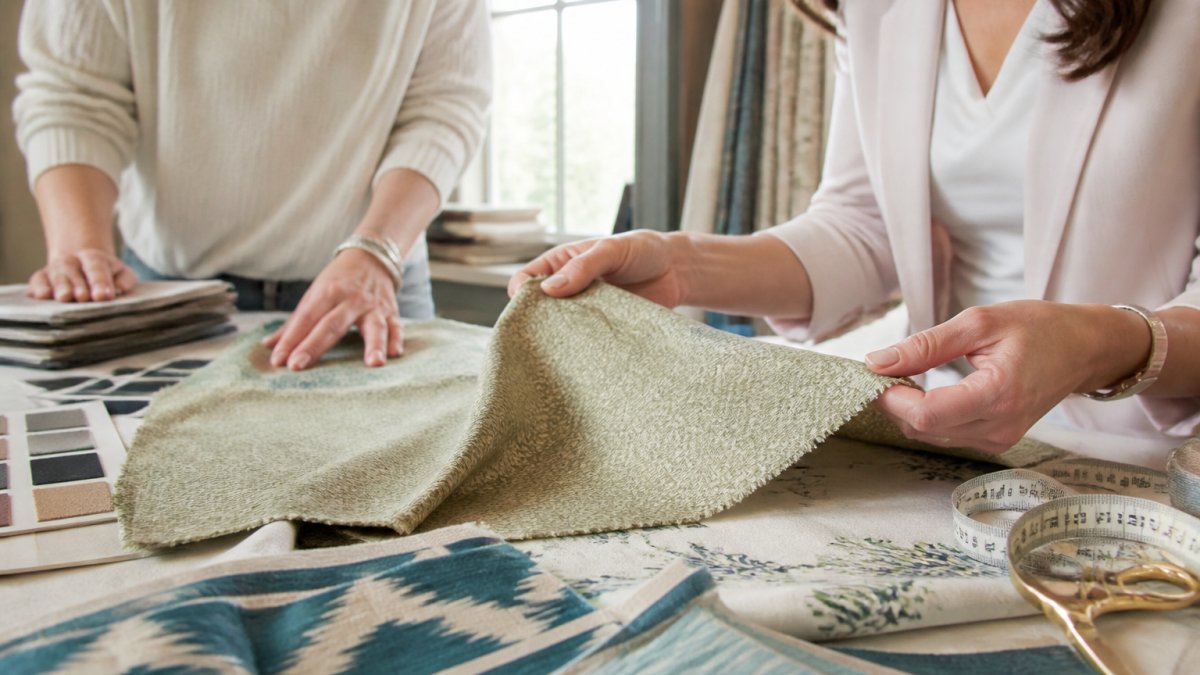
Fabric samples for interior design are the cheapest insurance in the sourcing process. A swatch lets you check color under real lighting, feel the hand, and confirm the fabric drapes as intended.
Here is where most swatch programs differ:
| Swatch Type | What You Get | Best For | Typical Cost Structure |
|---|---|---|---|
| Digital image only | Screen preview | Early mood boarding | Free |
| Cut swatch (small) | 2-4 inch square | Color and texture check | Free or low, often credited toward order |
| Memo sample | Larger cut, often 8x8 inches | Drape and scale review | Moderate, sometimes refundable on return |
| Hanging sample | Full-width, returnable | Client presentation | Deposit-based, refunded on return |
| Trade swatch book | Bound multi-pattern book | Studio reference library | Sold to account holders, sometimes at cost |
The gap between a small cut swatch and a memo sample matters more than designers expect. A 3-inch square tells you color, but not how a fabric folds, how heavy it feels across a two-meter drop, or whether the weave reads as intended at scale.
How Professional Swatch Programs Actually Work
Most hobbyist guides stop at "order a swatch." The professional version has mechanics worth understanding.
Deposit-and-return memos. Many trade suppliers send memo samples against a refundable deposit.
Swatch credits. Swatch fees are often credited back against your first order above a threshold.
Digital-first programs. Some suppliers ship a physical swatch only after you shortlist from a calibrated digital library.
Building a Swatch Workflow That Scales
A solo designer can sample ad hoc. A studio running multiple projects needs a system:
- Log every swatch with supplier, pattern name, dye lot if listed, and date received.
- Photograph swatches in consistent light so you can compare across projects months later.
- Flag reorderable vs. one-shot fabrics at intake, before they enter a client presentation.
Order memos for client presentations, cut swatches for color matching on repeat orders, and a trade swatch book when you want to stop guessing at what a supplier carries.
Designer Fabric by the Yard: What to Look for in Quality and Composition
Designer fabric by the yard lives or dies on composition. Two fabrics can look identical in a photo and behave completely differently on a rod or a sofa.
Start with the spec sheet, not the swatch photo. Width, weight, fiber content, and construction tell you more than any marketing description.
Fiber Content, Drape, and Hand-Feel
Fiber content determines how a fabric drapes, wears, and cleans.
Drape is how a fabric falls under its own weight; hand-feel is how it feels in your hand.
Consider our Tan Rayon Challis Fabric by the Yard, a lightweight 145 GSM fabric at $24.99 per yard.

The lesson: match fiber to function before you match color to the mood board.
Certifications Worth Knowing: GOTS and OEKO-TEX
Certifications answer a question clients increasingly ask: what is in this fabric?
Tan Rayon Challis Fabric by the Yard | Lightweight 145 GSM →
GOTS, the Global Organic Textile Standard, certifies organic fiber content and covers processing and social criteria across the supply chain. OEKO-TEX tests textiles for harmful substances, and its Standard 100 label applies to finished articles including fabrics and home textiles.
For residential work, these certifications matter most when a client has sensitivities, young children, or a sustainability goal.
Custom Drapery Workroom Services: When to Outsource Fabrication
Custom drapery workroom services make sense when fabrication risk outweighs the labor savings of doing it in-house. Non-standard window sizes, difficult ceiling heights, and lined or interlined panels are the usual triggers.
Outsourcing removes several failure points at once: no storing bolts, cutting on your own table, or managing a seamstress schedule. You get a finished panel with a single point of accountability.
When we handle custom drapery, the process runs from fabric selection through measurement, fabrication, and shipping, one vendor owns the outcome instead of three. For designers who want a specific look, our Curtain Panels are tailored to order.
The trade-off is lead time and control. For designers with a signature construction style, that matters. For everyone else, the time savings usually win.
Deadstock and Sustainable Sourcing: The Circular Economy Angle
Deadstock and circular economy sourcing solve two problems at once: unique inventory and waste reduction. Deadstock is surplus fabric left over from mill runs, fashion houses, or discontinued lines, often high quality, frequently unusual, and almost never reorderable.
That last point is the catch. Deadstock is a one-shot purchase. If your client wants a second set of panels in eighteen months, the fabric is likely gone.
Where Deadstock Actually Comes From
Understanding the source tells you what to expect:
- Mill overruns. A mill weaves more than a buyer ordered to cover defects. The surplus is sold off in lots, often in full bolts.
- Fashion-house leftovers. A brand commissions a seasonal run, then cancels or scales back. The unused yardage hits the secondary market, sometimes still on original rolls.
- Discontinued lines. A supplier retires a pattern. Remaining stock is liquidated rather than warehoused.
Each source carries different risk. Mill overruns tend to be consistent within a lot; fashion-house leftovers can be gorgeous but arrive with no spec sheet; discontinued lines are the safest bet if you can confirm fiber content.
How to Vet Deadstock Before You Commit
Deadstock has no standard spec sheet, so you build your own. Before you buy:
- Request a physical swatch. Never buy deadstock from a photo alone, there is no reorder to fall back on.
- Confirm fiber content by test or disclosure. If the seller cannot state composition, assume the worst and price accordingly.
- Ask for the full available yardage in writing. "Approximately 40 yards" is not a commitment. Get the number.
Handling the No-Reorder Problem
Deadstock's defining constraint is that it cannot be reordered, a design problem, not just a sourcing one. Three ways to work around it:
-
Design for the constraint. Use deadstock where a single run is acceptable, a feature window, an accent chair, a headboard. Avoid it for anything a client may want duplicated.
-
Disclose it in writing. Put the one-shot nature of the fabric in your client agreement. If the client later asks for a matching piece, the conversation is already on record.
-
Reserve yardage up front. Buy the full lot if the project justifies it. Holding the remaining yardage for the client is cheaper than sourcing a match that does not exist.
Certifications and Circular-Economy Claims
Deadstock is often marketed as sustainable by default, but that claim deserves scrutiny. It avoids new production, a real environmental benefit, yet it does not carry the same verification as certified new fabric.
- GOTS (Global Organic Textile Standard) certifies organic fiber content and covers processing and social criteria. Deadstock rarely carries GOTS because the chain of custody is broken.
- OEKO-TEX Standard 100 tests finished articles for harmful substances. Some deadstock sellers can provide this if the original mill tested the lot.
- Recycled-content certifications (such as the Global Recycled Standard) apply to fabrics made from recycled fiber, not to surplus new fabric.
If a client's sustainability brief requires certification, deadstock may not satisfy it even though the environmental story is strong. Be honest about that distinction.
When Deadstock Is the Right Tool
Use deadstock strategically:
- One-off statement pieces: cushions, accent chairs, a single feature window
- Client projects with a firm deadline: no reorder risk if the yardage is in hand
- Sustainability-forward briefs: where the story of reclaimed material is part of the value
For repeatable programs, like a hotel with forty identical rooms, deadstock is the wrong tool. For a designer building a reputation on pieces nobody else has, it is a genuine advantage.
How to Choose the Right Fabric Store Alternative for Your Practice
The right alternative depends on your project mix, not on which supplier has the best website. Use this decision framework:
| If Your Priority Is | Choose | Because |
|---|---|---|
| Fast turnaround on small jobs | Cut-to-order retailer | No MOQ, ships by the yard |
| Best pricing at volume | Wholesale trade account | Tiered pricing, bulk access |
| Unique, unrepeatable designs | Deadstock seller | Limited runs, no competition |
| Zero fabrication risk | Workroom hybrid | One vendor owns the finished panel |
| Certified sustainable materials | GOTS or OEKO-TEX supplier | Verified fiber and processing claims |
A practical starting point: pick two suppliers, not one. Keep a cut-to-order source for small and urgent jobs, and a trade or workroom partner for larger projects. Redundancy protects you when a dye lot runs out or a shipment slips.
At Beautiful Windows Elgin, we sit in the workroom-hybrid category. Our online store sells designer fabrics by the yard, including options like our White Rayon Challis Fabric by the Yard, a 100% rayon, 53/54 inch fabric at $24.99 per yard with a soft hand and fluid drape.

Conclusion
Sourcing fabric well is a supply chain problem disguised as a design problem. The designers who protect their margins vet suppliers before the order, order swatches before the commitment, and keep a backup source for when a dye lot disappears.
If you want one partner for both material and fabrication, Beautiful Windows Elgin offers curated designer fabrics by the yard, custom drapery services, and nationwide shipping from our Columbia, SC workroom.
Frequently Asked Questions
Is Etsy a good place for designers to buy fabric?
Etsy works for one-off vintage yardage or small-batch indie prints, but it is not built for consistent reorders. Sellers vanish, dye lots shift, and MOQs are rarely published. For client work where you need the same bolt six months later, a dedicated fabric store alternative with reorderable SKUs and documented fiber content is safer. Use Etsy for accents and samples, not for primary yardage on a multi-room project.
What should designers look for in a professional fabric supplier?
Start with reorderable inventory, published fiber content, and clear cut-to-order terms. Ask whether the supplier offers swatches, what the lead times look like for resupply, and whether they carry GOTS-certified or OEKO-TEX textiles if sustainability matters to your clients. A supplier that lists yardage, width, and weight per yard lets you calculate material selection accurately before you quote a project.
Can you order fabric samples from online fabric stores?
Many online fabric stores for interior designers offer swatch programs, though availability varies. Some send free swatches with a yardage order, others charge a small fee that credits back on purchase. When you request fabric samples for interior design work, ask about dye lot consistency and whether the swatch reflects current stock. A swatch that is six months old may not match the bolt you receive.
Which fabric stores offer custom drapery services?
Boutique fabric stores and drapery workrooms often combine fabric sales with fabrication. Beautiful Windows Elgin, for example, sells designer fabric by the yard and offers custom drapery workroom services on request, with nationwide shipping. When evaluating a workroom, ask about turnaround time, whether they handle non-standard window sizes, and what happens if a panel arrives with a defect.