

What Textile Finishing Means for Your Fabric Choices
Textile finishing is the set of mechanical and chemical treatments applied to fabric after it’s woven or knit, changing how it looks, feels, or performs. Before you buy fabric for drapery, upholstery, or a marine cushion, the finish matters as much as the fiber. Standards like the AATCC 22 spray test measure how a finish holds up, and resources like Beautifulwindowselgin can walk you through what a specific finish means for your project before you order a single yard.
The practical takeaway is simple:
- Check permanence: is the finish permanent, durable, semi-durable, or temporary?
- Match the finish to the end use: outdoor cushions need different chemistry than a formal drapery panel.
Key Takeaways
Textile finishing determines whether a fabric survives daily use or fails within months, and matching finish type to end use is the single most important buying decision.
| Point | Details |
|---|---|
| Definition matters | Finishing covers mechanical and chemical treatments applied after weaving to change look, feel, or performance. |
| Prep affects outcomes | Desizing and scouring must happen before finishing or chemical uptake becomes uneven. |
| Know the trade-off | Heavier chemical finishes add durability but often stiffen the fabric’s natural hand. |
| Check permanence | Ask whether a finish is permanent, durable, semi-durable, or temporary before buying. |
| Order samples first | Beautifulwindowselgin offers fabric samples and consultation so buyers can test finishes before committing to yardage. |
Table of Contents
- Explaining Textile Finishes and Where They Fit in Production
- Why Finishes Change How Fabric Performs and Feels
- Mechanical Vs. Chemical Finishes: What’s the Difference?
- Finishes That Change How Fabric Looks and Feels
- Performance Finishes: DWR, Flame Retardant, and Antimicrobial Explained
- How Are Textile Finishes Applied at Scale?
- How Long Do Textile Finishes Last, and How Do You Care for Them?
- A Quick Checklist for Choosing Finished Fabric
- How Beautifulwindowselgin Applies Finishing Knowledge to Fabric Selection
- A Fabric Specialist’s Take on Choosing the Right Finish
- Bring Your Fabric Questions to Beautifulwindowselgin
- Sources
Explaining Textile Finishes and Where They Fit in Production
Finishing isn’t a single step. It’s the last stage in a sequence that starts with raw “greige” goods, unfinished fabric straight off the loom or knitting machine, and ends with a roll ready to cut and sew.
- Greige goods arrive with sizing, natural oils, and processing residue still in the weave.
- Preparation removes that residue through desizing and scouring, which strip starches and impurities so the fiber absorbs dye and chemicals evenly.
- Dyeing or printing adds color, but only after prep, because contaminated fabric dyes unevenly.
- Finishing applies the mechanical or chemical treatments that define hand, drape, and performance.
- Converting cuts and packages the finished goods for sale.
Skip or shortcut the preparation stage and the finish suffers. Without proper desizing and scouring, a water-repellent coating bonds unevenly, leaving patches that wet through faster than the label promises, according to NC State’s Wilson College of Textiles. That’s why unfinished or poorly prepped goods often feel stiffer, take dye unevenly, and behave unpredictably in the wash. When you’re comparing fabric sources, a seller who can speak to how their goods were prepped, not just how they were finished, is telling you something real about quality control.
Why Finishes Change How Fabric Performs and Feels
A finish can turn a flat, dull cotton into something with sheen and structure, or soften a stiff weave into fabric that drapes like it was born for a curtain rod. Finishing decisions shape three things buyers actually notice: hand (how it feels), drape (how it falls), and longevity (how it holds up).
There’s always a trade-off. A heavier water-repellent finish resists spills beautifully but often stiffens the fabric’s natural feel, since higher add-on levels of repellent chemistry increase laundering durability at the cost of softness, per Texaux Chemicals’ overview of finish types. That’s a fine trade for a boat cushion. It’s the wrong choice for a bedroom drapery panel meant to pool softly on the floor.
Matching the finish to the use case comes down to a few questions:
- Does this fabric need to resist UV fading and mildew (marine, outdoor)?
- Does it need to move and fold naturally (drapery, apparel)?
- Does it need to survive heavy daily contact (upholstery, high-traffic)?
Statistic to know: finishes are generally sorted by end purpose, aesthetic (luster, softness) versus functional (stain resistance, UV protection, antimicrobial), and Texaux Chemicals notes that the right category depends entirely on where the fabric will live.
Mechanical Vs. Chemical Finishes: What’s the Difference?
Every finish falls into one of two families, and understanding the split clears up most of the confusion around fabric labels. Mechanical finishes reshape the fabric physically, using heat, pressure, or abrasion, without adding new chemistry. Chemical finishes bond compounds onto the fiber surface, usually followed by a curing step that locks them in.
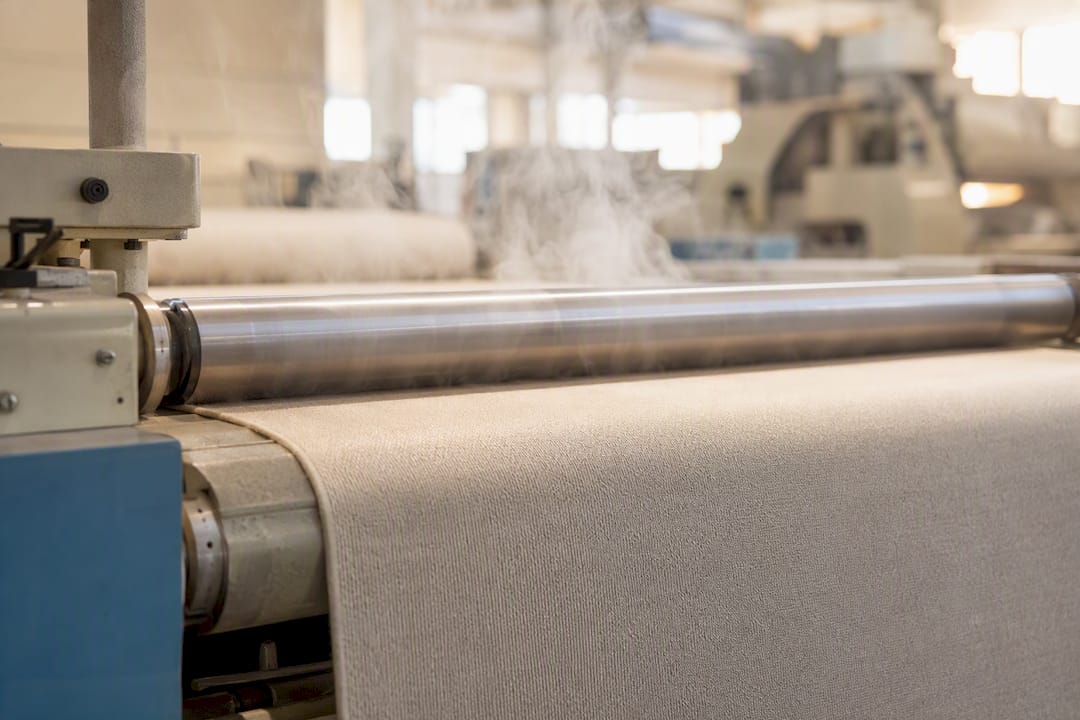
Calendering presses fabric between heated rollers for a smoother, glossier surface. Napping and shearing raise or trim fiber ends for a brushed, plush feel, common in flannel and some upholstery velvets. Sanforizing mechanically pre-shrinks cotton, typically holding residual shrinkage to a low and controlled percentage, according to Wikipedia’s overview of textile finishing). Heat-setting does the equivalent job for synthetics, locking in dimensional stability with heat instead of moisture.
Chemical finishes work differently. Durable water repellent (DWR) treatments, flame retardants, antimicrobial coatings, and easy-care resin finishes all involve applying a compound to the fabric surface, then curing it with heat so it bonds to the fiber, as Texaux Chemicals explains in its breakdown of finishing categories.
| Aspect | Mechanical finishing | Chemical finishing |
|---|---|---|
| How it works | Physical manipulation (heat, pressure, abrasion) | Compounds bonded to fiber, usually cured with heat |
| Examples | Calendering, napping, shearing, sanforizing | DWR, flame retardant, antimicrobial, resin easy-care |
| Adds chemistry? | No | Yes |
| Typical goal | Change texture, sheen, or dimensional stability | Add function: repellency, safety, hygiene |
Most fabrics you’ll actually buy use both, in sequence. A performance drapery fabric might get calendered for a smoother surface, then treated with a DWR finish for spill resistance, giving you softness and function in one yard.
Pro Tip: Ask whether a fabric’s water repellency was applied before or after any softening treatment. Order matters. Applied in the wrong sequence, one finish can partially cancel out the other.
Finishes That Change How Fabric Looks and Feels
Some finishes exist purely to make fabric more beautiful or more comfortable to live with, and these are the ones you’ll notice first when you run your hand across a bolt of fabric.
Mercerizing treats cotton yarn with a caustic solution under tension, giving it a subtle sheen and stronger dye uptake. It’s a controlled industrial process, not something to attempt at home, but the payoff is fabric that looks richer and holds color better over years of sun exposure near a window.
Calendering and glazing use heated rollers to flatten and polish the fabric surface, producing the crisp sheen you see in chintz or polished cotton. It’s a purely mechanical effect, and it can wear off with repeated hard laundering.
Napping, peaching, and brushing raise short fibers from the fabric surface using fine abrasive rollers, creating the soft, slightly fuzzy hand you feel in flannel, peached microfiber, and brushed cotton. These finishes trade some durability for comfort, since the raised fibers can flatten or pill over time.
- Mercerizing: adds sheen and color depth, mostly used on cotton
- Calendering: adds surface polish, mechanical and reversible with wear
- Napping/peaching: adds softness and warmth, best for lower-abrasion uses like drapery and bedding
If you’re shopping for curtain fabric, these aesthetic finishes are often what separates a fabric that photographs beautifully from one that also feels good against your hand every time you draw the drapes.
Performance Finishes: DWR, Flame Retardant, and Antimicrobial Explained
Functional finishes solve a specific problem, and knowing what each one actually does, and how long it lasts, keeps you from paying for a feature that won’t survive your washing machine.
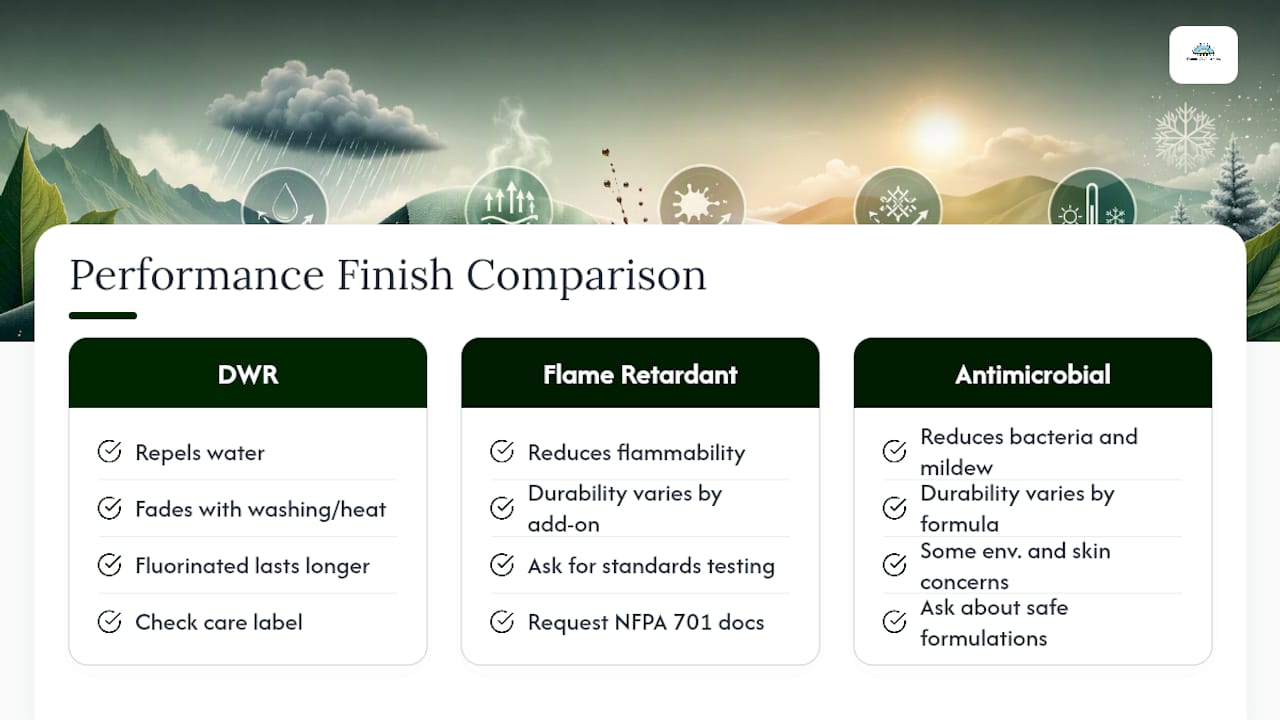
Durable water repellent (DWR) finishes cause water to bead and roll off rather than soak in. Traditional fluorinated DWR chemistries last longer through repeated laundering, but the industry has been shifting toward fluorine-free formulas over environmental concerns, which tend to need more frequent reapplication. Either way, DWR performance fades with washing and heat exposure, so check the label before tossing treated cushions or drapery in a hot dryer.
Flame retardant (FR) finishes matter most for hospitality, healthcare, and public-space textiles. If FR performance is required, ask for documentation against a named standard like NFPA 701 rather than accepting a general “flame resistant” claim with no test behind it.
Antimicrobial and antifungal finishes reduce odor-causing bacteria and mildew growth, useful for marine fabrics, bath textiles, and humid climates. Some formulations raise environmental and skin-sensitivity questions worth asking about if you have young children or pets in the house.
UV inhibitors slow fading and fiber breakdown from sun exposure, critical for outdoor fabrics and any drapery hung in a south-facing window.
A key trade-off runs through all of these: higher add-on levels of functional chemistry generally mean better performance and longer durability, but Texaux Chemicals’ research on finish types notes this comes at the cost of a stiffer, less natural hand. There’s no free lunch here, only the right balance for your specific room and use.
How Are Textile Finishes Applied at Scale?
Manufacturers use a handful of core methods to get finishing chemistry or texture onto fabric, and the method used affects everything from breathability to how the fabric will age.
- Pad-dry-cure is the workhorse method for chemical finishes: fabric passes through a chemical bath (the pad), gets dried, then cured with heat to bond the compound permanently. The percentage of chemical retained after drying is called the “add-on,” and higher add-on levels mean stronger, more durable performance.
- Coating and lamination apply a continuous polymer film to the fabric surface, typically through knife-over-roll coating or hot-melt lamination. This is how waterproof fabrics get made, but heavy coatings with add-on levels as high as 20 percent can dramatically cut breathability, since TextileTuts explains that breathability and film thickness move in opposite directions.
- Plasma treatment and enzymatic biofinishing offer lower-impact alternatives. Plasma modifies the fiber surface without heavy water or chemical use, and enzyme-based biofinishing using cellulases can soften fabric and reduce pilling with a smaller environmental footprint, according to ScienceDirect’s overview of textile finishing.
When you’re reading a spec sheet, look for the application method named explicitly. Vague claims like “specially treated” without a method attached usually mean there’s no real standard behind the finish.
How Long Do Textile Finishes Last, and How Do You Care for Them?
Not every finish is meant to last the life of the fabric, and knowing which category you’re buying prevents disappointment down the road.
- Permanent finishes, like sanforizing, are built into the fabric’s physical structure and don’t wash out.
- Durable finishes, like many DWR and FR treatments, survive dozens of launderings but do fade with wear.
- Semi-durable finishes hold up through moderate use but need reapplication after heavy washing.
- Temporary finishes, like some softening treatments, may not survive the first wash at all.
Ask about test results, not just marketing language. A supplier who can cite an AATCC spray rating or Martindale abrasion cycle count for upholstery fabric is giving you something you can compare across products, unlike a fabric described simply as “durable.”
Pro Tip: High heat is the enemy of most chemical finishes. If a fabric has a DWR or FR treatment, air dry or use low heat, since a hot dryer accelerates the breakdown of the bonded compounds.
A Quick Checklist for Choosing Finished Fabric
Before you commit to a bolt of fabric or a custom drapery order, run through this list.
- Ask what method applied the finish (pad-dry-cure, coating, mechanical) and what the add-on level or coating weight is.
- Ask how many launderings or how much abrasion the finish is rated to withstand, and request the standard behind that number.
- Watch for red flags: no named chemistry, no care instructions, or claims that sound too good (“never fades, never wears”) with no test data to back them up.
- Confirm the finish matches your end use, don’t pay for marine-grade UV protection on an indoor drapery panel that will never see direct sun.
If a seller can’t answer these questions clearly, that’s information too.
How Beautifulwindowselgin Applies Finishing Knowledge to Fabric Selection
Marrion and the team at Beautifulwindowselgin built their fabric selection process around exactly the questions above, because a designer choosing jacquard satin for a formal room needs different answers than a workroom sourcing marine-grade upholstery.
- Every fabric recommendation starts with matching the finish to the intended room, light exposure, and traffic level.
- Samples are available before you commit to yardage, so you can test hand and drape in your own space.
- The fabric FAQs page covers common ordering and care questions in plain language.
- Guidance on upholstery fabric durability helps buyers weigh finish trade-offs before ordering.
A Fabric Specialist’s Take on Choosing the Right Finish
Here’s the heuristic that actually matters: match the amount of finish to the amount of wear the fabric will take. Soft-touch drapery destined for a formal living room needs minimal finishing, just enough to stabilize the fabric and protect the color. High-wear upholstery in a house with kids or pets needs the opposite: heavier, more durable chemistry, even if it costs some softness.
The mistake I see most often is buyers assuming “more finish” always means “better fabric.” It doesn’t. A heavily treated fabric on a piece that barely gets touched is money spent on performance nobody needed.
Always request a launder test on samples before ordering yardage, not just a swatch you touch once in a showroom. And if sustainability matters to you, ask specifically about fluorine-free DWR formulations. The industry is moving that direction, and it’s a fair question to put to any supplier.
— Marrion
Bring Your Fabric Questions to Beautifulwindowselgin
Choosing the right finish gets a lot easier when you’re working with someone who sources fabric with these questions already answered. Beautifulwindowselgin carries designer fabrics by the yard, jacquard satin, embroidered textiles, upholstery and marine-grade options, each selected with an eye toward how the finish holds up in real rooms, not just on a spec sheet.
The company also offers custom drapery services with design consultation and installation guidance, so you’re not left guessing how a finished fabric will behave once it’s hanging in your window. If you’re comparing sheen options for the rest of the room, One Day Doors & Closets’ guide to interior sheen is a useful companion read.
The most practical next step is to order fabric samples before committing to full yardage. Browse the upholstery and drapery fabric collection and request swatches so you can test hand, drape, and finish performance in your own home before you buy.
Sources
- Dyeing & finishing fundamentals — Wilson College of Textiles, NC State
- Fabric finishing technologies: How coatings and treatments change fabric performance (TextileTuts)
- Textile finishing — ScienceDirect topic overview
Recommended
- Decode designer fabric terminology: a guide for homeowners – Fabric Store in Columbia, SC | Drapery Making Services
- Decorative Textile Selection Process: A 2026 Home Guide – Fabric Store in Columbia, SC | Drapery Making Services
- Why Invest in Quality Textiles: Benefits That Last – Fabric Store in Columbia, SC | Drapery Making Services
- Decorative Textile Tips for Stylish Home Interiors – Fabric Store in Columbia, SC | Drapery Making Services