


Pick the Right Puddle Depth: Curtain Puddling Styles, 1/2 to 14 Inches
Puddled curtains are drapery panels cut long enough to pool onto the floor rather than stop cleanly at the sill or hem. The three standard puddle depths are the break puddle (about ½ to 1 inch), the medium puddle (about 2 to 6 inches), and the true puddle (about 6 to 14 inches). A break suits almost any formal room, while a true puddle belongs in low-traffic, adult-only spaces with the right fabric weight behind it.
TL;DR:
- Fabrics over 200 gsm, like velvet and heavyweight linen, are best for maintaining a structured puddle, while lighter fabrics like sheers tend to collapse.
- For an 8-foot ceiling, a medium puddle requires panels about 86 to 90 inches long; a true puddle on a 10-foot ceiling may need 114 to 122 inches.
- Standard panel lengths often top out at 108 inches, so custom ordering is usually necessary for true puddles on taller windows.
- Puddles are ideal in low-traffic, formal rooms with heavier fabrics and high ceilings; they are unsuitable for kitchens, children’s rooms, or pet-heavy areas.
- Proper staging, including fan-pleating and leaving the fabric to settle overnight, is essential for achieving a neat, intentional puddle look.
Table of Contents
- What Are the Different Curtain Puddling Styles?
- How Do You Measure for a Puddle?
- Which Fabrics Hold a Puddle Without Collapsing?
- Is Puddling a Good Fit for Every Room?
- How Do You Style and Pleat a Puddle Correctly?
- How Do You Maintain and Clean Puddled Curtains?
- What Installation Rules Affect the Puddle?
- How Beautiful Windows Elgin Supports a Successful Puddle
- What Do Different Puddle Depths Actually Look Like?
- When Should You Actually Choose a Puddle Over Kiss Length?
- Get Your Puddle Right the First Time With Beautiful Windows Elgin
- Sources
- FAQ
What Are the Different Curtain Puddling Styles?
The break puddle is the safest entry point into puddling. Fabric grazes the floor with a soft curl, giving a tailored look that still reads as intentional in a busy household. According to designers and editorial sources who define these ranges, the medium or short puddle runs 2 to 6 inches and creates a visibly soft, gathered pool without swallowing the floor space in front of the window.
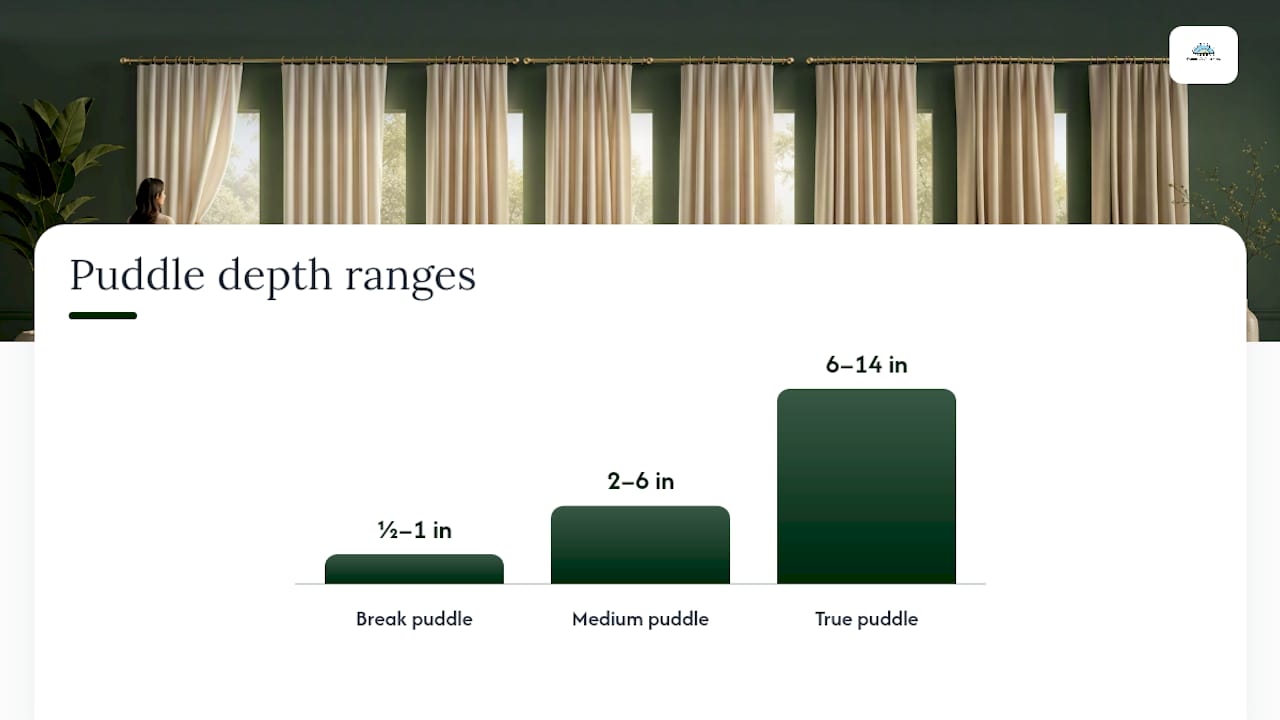
True puddling, at 6 to 14 inches, is the theatrical option reserved for formal living rooms and primary bedrooms with high ceilings. The extra fabric needs room to spread into folds rather than bunch into a lump.
Panel fullness changes how any of these depths reads. A curtain sewn at double fullness pools wider and looks more luxurious than a flat panel with the same drop length. Ceiling height matters too: an 8-foot ceiling makes a true puddle look overwhelming, while a 10 or 12-foot ceiling gives it the vertical drama it needs to look deliberate instead of accidental.
- Break puddle: ½ to 1 inch, tailored and low maintenance
- Medium puddle: 2 to 6 inches, soft and noticeable without excess yardage
- True puddle: 6 to 14 inches, formal and fabric-hungry, best with tall ceilings
How Do You Measure for a Puddle?
Getting the drop right starts at the rod, not the floor. Follow this sequence before cutting or ordering fabric.
- Measure from the top of the installed rod (or the ring, if using rings) straight down to the floor. This is your baseline drop.
- Decide your puddle depth: add ½ to 1 inch for a break, 2 to 6 inches for medium, or 6 to 14 inches for a true puddle.
- Add your chosen inches to the baseline drop to get total panel length.
- Add hemming margin. Most workrooms build in 6 to 8 inches for a bottom hem, on top of the puddle allowance, when cutting from raw yardage.
- Check ready-made limits. Standard lengths top out at 63, 84, 95 or 94, 108, and 120 inches, which rarely leaves enough for a true puddle on anything taller than an 8-foot ceiling.
For an 8-foot ceiling with an 84-inch drop to the floor, a medium puddle needs roughly 86 to 90 inches of finished panel length. On a 10-foot ceiling with a 108-inch drop, a true puddle can require 114 to 122 inches, which almost always means ordering custom drapery rather than off-the-shelf panels.
Which Fabrics Hold a Puddle Without Collapsing?
Weight decides whether a puddle looks styled or looks like a laundry pile. The general rule of thumb points to roughly 200 gsm as the floor for fabric that will hold its shape once it hits the ground.
That threshold is the single biggest predictor of whether a puddle looks intentional.
Velvet, heavier linen blends, heavyweight cotton, and dupioni or textured silk all sit comfortably above that line and drape into rounded folds. Light sheers, voile, and unlined cotton lawn almost always fail here. Ordering them longer will not fix the problem; it just adds more fabric to the pile on the floor.
- Velvet and heavyweight jacquard: excellent puddle memory, holds folds for weeks
- Heavier linen blends and structured cotton: reliable for medium puddles
- Light sheers and voile: avoid for puddling; better suited to kiss length or floor-length hems
- Lining or interlining: adds body to mid-weight fabrics, pushing a borderline 180 gsm cotton into puddle-ready territory
Is Puddling a Good Fit for Every Room?
Puddling earns its keep in formal living rooms, primary bedrooms, and dining rooms where foot traffic stays light and nobody is dragging a stroller or a laundry basket past the window daily.
It is a poor fit anywhere fabric will get stepped on, chewed, or run over. Kitchens, children’s rooms, and any window near a sliding door are common failure points. Pet owners face a specific hazard: a robot vacuum or an eager dog will treat a puddled hem as a chew toy or a track obstacle within days.
Flooring matters more than most homeowners expect. A rug under the window protects the hem from friction and foot traffic, while a hard floor, especially in a sunny room, tends to pick up dust and static faster than carpet does.
- Best fit: formal living rooms, primary bedrooms, low-traffic dining rooms
- Poor fit: kitchens, kids’ rooms, sliding-door entries, homes with active pets or robot vacuums
- Rug placement under the window reduces hem wear versus bare hardwood or tile
How Do You Style and Pleat a Puddle Correctly?
A puddle that looks accidental is the single most common styling mistake. Emily Henderson has pointed out that puddling requires real commitment: thin fabric or a token extra inch or two almost always reads as a hemming error rather than a design choice.
- Fan-pleat the extra fabric by hand into an accordion fold before final installation, then let it sit overnight so the folds set into memory. Mar Jennings recommends this exact fan-pleating technique as standard practice in professional workrooms.
- Arrange the puddle after hanging: spread a true puddle into a wide, flowing pool for drama, or tuck a medium puddle into tighter, stacked folds for a cleaner tailored look.
- Pair the puddle with a Roman shade or cellular shade underneath if you want daily light control without disturbing the pooled fabric, and add tiebacks for a staged, pulled-open daytime look.
Pro Tip: Train your puddle the same way you’d train a cowlick. Fan-pleat, pin loosely, and leave it overnight before guests arrive. Skipping this step is why most DIY puddles look messy on day one.
How Do You Maintain and Clean Puddled Curtains?
Puddled fabric on the floor collects dust and pet hair faster than a hemmed panel, and it needs a light weekly straightening to stay photogenic rather than rumpled.
A quick vacuum with a soft brush attachment, run along the folds rather than across them, handles most dust buildup. Deep cleaning depends entirely on fiber: velvet and silk need professional dry cleaning, while some heavyweight cottons are machine-washable if the label confirms it. Never assume a blend can go in the washer without checking.
- Weekly: hand-fluff and re-fan the folds to keep them looking deliberate
- Weekly: light vacuum with a brush attachment along the fold lines, not against them
- Quarterly or as needed: dry clean velvet, silk, and structured jacquard
- Ongoing: keep a rug or runner under the puddle zone to cut down on dust and pet hair pickup
What Installation Rules Affect the Puddle?
Placement decides whether the puddle stacks cleanly or drags awkwardly against the wall. The high-and-wide rule that designers favor calls for mounting the rod 4 to 6 inches above the window trim, higher still on tall ceilings, and extending the rod 6 to 12 inches past the frame on each side.
Rod diameter matters more once you add puddle weight. A thin curtain rod will bow under a heavy velvet panel with 10 inches of extra fabric pooling at the base. Multiple support brackets, spaced every 24 to 36 inches on wide windows, prevent that sag and keep rings or grommets moving smoothly. Chris Loves Julia’s installation advice notes that heavy panels need extra bracket support to avoid sagging between mounting points.
- Mount the rod 4 to 6 inches above trim, more on ceilings above 9 feet
- Extend the rod 6 to 12 inches beyond the window frame on each side
- Use multiple brackets on any span wider than 60 inches to prevent bowing
- Pleated headers and hidden tabs offer more puddle control than plain rod pockets
How Beautiful Windows Elgin Supports a Successful Puddle
Getting a puddle right depends on three decisions: correct fabric weight, accurate drop measurement, and clean pleating. Support for a successful puddle depends on accurate fabric weight choice, precise measurement, and proper pleating techniques to remove guesswork that leads to collapsed or accidental-looking puddles.
What Do Different Puddle Depths Actually Look Like?
Photos help more than inch measurements when you are picturing a puddle in your own room. A break puddle photographed against hardwood usually shows a soft curl at the base, barely a fold, sitting close to the panel’s natural drop. It looks tailored, almost invisible unless you’re standing close to the window.
A medium puddle photographed in a bedroom setting typically shows two or three visible folds cascading onto the floor, wide enough to catch light and cast shadow lines across the fabric. This is the depth most home stylists photograph for a “cozy but polished” look, because it reads as intentional in nearly any lighting.
True puddles photographed in formal settings, often paired with velvet or heavy jacquard, show a wide spread of fabric, sometimes 18 to 24 inches across at the base, arranged into deliberate waves rather than a straight drop. These are the images that show up most in editorial spreads, largely because the fabric weight and the room scale are both doing exactly what they need to.
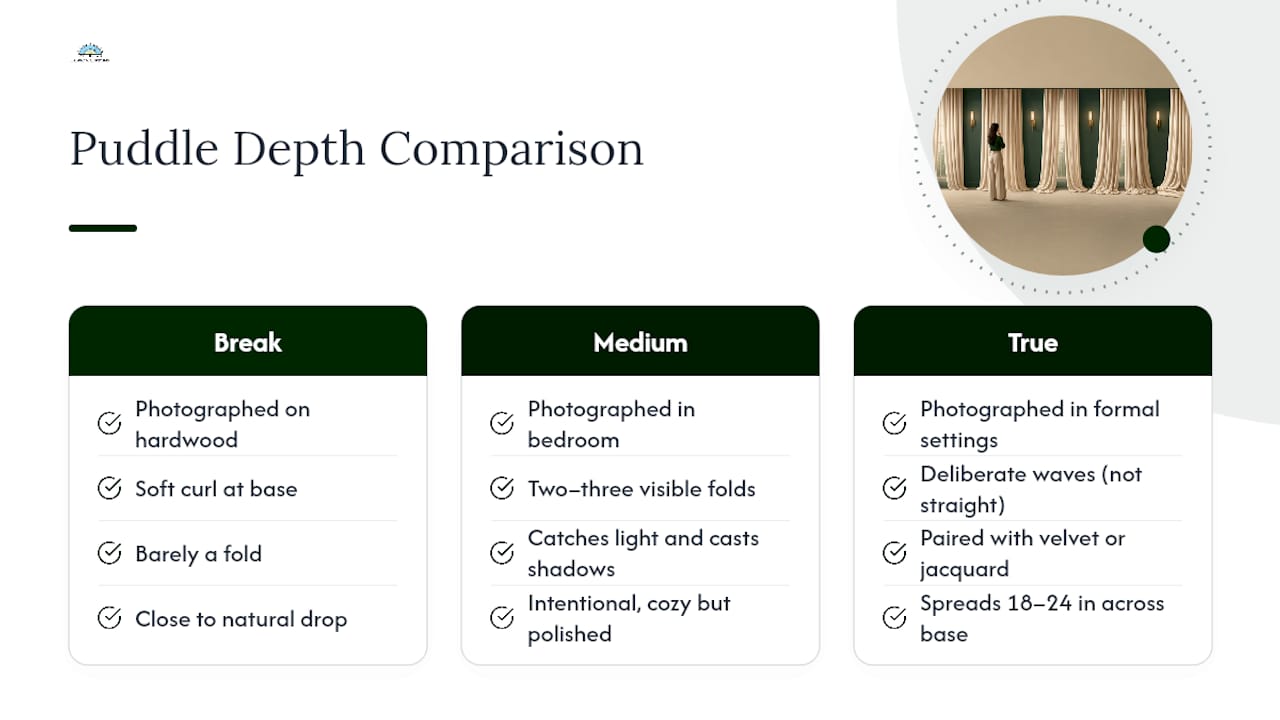
A useful visual test before committing to a puddle depth: clip a bedsheet or an old curtain panel to your existing rod at your intended length, let it sit for a day, and photograph it in the room’s actual light. Compare that photo against the break, medium, and true examples above. Seeing your own window, in your own light, at the depth you’re considering tells you more than any catalog photo will.
Custom fabric swatches from a curated fabric collection let you hold the actual weight and drape against your window before committing to yardage, which is the closest you can get to a real preview short of hanging finished panels.
When Should You Actually Choose a Puddle Over Kiss Length?
Marrion’s take: choose a puddle when the room is formal, low-traffic, and the fabric is heavy enough to hold folds on its own; choose kiss length everywhere else. Before ordering, clip a spare sheet to the rod at your target length and live with it for 48 hours. If it still looks deliberate on day two, order the puddle. If it looks like a mistake by day two, it will look like one in the finished room too.
— Marrion
Get Your Puddle Right the First Time With Beautiful Windows Elgin
Most puddling disasters trace back to one of three mistakes: the wrong fabric weight, a drop calculated without a hemming margin, or panels hung with no pleating plan. A curated selection of designer fabrics sold by the yard can be paired with custom drapery making services and design consultation to help ensure the fabric chosen suits the desired puddle depth before cutting.

Before booking a consultation, have three things ready: your final rod height, your target puddle depth (break, medium, or true), and a sense of which fabric weight you’re leaning toward. Request a swatch from the fabric-by-the-yard collection to check drape and hand before committing to yardage. Beautiful Windows Elgin ships fabric and finished panels nationwide, and its custom drapery service covers everything from measurement guidance to final installation support. Visit the site to start a consultation and get a fabric sample sent to your door.
Sources
- How Much Should Curtains Puddle? - Decor Snob
- Curtain Length Guide 2026: Standard, Custom, Floor, Puddle
- How to hang curtains (Style by Emily Henderson)
- Practically Perfect Puddling - Mar Jennings
FAQ
Is Puddling Curtains Still in Style?
Yes, puddling remains a favored look for formal rooms, particularly the break and medium depths that read as tailored rather than dated. True puddles still appear regularly in high-ceiling formal spaces where fabric weight and room scale support the drama.
Is It a Good Idea to Use Puddled Curtains?
It depends on the room. Puddling works well in low-traffic formal living rooms and primary bedrooms with heavier fabrics like velvet or structured cotton, but it’s a poor choice near pets, kids, or high foot traffic where hems get dragged or chewed.
What Are the Different Types of Curtain Hanging Styles?
Beyond puddling, common lengths include kiss length, where the hem just grazes the floor with no pooling, and float length, which stops just above the floor by half an inch or so. Header styles like pleated, ring-top, and hidden tab also change how a curtain hangs and how well it can support a puddle.
How Much Fabric Do I Need to Add for a Puddle?
Add ½ to 1 inch for a break puddle, 2 to 6 inches for a medium puddle, and 6 to 14 inches for a true puddle, plus a standard 6 to 8 inch hemming margin if cutting from raw yardage. Custom lengths from a service like Beautiful Windows Elgin remove the guesswork since panels are cut to your exact drop and puddle depth.
What Fabric Weight Works Best for Puddling?
Aim for fabric at or above roughly 200 gsm, such as velvet, heavyweight cotton, or structured linen blends. Lighter fabrics under 150 to 200 gsm, including most sheers, tend to collapse sideways instead of holding a fold.