


Best Fabric for DIY Window Curtains: 2026 Guide
Table of Contents
- Quick Comparison: Best Fabrics for DIY Window Curtains
- Natural vs. Synthetic Curtain Fabrics: What Works for DIY
- How to Calculate Yardage for Curtains
- Curtain Lining Types and Uses: Blackout, Thermal, and More
- Sewing Tips for Heavy Curtain Fabrics
- Top Fabric Picks for DIY Window Curtains
- Matching Fabric to Room Function and Light Control
- Conclusion: Choosing Your Best Fabric
- Frequently Asked Questions
Last Updated: October 4, 2026
Quick Comparison: Best Fabrics for DIY Window Curtains
Choosing the best fabric for DIY window curtains comes down to three things: weight, weave, and how much light you want to block. Get those right and the sewing becomes easy. Get them wrong and even perfect stitching will hang badly.
At Beautiful Windows Elgin, we sell designer fabric by the yard and offer custom drapery services. According to Joey Z Shopping's guidance on fabric requirements, 70% of professional curtain makers recommend 2 to 2.5 times the window width for optimal drape. That single ratio matters more than any fabric label.
Here's the short version before we get into detail:
| Fabric | Weight | Best For | Watch Out For |
|---|---|---|---|
| 100% Cotton (Blue Grey, $36.99/yd) | 285 gsm | Living rooms, multi-purpose | Wrinkles without a lining |
| Linen-Cotton Blend (Aiden, $46.99/yd) | 187 gsm | Bedrooms, soft drape | Lighter body, needs lining |
| Poly-Cotton (Hart Green, $52.99/yd) | 374 gsm | High-traffic rooms | Heavier needle required |
| 100% Polyester (Anjou Grey, $38.99/yd) | 285 gsm | Kitchens, humid rooms | Less natural hand-feel |
Below, we'll walk through yardage math, lining choices, and the sewing adjustments that keep heavy panels from puckering.

Natural vs. Synthetic Curtain Fabrics: What Works for DIY
Natural fibers bring warmth and texture that synthetics struggle to copy. Cotton, linen, and bamboo have replaced synthetic solids as the default choice for fabric window treatments in 2026, according to 3 Day Blinds' window treatment trends. That shift makes sense for DIY sewers, because natural fibers press cleanly and take a seam well.
They also wrinkle. Pure linen has a high wrinkle tendency that makes it impractical for everyday home use, which is why linen-blend fabrics are outperforming 100% linen in the 2026 market (Joy Deco's fabric guidance). A blend keeps the texture and loses most of the ironing.
Synthetic blends solve different problems. Polyester delivers high wrinkle resistance, shrink resistance, and colorfastness, which is why industry analysis for 2026-2035 still treats it as an economical standard for curtain fabric (Business Research Insights curtain fabric market report).

How to Calculate Yardage for Curtains
Yardage math is where most DIY curtain projects go wrong, because fabric is sold by length but curtains are sized by width.
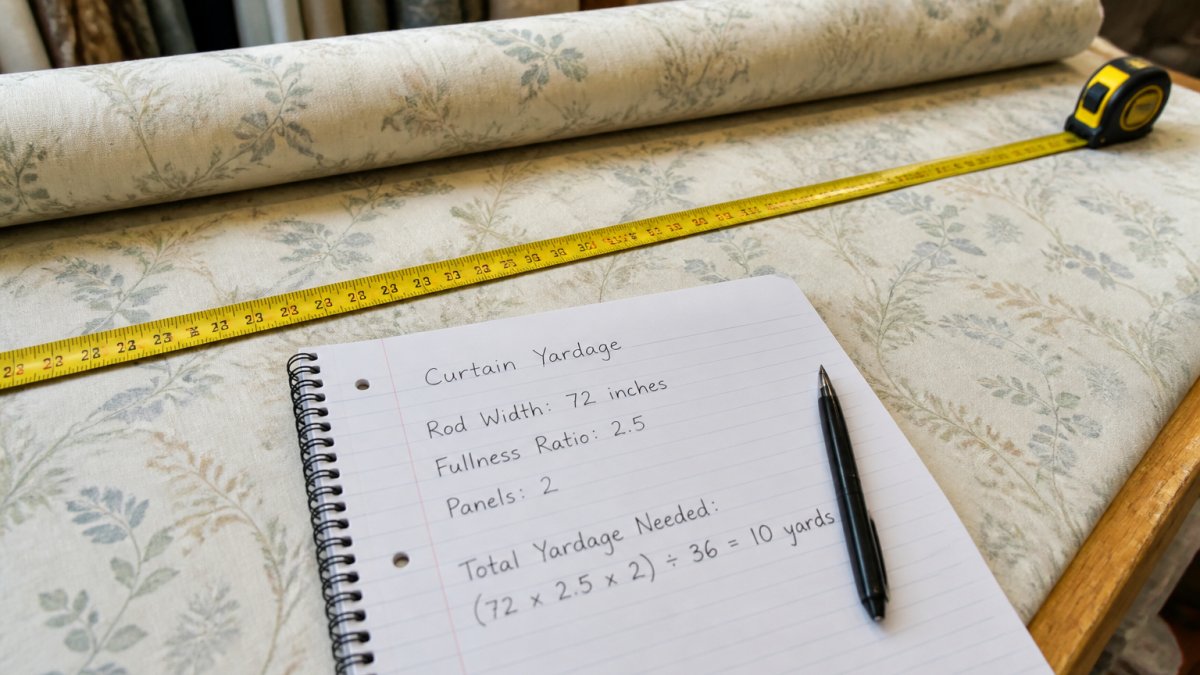
Step 1: Measure the rod, not the window. Measure the full rod width, including any return to the wall.
Step 2: Decide your fullness ratio. Fullness is how much fabric width you gather into the rod width.
- 1.5x: flat, modern, minimal gather
- 2x: standard gathered look
- 2.5x: full, tailored drape
- 3x: heavy pleats, formal rooms
Step 3: Convert to panels. Divide your total fabric width by the usable width of the bolt.
Worked example: A 60-inch rod at 2x fullness needs 120 inches of fabric width.
Step 4: Calculate length per panel. Measure from the rod to your desired drop, then add hem allowance:
- Top hem (rod pocket or header): 4 inches
- Bottom hem (double-fold): 8 inches for a 4-inch finished hem
- Total add: 12 inches per panel
A 96-inch finished length needs 108 inches of cut length per panel.
Step 5: Add for pattern repeat. If the fabric has a vertical repeat, every panel after the first needs one extra repeat to match the motif across seams.
Step 6: Convert to yards. Total inches ÷ 36 = yards. Round up to the nearest half yard.
If you are working with a fabric that has a horizontal repeat, add one full repeat per panel for every seam you plan to match. For a three-panel window with two seams, that is two extra repeats total.
Curtain Lining Types and Uses: Blackout, Thermal, and More
Lining is the difference between a curtain that looks custom and one that looks homemade. It adds body, protects the face fabric from sun damage, and changes how the panel performs at the window.
Regular lining is a lightweight cotton or poly-cotton fabric, usually 2 to 3 ounces per square yard.

Blackout lining is a tightly woven fabric with a foam or acrylic coating, typically 4 to 6 ounces per square yard. It blocks 99% or more of light when the panel is closed and the edges overlap the window frame.
Thermal lining is a blackout lining with a reflective or insulating layer, often a mylar or aluminum film, that reduces heat transfer through the glass. It works in both directions: it keeps summer heat out and winter warmth in.
Blue Grey Color—Window Curtain Fabric—100% Cotton—Strong →
Interlining is a separate layer of flannel or bump cloth that sits between the face fabric and the lining. It is not a lining by itself.
How to choose:
- Bedrooms: blackout lining, or blackout plus interlining for a hotel-quality drape
- Living rooms: regular lining, or interlining if you want a fuller fold
- Kitchens and bathrooms: regular lining or none, because humidity and cooking grease are hard on coated linings
- Home offices: thermal lining if afternoon glare hits your screen
- Sun-facing windows: any lining is better than none, because UV fades face fabric from the back as well as the front
Construction notes for DIYers:
- Cut lining 1 to 2 inches narrower and 1 to 2 inches shorter than the face fabric so the lining does not peek out at the edges.
- Sew the lining to the face fabric at the sides and bottom, then turn and press. This is called bagging out, and it hides all raw edges.
- Use a 100/16 needle and polyester thread for lined panels. The extra layers dull needles faster, so change the needle at the start of every lined project.
- Hang the panel for 24 to 48 hours before hemming. Lined panels relax and drop, and hemming before the drop means your finished length will be short.
Sewing Tips for Heavy Curtain Fabrics
Heavy fabric punishes shortcuts. A standard 80/12 needle will skip stitches on 374 gsm fabric, so switch to a 100/16 or 110/18 denim needle and a longer stitch length of 3.0 to 3.5 mm.
Support the weight. A walking foot feeds heavy layers evenly and prevents the bottom layer from lagging behind. Use polyester thread, not cotton, because cotton thread snaps under the load of a full panel.
Press as you go. Pressing each seam flat before moving to the next one prevents the bulk from shifting. For side hems on heavyweight panels, use a 4-inch double-fold hem rather than the standard 2-inch. It hangs straighter and hides the weight.
Top Fabric Picks for DIY Window Curtains
Our top pick for most DIY projects is the Blue Grey Color, Window Curtain Fabric at $36.99 per yard. It carries 75,000 double rubs, and its 54-inch width keeps yardage math simple.
For a softer, more contemporary look, the Aiden Linen Cotton Fabric for Window Curtains by the Yard |52" at $46.99 per yard gives you a linen texture with a structured drape at 187 gsm.
If you need something durable, the Hart Durable Green Curtain Fabric at $52.99 per yard weighs 374 gsm and holds 30,000 double rubs. It is a heavier fabric, so consider a heavy-duty needle and a walking foot.
Budget-conscious sewers should look at the Anjou Grey Window Curtain Fabric at $38.99 per yard. It resists wrinkles, cleans with water-based agents, and holds a Grade 4.5 colorfastness rating.
Matching Fabric to Room Function and Light Control
Room function should decide your fabric weight, not the other way around.
- Bedrooms: Blackout lining plus a midweight face fabric. Aim for full opacity.
- Living rooms: Medium weight with regular lining. You want light filtration, not blockage.
- Kitchens and bathrooms: Polyester or poly-cotton. Humidity ruins natural fibers that can't be washed.
- Home offices: Thermal lining if afternoon glare hits your screen.
Opacity runs on a scale from sheer to full blackout. Sheer fabrics filter light and offer almost no privacy at night. Heavyweight fabrics with blackout lining give you full window coverage and thermal insulation in one panel.
Hardware compatibility matters here too. Grommet headers need a fabric that holds its shape under the metal ring, so avoid very light blends. Rod pocket headers work with almost anything but bunch when the panel is heavy. Pinch pleat headers need a fabric with enough body to hold the pleat, which is why we sew our pinch pleat panels from midweight and heavyweight goods.
Conclusion: Choosing Your Best Fabric
The hardest part of DIY window curtains isn't the sewing. It's committing to a fabric before you've seen it in your own light, on your own window, at your own scale.
That's why we sell designer fabric by the yard with nationwide shipping, so you can order the yardage you actually need instead of guessing at a pre-made panel. If you'd rather start from a fabric with built-in pattern, our embroidered fabric for custom curtains gives you a decorative face cloth that skips the print-matching step. And if the project turns out bigger than you planned, our custom drapery workroom can take it from there with your choice of header, lining, and hem.
Select your Fabric and start with the yardage math above. Get the weight right first, and everything else follows.
Frequently Asked Questions
What is the easiest fabric to sew for curtains?
Cotton and cotton-polyester blends are the easiest to sew for DIY window curtains. They hold a crease well, do not slip under the needle, and resist fraying better than loosely woven linen. A medium-weight fabric like the Blue Grey Color Window Curtain Fabric (54 inches wide) can work well for beginners because it feeds smoothly through a standard machine and presses flat for clean hems.
How do I choose the right weight fabric for curtains?
Match fabric weight to the room and the look you want. Lightweight fabrics (under 200 GSM) like sheer cotton or linen blends suit living rooms where you want light filtration. Medium-weight fabrics (200-300 GSM) offer a structured drape and work in most rooms. Heavyweight fabrics (over 300 GSM) provide thermal insulation and block more light, making them ideal for bedrooms. The Hart Durable Green Curtain Fabric weighs 374 GSM, which gives it enough body to hang with deep folds.
Do I need to line my DIY curtains?
Lining is optional but adds real benefits. A blackout lining blocks light and reduces noise, which helps in bedrooms. Thermal lining adds insulation and can lower energy costs. A standard cotton lining protects the face fabric from sun damage and gives the curtain more body. If you skip lining, choose a fabric with a tight weave and enough weight to hang well on its own, like a polyester or cotton-poly blend.
Is cotton or polyester better for curtains?
It depends on your priorities. Cotton breathes well, drapes naturally, and takes dye beautifully, but it can shrink and wrinkle. Polyester resists wrinkles, holds its shape, and stands up to sunlight without fading. For DIY window curtains, a cotton-polyester blend often gives you the best of both: the natural hand-feel of cotton with the durability and easy care of polyester. The Ascot Blue-Bell Cotton Curtain Fabric is a 58% cotton, 42% polyester blend that balances softness with resilience.
How much extra fabric do I need for curtain pleats?
For pleated curtains, plan for 2 to 2.5 times the window width. That means a 48-inch-wide window needs 96 to 120 inches of fabric across. For gathered or ruffled headers, use 1.5 to 2 times the width. Flat panels can use 1 to 1.5 times the width if you only want minimal coverage. Always add 8 to 12 inches to the total length for hemming and header allowance, and round up to the nearest yard when ordering.