

Best Fabric Store Alternatives 2026: Where to Shop Fabric?
Last Updated: October 30, 2026
Quick Summary
The best fabric store alternatives in 2026 are not one store but a mix of online specialists, independent shops, and workrooms matched to your project. Compare every candidate on landed cost per yard, minimum order and cut policy, return policy, specification transparency, and swatch program before you buy.
- The U.S. fabric, craft and sewing supply trade counts 31,349 businesses and grew 1.3% a year from 2021 to 2026.
- Zelouf Fabrics offers up to 10 free swatches at a time, according to Kaylee Makes' 2026 roundup.
- Mill End Fabrics points Joann shoppers toward Mood Fabrics, Fabric Wholesale Direct, OnlineFabricStore, and Fabric Guru.
- Order one extra yard beyond your calculated need for projects with a large repeat or directional print.
- Quilting calls for 100% cotton quilting-weight fabric, usually 44/45 inches wide.
Table of Contents
- Why Fabric Store Alternatives Matter in 2026
- Joann Alternatives: What Changed and Where Shoppers Went
- How to Compare Fabric Retailers Before You Buy
- Fabric Swatches and Samples: The Cheapest Insurance You Can Buy
- Drapery Fabric Suppliers: What to Look For
- Custom Drapery Workroom Services vs. DIY Sewing
- Matching Fabric to Your Project: Quilting, Apparel, and Home Décor
- Choose Your Fabric and Start Your Project
- Frequently Asked Questions
Why Fabric Store Alternatives Matter in 2026
This guide from Beautiful Windows Elgin covers the best fabric store alternatives in 2026, how to compare them, and how to match a retailer to your project.
The short answer: there is no single replacement. There is a right retailer for each project.
If you want a broader roundup to browse first, our guide to the best fabric store alternatives for designers covers more options.
Joann Alternatives: What Changed and Where Shoppers Went
Shoppers did not migrate to one store after Joann's closures. They scattered.
A 2026 roundup from Kaylee Makes' guide to online fabric stores names Zelouf Fabrics, DFW Fabric Mart, Vogue Fabrics, Spandex World, and Linda's among its favorites, and notes that Zelouf offers up to 10 free swatches at a time. Mill End Fabrics' JOANN alternative guide points readers toward Mood Fabrics, Fabric Wholesale Direct, OnlineFabricStore, and Fabric Guru.
How to Compare Fabric Retailers Before You Buy
Most fabric store roundups tell you where to shop. Few tell you how to decide. This section gives you a repeatable comparison framework so you can evaluate any retailer, online specialist, independent shop, or workroom, on the same terms.
The Five-Point Comparison Framework
Compare every candidate retailer on these five points, in this order:
- Landed cost per yard, price per yard plus shipping, cut fees, and minimum-order effects
- Minimum order and cut policy, can you buy 1 yard, or must you buy a bolt?
- Return and exchange policy, what happens if the color is wrong?
- Fabric specification transparency, fiber content, weight, width, repeat, and care
- Swatch program, free, paid, or none, and how many you can order
Fabric quality comes after these five. Most buyers reverse that order and regret it, because a beautiful fabric with a no-return policy and a 5-yard minimum is a costly gamble.
Landed Cost: A Worked Example
Price per yard tells you little on its own. A cheap bolt with a two-yard minimum and paid shipping can cost more than a slightly higher-priced fabric with free shipping over a threshold.
Build a landed-cost estimate before you commit:
- Fabric cost: price per yard × yardage needed, plus extra yardage for matching repeats and pattern alignment
- Minimum order: some workrooms and wholesalers require a full bolt or a multi-yard minimum
- Shipping: flat rate, weight-based, or free above a threshold
A common pattern: a fabric listed at a lower per-yard price but with a 3-yard minimum and paid shipping lands higher than a mid-priced fabric with a 1-yard minimum and free shipping over a threshold.
Return Policies: What to Expect and What to Ask
Before you order, confirm the return terms:
- Is cut yardage returnable? Most retailers say no. Some allow exchange for defective goods only.
- What counts as defective? Holes, misweaves, and wrong fiber content usually qualify; color dissatisfaction usually does not.
- Is there a restocking fee? Some retailers charge a percentage on returns of uncut bolts.
Color Accuracy and Fabric Quality: How to Assess Remotely
Color accuracy is the other trap. Screens render color differently, and dye lots can vary between bolts of the same fabric. For a dedicated walkthrough, read our guide to matching fabric colors online.
Ask these questions before you buy:
- Fiber content: Is it stated as a percentage (e.g., 100% cotton, 55% linen / 45% rayon)?
- Weight: Is it given in ounces per square yard or grams per square meter?
- Width: Is it 44/45 inches, 54 inches, or 60 inches? Width changes your yardage math.
If a listing omits fiber content or weight, treat that as a warning sign. You cannot assess drape, durability, or pleat retention without those numbers.
In-Store vs. Online: A Quick Decision Guide
| Factor | In-Store | Online |
|---|---|---|
| Color check | Direct, under store lighting | Requires swatch or return policy |
| Hand-feel | Immediate | Requires swatch |
| Selection | Limited to floor stock | Broader, including designer lines |
| Price transparency | Often unmarked or sale-driven | Listed per yard |
| Convenience | Immediate pickup | Shipping lead time |
| Best for | Time-sensitive, color-critical projects | Specialty fibers, designer fabrics, bulk |
A practical hybrid: order swatches online, then buy full yardage from whichever channel has the best landed cost once you have confirmed the hand and color.
Fabric Swatches and Samples: The Cheapest Insurance You Can Buy
Fabric swatches are small cut samples a retailer sends so you can check color, weight, and texture before ordering full yardage.
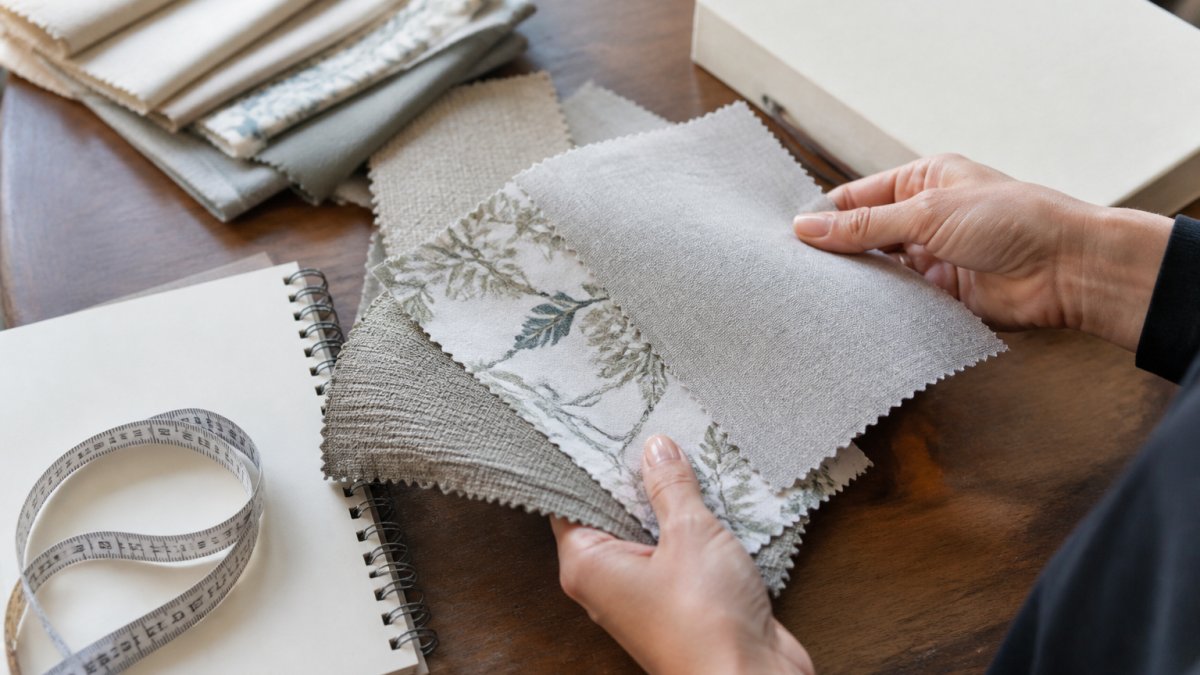
Order swatches for every project where color or hand-feel matters. Tape them to the wall near the window, check them at night under lamplight, and compare them against your paint and flooring.
Once you are ready to order, our guide to ordering fabric samples online covers the full process.
Drapery Fabric Suppliers: What to Look For
A drapery fabric supplier should tell you three things up front: fiber content, weight, and whether the fabric is suitable for pleating and lining. Suppliers who dodge those questions are selling décor, not drapery.
Weight matters most. Lightweight cottons hang softly and suit relaxed rooms. Medium-weight linens and blends hold a pleat and resist fading. Heavy upholstery-grade weaves block light and insulate but need sturdy hardware.
For readers comparing suppliers directly, our page on a Fabric Bistro alternative for custom drapery lays out what to evaluate side by side.
Custom Drapery Workroom Services vs. DIY Sewing
Custom drapery workroom services handle measuring, pattern matching, lining, and fabrication for you. DIY sewing costs less in labor but demands time, equipment, and a tolerance for redoing hems.
Here is the honest split:
| Factor | Custom Workroom | DIY Sewing |
|---|---|---|
| Time to finished panels | Weeks, handled for you | Weekends, depending on skill |
| Tools needed | None | Sewing machine, serger, long table |
| Pattern matching | Handled by the workroom | On you, and unforgiving |
| Best for | Difficult windows, designers | Simple panels, experienced sewers |
At Beautiful Windows Elgin, we offer custom drapery services on request and ship designer fabric nationwide for makers who prefer to sew their own. For a deeper comparison to help you decide, see our guide to custom drapery vs store bought curtains.
Matching Fabric to Your Project: Quilting, Apparel, and Home Décor
Match fabric to the project before you match it to a budget. This section is a project-led decision guide: for each major use case, here is what to look for, what to avoid, and how to compare retailers on the criteria that actually matter for that project.
Quilting: Tight Weave, Low Stretch, Consistent Color
Quilting wants tightly woven cotton with little stretch. The standard is 100% cotton quilting-weight fabric, usually 44/45 inches wide.
- Fiber: 100% cotton is the default; blends can work but check shrinkage
- Weight: medium weight, often described as quilting weight
- Weave: tight, consistent weave so seams do not pull
Retailer criteria for quilting: Look for retailers that sell precuts (fat quarters, charm packs, jelly rolls) alongside yardage, publish dye-lot information, and offer free or low-cost swatches.
What to avoid: loose-weave decorator cotton, fabrics with more than a small percentage of spandex, and any listing that does not state fiber content.
Apparel: Match Knit or Woven to the Pattern's Stretch Requirement
Apparel needs drape and recovery, so knits and wovens behave very differently.
- Knits: look for 4-way or 2-way stretch percentages, recovery, and weight in ounces per square yard
- Wovens: look for drape, hand, and whether the fabric needs lining
- Fiber: linen breathes and wrinkles; cotton presses well; synthetics resist fading but can pill
Retailer criteria for apparel: Look for retailers that state stretch percentage, weight, and width, and that organize inventory by fabric type (knit vs. woven) rather than only by color.
What to avoid: buying knit fabric without a stated stretch percentage, and buying woven fabric for a pattern that requires stretch.
Upholstery: Heavy Weight, Tight Weave, Rub-Tested Durability
Home décor calls for heavier upholstery and drapery weaves that resist wear and light. Upholstery is the most specification-driven category.
- Weight: heavy weight, often measured in ounces per square yard
- Weave: tight weave; check for abrasion testing (rub counts) where published
- Fiber: synthetics and blends often outperform natural fibers for durability
Retailer criteria for upholstery: Look for retailers that publish abrasion results, weight, and repeat, and that sell swatches large enough to judge color and texture.
What to avoid: lightweight decorator fabric for high-use furniture, and any listing without weight or fiber content.
Drapery: Medium to Heavy Weight, Pleat Retention, Fade Resistance
Drapery fabric needs to hold a pleat, resist fading, and work with lining. Weight matters most.
- Lightweight cottons: hang softly, suit relaxed rooms
- Medium-weight linens and blends: hold a pleat and resist fading
- Heavy upholstery-grade weaves: block light and insulate but need sturdy hardware
Retailer criteria for drapery: Look for suppliers that state fiber content, weight, and whether the fabric is suitable for pleating and lining. Suppliers who dodge those questions are selling décor, not drapery. For readers comparing suppliers directly, our page on a Fabric Bistro alternative for custom drapery lays out what to evaluate side by side.
Quick Reference: Project-to-Fabric Match
| Project | Fiber | Weight | Key Spec to Confirm | Retailer Priority |
|---|---|---|---|---|
| Quilting | 100% cotton | Medium (quilting weight) | Weave tightness, dye lot | Precuts and swatches |
| Apparel (knit) | Cotton, rayon, blends | Varies by pattern | Stretch percentage, recovery | Swatch program |
| Apparel (woven) | Linen, cotton, blends | Varies by pattern | Drape, width | Swatch program |
| Upholstery | Synthetic blends, cotton | Heavy | Abrasion rubs, repeat | Return policy, swatch size |
| Drapery | Linen blends, synthetics | Medium to heavy | Pleat retention, fade resistance | Specification transparency |
Fiber content drives most of this. Check the fiber line before the color line. A fabric that matches your color scheme but fails the fiber and weight requirements for your project will disappoint you every time you use it.
Choose Your Fabric and Start Your Project
The best fabric store alternatives in 2026 are the ones that match your project, your timeline, and your tolerance for risk. Order swatches, read the return policy, and calculate landed cost before you commit. If your project calls for drapery or upholstery, you can also browse our embroidered fabric for custom curtains and upholstery fabric.
Frequently Asked Questions
Where are people buying fabric now that Joann's is closed?
Shoppers have spread across three main channels: online fabric retailers, independent local fabric shops, and boutique stores that also run a drapery workroom. Shoppers now buy from online fabric retailers, independent local shops, and boutiques that also run a drapery workroom.
Can you order fabric samples before buying yardage?
Yes, and you should. Fabric swatches and samples let you check color accuracy, fiber content, and weight in your own lighting before committing to yardage. Swatch availability and terms vary by retailer, so check the current offer before ordering. Order swatches at least a week before you need to cut, and compare them against your paint, flooring, and existing upholstery in both daylight and lamplight.
How do you evaluate fabric quality when shopping online?
Read the fiber content and weight before anything else. A linen-cotton blend behaves differently from a polyester lookalike, and weight tells you whether a fabric will drape softly or hold a structured shape. Request a swatch to check hand feel, weave density, and whether the color matches your screen. For upholstery and drapery, ask the supplier how the fabric performs in daily use and whether it is appropriate for the project you have in mind.
What should you look for in a fabric supplier for custom drapery?
Look for a supplier who sells by the yard and can answer questions about weight and fiber content. Confirm the return policy before ordering, and check whether the supplier ships nationwide.
That approach saves more money than chasing the lowest price per yard. At Beautiful Windows Elgin, we sell curated designer fabric by the yard with nationwide shipping, and we build custom drapery for windows that standard panels cannot fit. Browse the collection, request swatches, and get started with Beautiful Windows Elgin on your next project.
