


Cornice vs Valance for Homeowners: Measure, Brief, and Pick Fabric
A cornice is a rigid, box-like window topper built like a small piece of furniture, while a valance is a soft fabric topper that drapes and moves. Choose a cornice for formal rooms, large windows, or a tailored, built-in look. Choose a valance for kitchens, small windows, or when you want the freedom to swap fabric with the seasons.
TL;DR:
- Cornices are more durable and suited for formal rooms, but they cost more and take longer to install than valances.
- Valances are lightweight, easier to change seasonally, and work better for small or awkwardly shaped windows.
- Proper measurement includes total wall projection, return depth, and support for weight, especially for large or heavy cornices.
- Fabric choice influences style and longevity: lined valances resist sun fade, while cornices with painted or stained finishes need careful upkeep.
- Both styles can be customized with various constructions, but tailored options and precise measurements are essential for a proper fit and look.
Table of Contents
- Cornice vs Valance: A Side-by-Side Comparison
- What Are Cornices and Valances Made Of?
- How Do You Measure and Install Each One?
- Which Rooms and Window Sizes Suit Each Style?
- Which Style Holds Up Better Over Time?
- How Do You Choose Between a Cornice and a Valance?
- Fabrication Notes From Beautiful Windows Elgin
- Our Take on Choosing the Right Topper
- Ready to Order Fabric or Start a Custom Topper?
- Sources
- FAQ
Cornice vs Valance: A Side-by-Side Comparison
The fastest way to tell these two apart is to ask whether the topper could stand on its own if you took the fabric off. A cornice has a hidden frame underneath, usually plywood, so it holds its shape no matter what. A valance has no internal skeleton. It hangs the way any curtain hangs, with folds and movement that respond to the fabric’s own weight.
That structural difference cascades into everything else: cost, installation time, and how easily you can change your mind next year.
- Construction: Cornice = wood or MDF box wrapped in fabric or paint. Valance = soft fabric only, no frame.
- Look: Cornice reads tailored and architectural. Valance reads soft and casual, even when made from a formal fabric.
- Mounting difficulty: Cornice requires wall brackets rated for weight. Valance typically hangs from a curtain rod or a lightweight board.
- Best rooms: Cornice suits formal dining rooms and living rooms with large windows. Valance suits kitchens, bedrooms, and small or oddly shaped windows.
- Maintenance: Cornice needs occasional dusting and repainting. Valance can often be laundered or dry-cleaned.
- Cost direction: Cornice runs higher due to materials and labor. Valance is generally the less costly route.
Picture a formal dining room with an 80-inch window: a cornice frames it like a piece of trim work. Now picture a kitchen sink window: a gathered valance in a washable cotton print does the job without demanding a toolbox. A small bedroom window often does better with a shallow valance, since a deep cornice can visually shrink the space.
What Are Cornices and Valances Made Of?
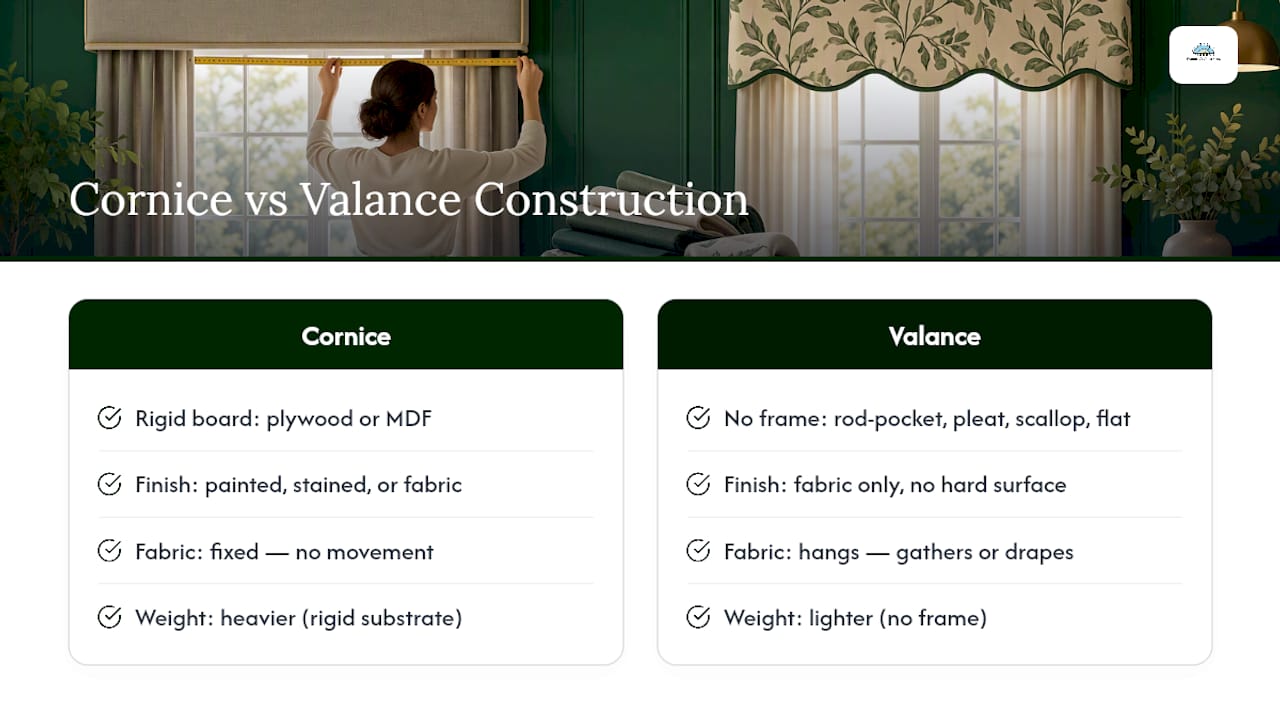
A cornice starts as a plywood or MDF box, built to the exact width and drop the window needs, then wrapped in batting and fabric like an upholstered headboard. Some are painted or stained instead of upholstered, which shifts the whole piece toward a furniture look rather than a soft-goods one. That rigid substrate is why cornices weigh more and why the fabric on them never moves, wrinkles, or fades from folding.
Valances skip the frame entirely. Common constructions include rod-pocket (fabric gathered directly onto a rod), box-pleat (crisp, structured pleats spaced evenly), scalloped (a curved lower edge, often layered), and tailored flat panels with little to no fullness. Each style changes how the fabric hangs and how much yardage it needs.
Lining matters more than most homeowners expect. A lined valance resists sun fade and holds its shape better over years of use, while an unlined one is lighter and cheaper but shows more wear at a sunny window. On a cornice, the finish, whether paint, stain, or fabric, determines whether repairs mean a sponge or a full reupholstery.
How Do You Measure and Install Each One?
Measuring for either topper starts with the hardware, not the glass. A cornice or valance that only accounts for window width will expose brackets and rods that were meant to disappear behind fabric.
Specification guides list three standard cornice board profiles: straight, angled, and curved. Straight cornices commonly come in several standard drops, while angled and curved versions typically come in larger standard drops. Returns, the side pieces that turn the corner back to the wall, usually range in size depending on how far the rod or blind projects from the glass.
Before any hardware goes on the wall, run through this checklist:
- Measure total projection from the wall, including any blinds or shades mounted underneath.
- Confirm return depth is generous enough to fully conceal end brackets.
- Verify wall material can support cornice weight, since drywall alone often needs anchors or into-stud mounting.
- Check clearance for any operating hardware, cords, or wands.
- Confirm drop length clears the window trim by the amount your design calls for.
Undersized returns are a common miss. Plan the width and returns generously, because a return that looks fine on paper can still leave a bracket peeking out in the room.
Pro Tip: On patterned fabric, ask your workroom to center the pattern repeat on the cornice face and match it at the seam before cutting. A mismatched repeat is one of the fastest ways to make a custom piece look homemade.
Which Rooms and Window Sizes Suit Each Style?
Formal spaces tend to favor structure. A cornice suits a formal living or dining room, a large window, or a layered treatment where it sits above drapery panels and blinds. The rigid edge reads as architecture rather than decoration, which is exactly why designers reach for it when a room needs to feel finished and permanent.
Valances go the other direction. They suit kitchens, bedrooms, and small or awkwardly shaped windows where a heavy structure would overwhelm the wall. Because a valance is just fabric, swapping it for a new season or a new paint color costs far less than rebuilding a cornice.
Fabric choice does most of the styling work either way:
- Natural fibers like linen and cotton keep both treatments looking current rather than dated.
- Pattern scale should match window size. Small windows read better with smaller-scale prints.
- Restrained trim, a single contrast band or narrow cord, tends to age better than heavy fringe or multiple trims stacked together.
Current styling coverage points toward clean lines and natural fibers for both cornices and valances, which answers the “are valances outdated” question directly: not when they’re built with restraint. Deep gathers, tall drops, and heavy pleats add visual weight and collect dust, so a shallow valance or slim cornice tends to serve small or low-light rooms better.
Which Style Holds Up Better Over Time?
Dust collects differently on each, so consider energy-efficient window replacement in Potomac, MD for improving your home’s overall insulation and reducing energy costs. A flat or lightly pleated valance sheds dust with a shake or a trip through the washing machine, depending on fabric content. A cornice’s fabric is stretched over a rigid form, so it can’t be laundered. Cleaning usually means a vacuum brush attachment or, for painted versions, a damp cloth.
Sun exposure is the other long-term factor. Unlined valances in south-facing windows fade fastest, while a lined valance or a cornice with a UV-resistant fabric holds its color much longer. For easy upkeep, look for tightly woven cottons or performance blends that resist both fading and staining, and skip fabrics with loose weaves that trap dust in a busy kitchen.
How Do You Choose Between a Cornice and a Valance?
Start with four questions before you contact a fabric retailer or installer: What look are you after (tailored versus soft)? How large is the window? What’s the budget? And how much clearance does your blind or curtain hardware need?
Bring these questions to whoever is building it:
- What substrate do you use for cornice frames, and can I see a sample?
- What return depth do you recommend for my window and hardware setup?
- Will this mount to the wall studs, or does it need anchors?
- What finish options are available, paint, stain, or fabric-wrapped?
- What’s the lead time, and can I get a fabric sample before committing?
Designers consistently frame the decision as a straightforward trade-off: cornices cost more and take longer to install, while valances are softer and comparatively inexpensive. That single trade-off, budget and installation complexity against a tailored, architectural finish, drives most homeowner decisions before fabric even enters the conversation.
Fabrication Notes From Beautiful Windows Elgin
Pattern scale is everything on a topper this size. A print that looks elegant on a full curtain panel can look busy shrunk down onto a cornice face or a shallow valance, so match the repeat to the piece before you buy yardage. Choose upholstery-weight fabric and full lining for a cornice meant to last years; save lighter cottons for valances you plan to rotate seasonally. The company ships fabric samples nationwide and offers custom drapery fabrication, so you can hold a swatch against your window before committing.
Our Take on Choosing the Right Topper
We tend to recommend a cornice when a client wants something that feels built into the room, not added onto it. For anything softer, seasonal, or budget-conscious, a valance almost always wins. Ready-made panels work fine for standard windows, but once a window is oversized, oddly proportioned, or paired with a specific fabric you’ve fallen for, custom drapery earns its cost back in fit alone.
— Marrion
Ready to Order Fabric or Start a Custom Topper?
This company provides a real person to talk through drop, return, and fabric weight before you cut a single yard, a service not offered by all fabric sellers. Instead of guessing whether a print will read right on a cornice face or a gathered valance, you get sample yardage in hand and design input from a workroom that builds both, not just one.

Before you reach out, measure your window’s width, height, and total wall projection, and snap a photo of the space in daylight. Their Custom Drapery Making Service works from those details to recommend construction, fabric weight, and finish, and they ship nationwide so distance from Columbia, SC isn’t a barrier. If you already know you want fabric in hand first, browse fabric by the yard and custom drapery options and order a swatch before committing to a full yardage cut.
Sources
- Valances vs pelmets vs swags vs cornices: the differences, benefits and drawbacks | Homes and Gardens
- Cornice Board (technical specification) | Sweets/construction documentation
- Differences between valances, swags, and cornices | The Spruce
- Valence/window treatment trends (House Beautiful)
FAQ
Are Valances Outdated in 2026?
No. Trend coverage shows valances remain current when built with clean lines and natural fibers rather than heavy ruffles or dated trims. A tailored flat valance in linen or cotton reads modern in almost any room.
Are Window Cornices Still in Style?
Yes, especially in formal rooms. Designers continue to specify cornices for large windows and built-in looks, and the restrained, simplified style favored in 2026 suits a cornice’s clean architectural lines.
What Are the Three Types of Cornices?
Specification guides identify straight, angled, and curved cornice profiles. Straight versions typically use 8, 12, or 18 inch drops, while angled and curved cornices usually run 12 or 18 inches, with returns adjusted to clear the hardware underneath.
What’s the Difference Between a Cornice and a Valance?
A cornice is a rigid, frame-built topper that holds its shape permanently, while a valance is soft fabric that hangs and moves like a curtain. Cornices cost more to build and install; valances are generally less expensive and easier to swap between seasons.
Does Beautiful Windows Elgin Make Custom Cornices or Valances?
Beautiful Windows Elgin fabricates custom drapery and fabric treatments and provides fabric by the yard for workrooms building either style. Pricing depends on fabric selection and construction, so reach out through the Custom Drapery Making Service page for a project quote.