


DIY Homeowners: Measure Cafe Curtain Fabric and Order Without Second Guessing
Linen delivers a relaxed, airy look with moderate privacy; cotton and cotton blends offer the best balance of durability and pattern choice for kitchens; sheer voile maximizes light but gives up almost all privacy. The real decision is not which fabric looks best on a swatch card. It is how much light filtering you’re willing to trade for privacy and easy care. Once you settle that trade-off, measuring and calculating yardage is straightforward.
TL;DR:
- Choosing the right cafe curtain fabric depends mainly on balancing light filtering and privacy needs, with linen for light and cotton for durability.
- Fabric weight, opacity, weave, and care requirements must be evaluated against the room’s conditions, especially in kitchens prone to moisture and grease.
- Accurate measurement begins with rod placement, using a fullness multiplier of at least 2x for a lush look, and includes allowances for headers, hems, and shrinkage.
- Fabric choice should follow the fullness and header style decisions, with linen, cotton, or blends suited for specific room functions and aesthetic preferences.
- Testing fabric swatches in the actual light helps avoid surprises, and professional consultation ensures proper yardage and installation for a polished result.
Table of Contents
- What Makes Cafe Curtain Fabric Different From Regular Curtain Fabric
- The Best Fabrics for Cafe Curtains, Compared
- How to Measure Cafe Curtains and Calculate Yardage
- Choosing a Header Style and Rod for Your Fabric
- Pattern, Color, and Styling Tips for Cafe Curtains
- Lining and Care: Keeping Cafe Curtains Looking Sharp
- How Beautiful Windows Elgin Supports Your Cafe Curtain Project
- What Actually Matters When You’re Choosing This Fabric
- Ready to Order? Start With a Swatch or a Consultation
- Sources
What Makes Cafe Curtain Fabric Different From Regular Curtain Fabric
Cafe curtains hang from a rod mounted at the window’s midpoint, not the top of the frame. That single detail changes almost everything about how you shop for fabric. A full-length drapery panel has to manage heat loss, room-darkening, and floor-to-ceiling visual weight. A cafe curtain only has to cover the bottom half (or sometimes two-thirds) of the glass, usually stopping at the sill, just below the sill, or at the window apron.
Because the fabric works over a shorter distance, its physical properties matter more per inch than they would on a nine-foot drapery panel. A heavy jacquard that drapes beautifully floor to ceiling can look stiff and boxy chopped down to 24 inches. A gauzy voile that reads as elegant on a large window can look flimsy and thin on a small one.
Before choosing a fabric, evaluate it against these attributes:
- Weight (measured in grams per square meter, or GSM): lighter fabrics under 150 GSM move easily and filter light; anything over 250 GSM starts to resist gathering.
- Opacity: how much street or neighbor visibility you’re comfortable with, especially for kitchen and bathroom windows.
- Weave and texture: a tight plain weave launders and presses more predictably than a loose basketweave, which tends to shift and pucker.
- Hand: the way fabric feels and falls; a stiff hand holds pleats crisply, a soft hand drapes in loose folds.
- Shrinkage and care: natural fibers like linen and cotton can shrink 3% to 5% on first wash if not preshrunk.
A kitchen window over a sink needs a fabric that tolerates steam and frequent washing. A street-facing living room window prioritizes opacity and light control. A bathroom window needs something that resists moisture without mildewing. Matching the fabric’s physical traits to the room’s actual conditions, not just the color palette, is what separates cafe curtains that hold up for years from ones that need replacing after one humid summer.
The Best Fabrics for Cafe Curtains, Compared
Modern cafe curtains lean heavily on linen and cotton because both fabrics strike a workable balance between charm and practicality, and that trend has held steady for kitchens and dining rooms in particular. Here’s how the main fabric families actually perform once they’re hanging.
Linen gives cafe curtains their signature relaxed texture. Its slightly irregular weave catches light in a way synthetic fabrics can’t replicate, and it drapes with a soft, lived-in quality rather than a stiff, formal one. The trade-off is opacity: most linen sold for curtains falls in a semi-sheer to medium range, so it filters light beautifully but won’t block a neighbor’s direct line of sight. Linen also wrinkles easily and benefits from a light steam rather than a hot iron, which some homeowners find annoying and others consider part of its charm.
Cotton and cotton blends are the workhorse choice, and for good reason. Cotton comes in a far wider range of weights, prints, and finishes than linen, from lightweight lawn to heavier twill, so you can dial in exactly how much opacity you want. It launders easily, presses crisply, and holds a printed pattern without the color migration you sometimes get on synthetic-natural blends. Poly-cotton blends add wrinkle resistance and a bit more durability against sun fading, at a slight cost to that natural, breathable hand.
Sheer voile and lightweight polyester sheers exist for one purpose: maximizing daylight while softening a bare window. They offer essentially no privacy and minimal insulation, but for an interior kitchen window facing a fenced yard, or layered under a heavier valance, sheers do a job nothing else does as well. They’re also the easiest fabric family to machine wash and require no ironing if hung damp.
Heavier-weight blends and performance fabrics come into play when the curtain needs to survive more than light duty. A grease-prone stovetop window or a high-traffic mudroom entrance benefits from a stain-resistant or tightly woven cotton-poly blend that wipes clean and resists yellowing. These fabrics sacrifice some of the softness of pure linen or lightweight cotton but gain real functional durability.
- Privacy priority: cotton or a heavier cotton blend.
- Texture and natural look priority: linen.
- Maximum light, minimal privacy: sheer voile.
- High-mess kitchen zone: stain-resistant cotton-poly blend.
- Pattern availability: cotton, by a wide margin.
Pro Tip: Hold your shortlisted fabric up to the actual window at the time of day the room gets the most light. A linen that looks perfectly opaque under store lighting can turn nearly transparent in direct afternoon sun.
How to Measure Cafe Curtains and Calculate Yardage
Mount the rod before you measure anything. Cafe curtain math starts at the rod, not the top of the window frame, because that placement determines your entire finished length. Once the rod is up, measure straight down to your chosen finish point, whether that’s the windowsill, just below the sill, or the bottom of the window apron.
Follow this sequence:
- Measure rod to finish point. This is your finished panel length. A typical cafe curtain runs a few dozen inches in length, but let the window dictate the number.
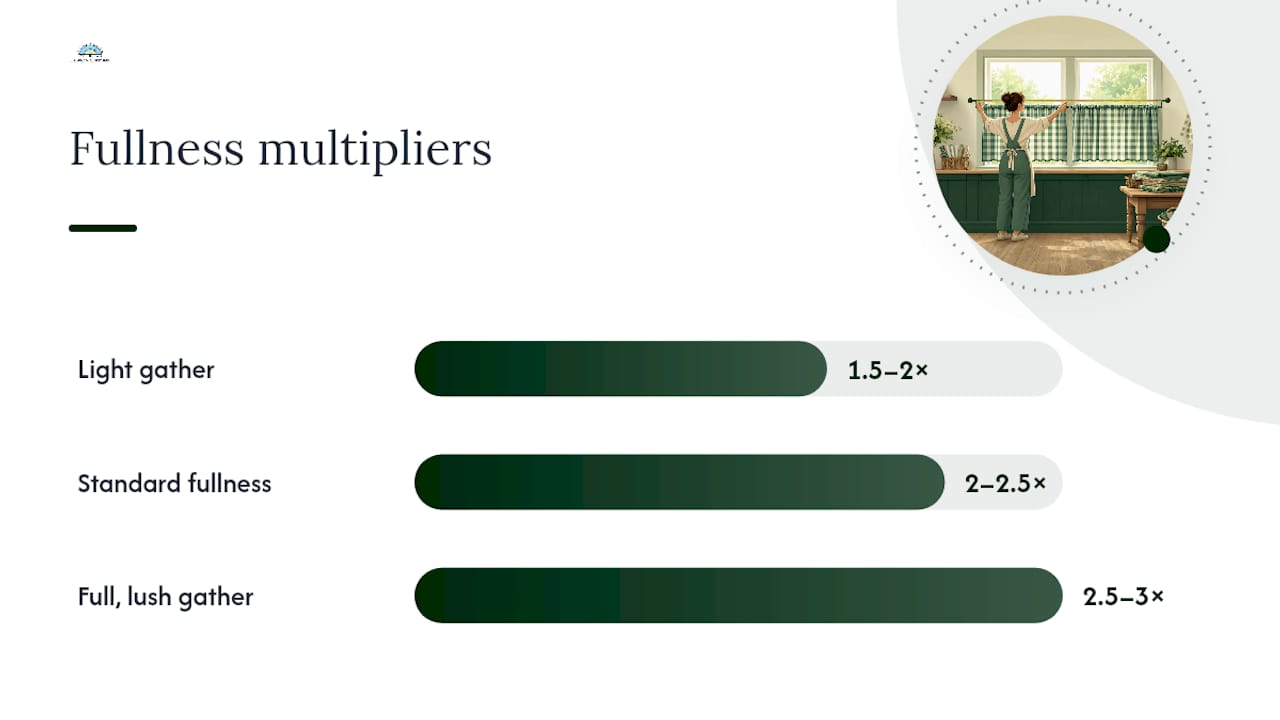
- Choose your fullness multiplier. Light gather uses 1.5x to 2x the rod width; standard fullness uses 2x to 2.5x; a full, lush gather uses 2.5x to 3x. Because cafe panels are short, a multiplier of 2x or higher tends to look more intentional than skimpy panels stretched thin.
- Calculate cut length. Add finished length, header allowance (a few inches depending on header style), footer or hem allowance, and a small cut allowance for shrinkage and seams.
- Convert to yardage. Multiply your finished rod width by the fullness multiplier to get total fabric width needed, then divide by your fabric’s usable width to get the number of panel widths. Multiply that by your cut length, then divide by 36 to convert inches to yards.
On 54-inch-wide decorator fabric, that’s two panel widths. If your cut length comes to 32 inches (28-inch finished length, plus a 3-inch header, plus a 1-inch cut allowance), two widths at 32 inches each equals 64 inches, or roughly 1.8 yards. Round up to 2 yards to leave margin for pattern matching.
A short cafe panel benefits from a deeper hem, typically a 3 to 4 inch double hem, since that extra weight helps the fabric hang straight instead of curling at the bottom edge. Just don’t oversize the hem on a very short panel, or it will visually swallow the proportion of the curtain. If you’re planning to line the panel, measure the lining separately; lining is generally cut about an inch shorter than the face fabric so it doesn’t peek out below the hem.
Before you cut fabric, ensure the rod is mounted at final height, the finish point is confirmed, the fullness multiplier matches your chosen header style, and the cut length accounts for header, hem, and shrinkage allowances. Our complete yardage guide walks through additional scenarios, including patterned fabric repeats, and our window measuring guide covers the pitfalls that trip up most first-time measurers.
Choosing a Header Style and Rod for Your Fabric
The header you sew changes how much fullness you need and how the fabric reads once it’s hanging. A rod pocket header is the simplest to sew and works well with lightweight linen or sheer voile, since the fabric gathers naturally along the rod without hardware showing. A pinch pleat header creates crisp, tailored folds and suits medium-weight cotton or blends that hold a pleat’s shape. A tab top header shows more rod and gives a casual, almost farmhouse look, best paired with a textured fabric like linen.
Rod choice depends almost entirely on fabric weight. Tension rods work well for lightweight cafe curtains because they require no drilling and install in minutes, making them a favorite for renters and quick refreshes. Lined panels or anything in a heavier cotton blend need a bracket-mounted rod, since tension rods can bow or slip under sustained weight.
- Rod diameter: ⅝ inch to 1 inch covers most cafe curtain applications; thinner rods suit lightweight fabric, thicker rods support pleated or lined panels.
- Inside mount: measure the exact width inside the window frame; leaves a cleaner, built-in look.
- Outside mount: measure a few inches beyond the frame on each side; allows more light coverage and a slightly larger visual footprint.
- Header allowance changes cut length: a rod pocket typically needs 3 to 4 inches, while a pinch pleat header with buckram can need 5 to 6 inches, so confirm your header before finalizing yardage.
Our installation guide walks through mounting brackets correctly the first time, which matters more than most DIYers expect once a heavier lined panel is involved.
Pattern, Color, and Styling Tips for Cafe Curtains
Short panels punish oversized prints. A large floral or bold geometric repeat that reads beautifully on a nine-foot drapery gets cropped awkwardly on a 28-inch cafe curtain, often cutting off the pattern mid-motif. Small-to-medium repeats, stripes, or subtle textures translate far better to the shorter format, which is why real kitchen projects consistently gravitate toward compact prints like ticking stripes, small florals, or farmhouse-style gingham.
Color works hardest in a kitchen or breakfast nook, where cafe curtains often function as the visual anchor for the whole vignette. A curtain in a saturated color against white cabinetry draws the eye and ties together dish towels, chair cushions, and accent pieces without needing to match everything exactly.
- Pair cafe curtains with a coordinating valance for extra privacy at the top of the window without sacrificing the light at eye level.
- Layer with a roller shade behind the panel for full-privacy flexibility at night.
- Order a fabric swatch and clip it to your actual rod for a day before committing; drape reads differently in a store than in your kitchen’s light.
- Keep prints on the smaller side if the window is under 30 inches wide, and save bolder scale for windows 40 inches and up.
Our kitchen curtain styling guide has more specific pairing examples if you’re planning a full kitchen refresh around your window treatment.
Lining and Care: Keeping Cafe Curtains Looking Sharp
Lining isn’t mandatory on a cafe curtain the way it often is on full-length drapery, but it solves three specific problems: added privacy, better light control, and a small thermal buffer near the glass. If your kitchen window faces a busy street or a close neighbor, lining a sheer or lightweight linen panel closes the visibility gap without switching fabrics entirely. Cut lining roughly an inch shorter than your face fabric’s finished cut length so it stays hidden behind the hem.
Care varies by fiber. Cotton and cotton blends tolerate regular machine washing on a gentle, cool cycle and can go straight into a low-heat dryer. Linen prefers a gentle cycle and air drying, then a light steam rather than a hot iron to avoid scorching the natural fibers. Sheer polyester is the lowest-maintenance option: cool wash, hang dry, no ironing needed in most cases.
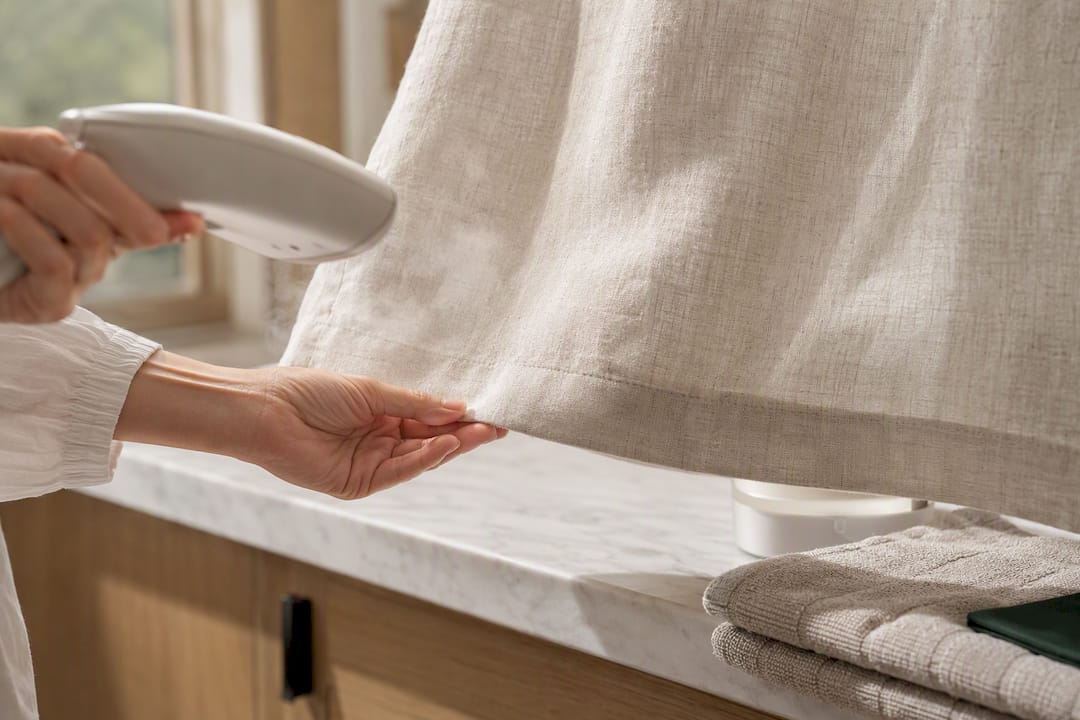
Kitchen cafe curtains take more abuse than any other room’s window treatment, thanks to grease splatter and steam. Plan on washing kitchen panels every four to six weeks, more often near a busy stovetop, and choose a tightly woven cotton or poly-blend over a loose linen weave if grease is a recurring issue. Our lining guide covers specific lining weights for different light-control needs.
Pro Tip: Preshrink washable fabric by running it through one wash-and-dry cycle before cutting. It costs you an afternoon but saves you from a curtain that mysteriously shrinks an inch after its first laundering.
How Beautiful Windows Elgin Supports Your Cafe Curtain Project
Choosing fabric from a screen is guesswork until you can touch it. Beautifulwindowselgin sells designer fabrics by the yard, including linen, cotton, and blended options suited to cafe curtains, with samples available so you can check weight, opacity, and hand against your actual window before committing to yardage.
A design consultation catches the measuring mistakes that cost DIYers time and fabric: wrong fullness for the header style, a rod mounted at the wrong height, or a fabric weight that won’t hold the intended pleat. Beautifulwindowselgin’s team walks through those decisions with you and offers custom drapery services when you’d rather hand off the sewing entirely.
If you’re ready to move from planning to ordering, three paths work: order swatches to test drape and color at home, request a measurement check before you cut, or book a consultation for a fully custom cafe curtain built to your window’s exact dimensions.
What Actually Matters When You’re Choosing This Fabric
Most cafe curtain advice fixates on style boards and color palettes, and almost skips the part that determines whether the project actually works: the fullness multiplier. That’s the detail conventional guides underplay, and it’s the one most likely to make a DIY cafe curtain look homemade instead of intentional.
The conventional wisdom also oversells sheer voile as a universal starter fabric. It photographs well, but plenty of homeowners hang it on a street-facing kitchen window and regret it within a week once they realize how little privacy it offers after dark with the lights on.
If you take one thing from this guide, prioritize the fullness and header decision before you fall in love with a print. Fabric choice matters, but it’s the second decision, not the first. Get the math right, and almost any reasonable fabric family, linen, cotton, or a blend, will hang the way you pictured it.
— Marrion
Ready to Order? Start With a Swatch or a Consultation
Beautifulwindowselgin is the practical next step once you know your fabric family and your measurements: instead of guessing from a screen, you can hold the actual weight, weave, and color against your window before you cut a single yard.

Beautiful Windows Elgin, a fabric store in Columbia, SC offering drapery making services, carries designer drapery fabrics suited to cafe curtains at multiple weights and opacities, along with striped fabrics for a more tailored kitchen look. Sample yardage ships nationwide, so you can test drape and light filtering in your own window before committing to a full cut. If your measurements or fullness math need a second set of eyes, a design consultation can confirm your rod placement, header style, and yardage before fabric gets cut. Check the fabric FAQ page for sample-ordering details, or reach out to book a consultation and get your cafe curtain project moving from plan to finished window.
Sources
For deeper measurement math, the cafe curtain yardage guide covers formulas in more detail. For custom prints by the yard, Spoonflower’s cafe curtain fabric collection offers print-on-demand options. For styling inspiration, real farmhouse kitchen projects on Emily Henderson’s blog show patterned cafe curtains in practice.
- Cafe Curtains: How to Measure and Calculate Fabric
- Cafe Curtains Are Back! Here’s How to Get Them Right
- I Did It! I Finally Chose Fabric For The Farmhouse Kitchen Cafe Curtains…We’ve Gone Patterned